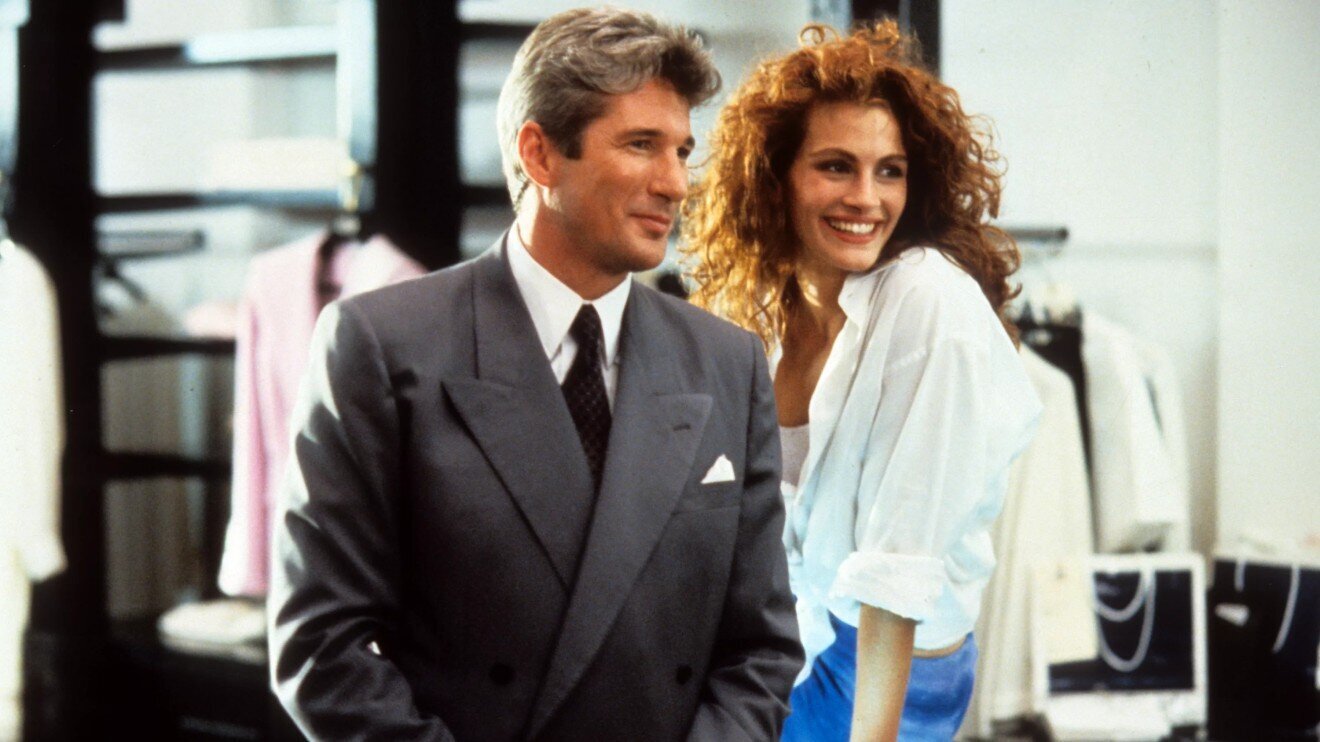
The film Pretty Woman, released in 1990, became one of the most successful romantic films in cinema history. By 1996 — when the novel takes place — the picture had already spent six years as a worldwide phenomenon and a cult classic. Director Garry Marshall created a modern fairy tale that earned Walt Disney Studios a record-breaking $463.4 million worldwide.
J. F. Lawton’s original screenplay was titled «3000» and was a dark drama about prostitution in 1980s Los Angeles. But Disney executive producer Jeffrey Katzenberg insisted on a radical rewrite, into a romantic fairy-tale comedy about love overcoming social barriers.
The Character of Edward Lewis
Richard Gere brought Edward Lewis to the screen — a corporate raider embodying the American business establishment of the Reagan era. The character became an archetype of the successful entrepreneur: impeccably dressed, self-assured, living in a luxury suite at the Beverly Wilshire, driving a Lotus Esprit sports car.
Interestingly, Gere initially turned down the role; Christopher Reeve, Daniel Day-Lewis, Kevin Kline, and Denzel Washington were all considered. Al Pacino, Sylvester Stallone, and Burt Reynolds also passed on it. Gere only agreed after meeting Julia Roberts, who convinced him.
A status symbol: By the mid-1990s, Edward Lewis had become synonymous with business success and elegance. His flawless appearance, expensive suits, and confident manner became a model to emulate for entrepreneurs worldwide.
Style and Image
Edward Lewis’s suits in the film built the image of a flawless businessman. Sharp business suits, expensive shirts, elegant ties — every piece of the character’s wardrobe was chosen with great care. Costume designer Marilyn Vance created a look for Gere that blended classic elegance with contemporary flair.
Particular attention went to details: expensive watches, cufflinks, immaculately pressed shirts. This outward polish contrasted with the character’s inner emptiness and loneliness, adding depth to the role.
Cultural Impact
By 1996, Pretty Woman had already become part of mass culture. The film spawned countless imitations and quotes, and Edward Lewis’s image became a cultural touchstone. Scenes on Rodeo Drive, in expensive restaurants and hotels, shaped popular ideas about the lifestyle of a successful American businessman.
The film was the fourth-highest-grossing movie of 1990 in the U.S. and Canada, and third worldwide. At the Academy Awards, it earned a Best Actress nomination for Julia Roberts, along with Golden Globe and BAFTA nominations.
Richard Gere: Actor and Style Icon
By the time Pretty Woman was filmed, Richard Gere was already a recognized Hollywood star. Born in 1949 in Philadelphia, he began his career on stage before moving into film. His breakthrough role came in Saturday Night Fever (1977), but true fame arrived with American Gigolo (1980).
Director Garry Marshall specifically asked Gere to play the role more restrained than usual. As the actor recalled, Marshall told him: «No, no, no, Richard. In this movie, one of you moves, and one of you doesn’t. Guess which one you are?» That note helped shape a more refined, less aggressive businessman.
An interesting detail: The jewelry-store scene, where Gere playfully snaps the box shut on Julia Roberts’s fingers, was the actor’s improvisation. Roberts’s startled laugh was a completely genuine reaction.
The Businessman on Screen
Edward Lewis represented a new wave in how Hollywood portrayed businessmen. Unlike the traditionally negative image of the greedy capitalist, Edward is shown as a man capable of change and love. He’s a corporate raider who acquires companies, but over the course of the film, under Vivian’s (Julia Roberts’s) influence, he changes his approach to business.
The film conveyed the idea that a successful businessman could be not just rich, but charming, romantic, and capable of moral growth — a concept that significantly shaped cultural perceptions of entrepreneurship in the 1990s.
The Era’s Context
Pretty Woman arrived at the tail end of the Reagan era, when the cult of wealth and success had reached its peak. The film reflected the spirit of the time — a drive for material comfort, belief in the American Dream, and the possibility of social mobility. Edward Lewis embodied that era’s ideals: financial success, status, power.
By 1996, when the novel is set, that image was already firmly rooted in mass consciousness. Russian entrepreneurs, learning Western standards of doing business, often looked to exactly this kind of Hollywood model of success.
International Success
Pretty Woman became an international hit, breaking numerous records. It stayed at No. 1 in Australia for 12 weeks, and 9 straight weeks in the U.K. Total box office topped $463 million, making it the highest-grossing R-rated Disney film at the time.
The film’s success helped spread American pop culture around the world. Its lead characters became recognizable icons, and their lifestyle became something to emulate among the middle class in countries everywhere.
The film’s legacy: Pretty Woman was adapted into a Broadway musical that opened in 2018. It regularly appears on lists of the greatest romantic comedies of all time and continues to influence contemporary pop culture.
Reception and Criticism
Critics were divided. Many faulted the film for romanticizing prostitution and oversimplifying social issues. Audiences, however, embraced it enthusiastically, reflected in its enormous box office and high audience ratings.
Roger Ebert of the Chicago Sun-Times gave it a positive review, praising the film’s particular romanticism and the quality of the performances. He noted that Gere «plays new notes here — his cockiness is gone, and he is tentative, correct, even shy.»
Janet Maslin of the New York Times wrote that, despite its contentious premise, the film manages to be «dizzy, breezy escapism.» She specifically noted that Gere «conveys the dignity and presence appropriate to a captain of industry.»
Influence on Fashion and Style
Pretty Woman’s costumes significantly influenced early-1990s business fashion. Edward Lewis’s elegant outfits set the standard for the successful man’s business wardrobe. Sharp suits, expensive shirts, quality accessories — all became mandatory attributes of the successful businessman.
Julia Roberts’s red evening gown from the opera scene was named one of the most memorable dresses in film history. But Gere’s menswear was just as influential, shaping expectations of how a modern businessman should look.
The Symbolism of Transformation
The film’s central theme — the mutual transformation of its two leads — shows up most vividly in their changing appearance. Just as Vivian transforms from a street girl into an elegant lady, Edward evolves from a cold businessman into a man capable of genuine feeling.
When a Russian businessman in 1996 saw himself in the mirror as «a real Richard Gere,» he was in effect undergoing a similar transformation — from Soviet man to Western businessman. The new clothes symbolized not just a change of style, but a change of identity — joining a different culture and way of life.
Compiled from public sources and archival material on the film Pretty Woman (1990)
For full context, consulting the original film is recommended