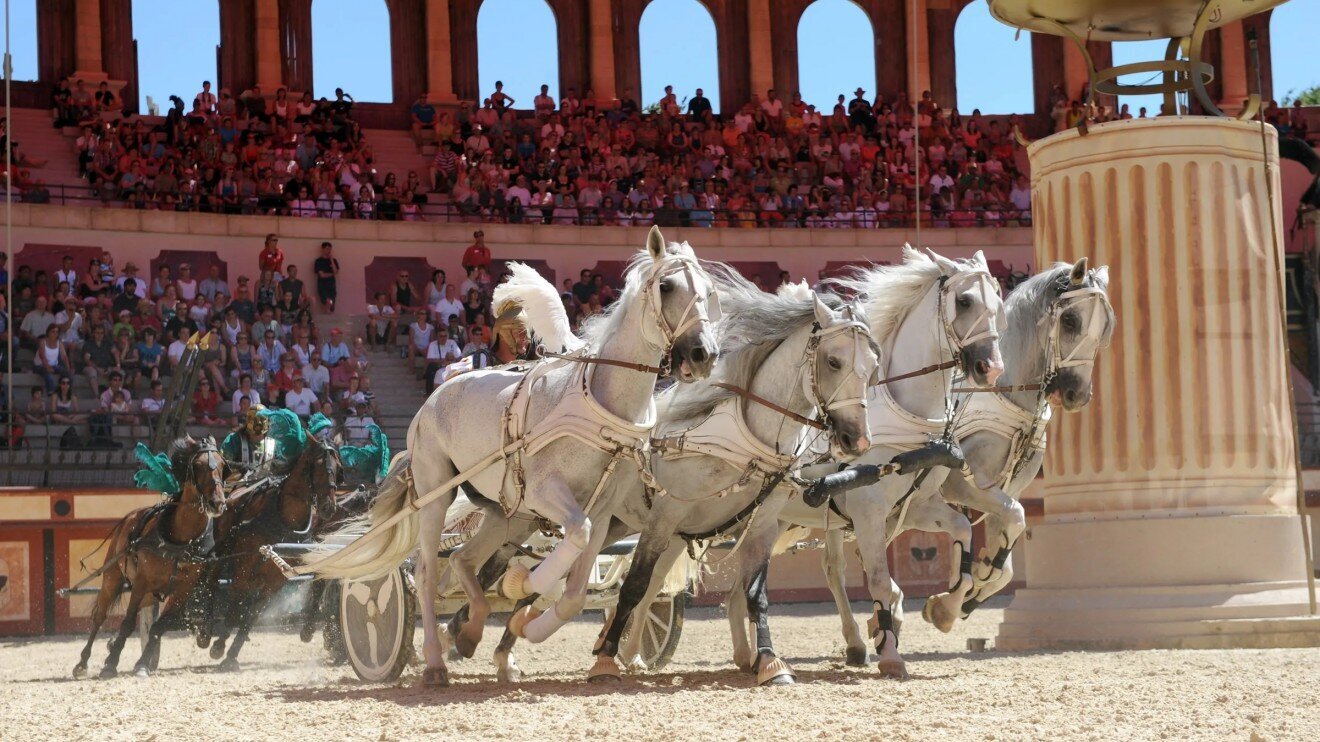
The quadriga was an ancient two-wheeled chariot drawn by a team of four horses. The name comes from the Latin quadriga, a contraction of quadriiuga (from quadri-, "four," and iugum, "yoke").
In ancient Rome, quadrigas were widely used during ceremonial triumphal processions, when a victorious general would ride into the city on one. Quadrigas were also popular in racing competitions at Roman circuses and hippodromes, where the skill of driving a team of four horses was considered the pinnacle of a charioteer's craft.
Quadrigas were frequently depicted in ancient art and became a symbol of triumph, victory, and glory. Numerous bas-reliefs, sculptures, and coins bearing quadrigas survive to this day. The most famous surviving depictions include:
- • The quadriga on the Arch of Constantine in Rome
- • The quadriga on the Brandenburg Gate in Berlin
- • The bronze quadriga of St. Mark in Venice
Figuratively — the sense used in this passage of the novel — a "quadriga" refers to a group of four men moving together, like horses harnessed to a chariot. This figure of speech underscores the coordination and purposefulness of the group of "hulking guys," drawing an allusion to ancient power and unity.
In the context of 1993 Russia, invoking "hulking guys" through an ancient analogy may allude to the rise of private security firms and criminal groups characteristic of the post-Soviet period, when physical force often became the deciding argument in business and political matters.