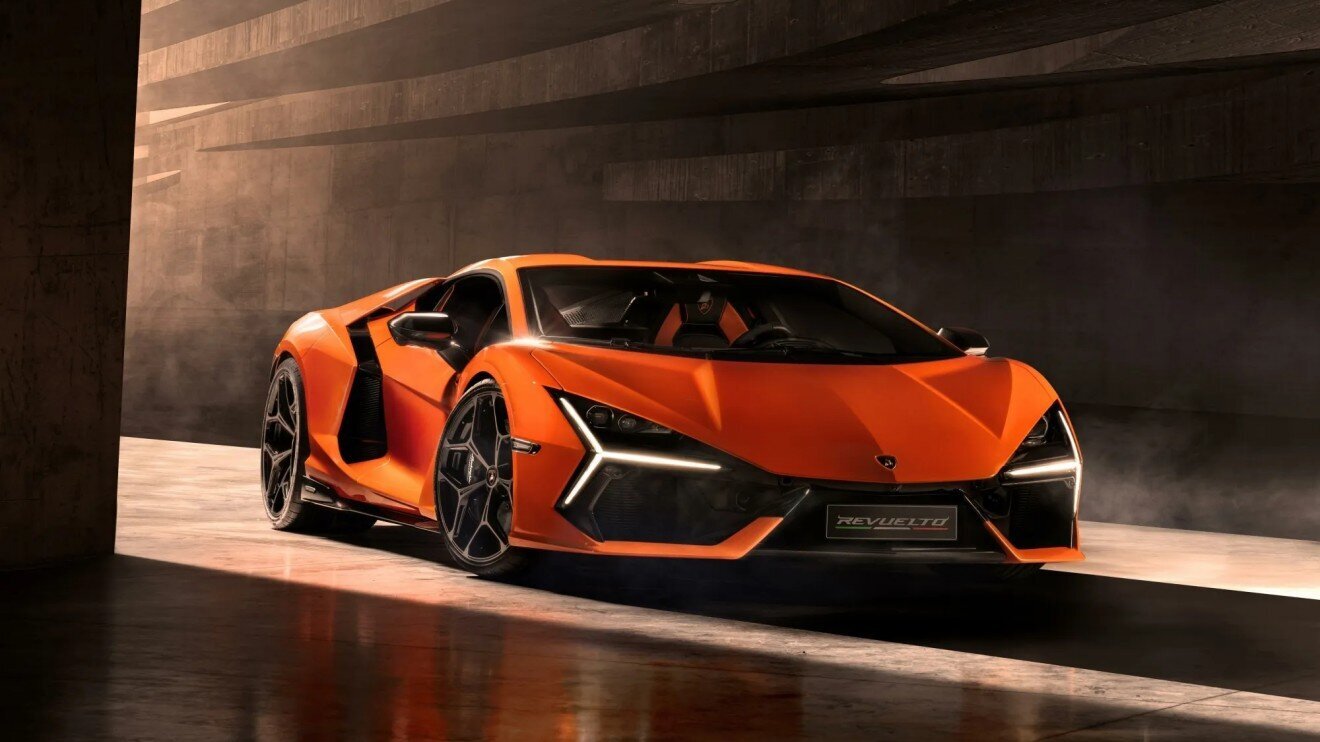
Lamborghini
The Italian supercar maker
Automobili Lamborghini S.p.A. is an Italian manufacturer of expensive sports cars, headquartered in the commune of Sant’Agata Bolognese, near Bologna. The company was founded in 1963 by Ferruccio Lamborghini, who at the time already owned a large tractor-manufacturing company.
Founding history
Ferruccio Lamborghini (1916–1993) was a successful entrepreneur who owned a tractor manufacturing business. By the early 1960s he could afford to buy expensive cars: a Mercedes 300SL, a Maserati 3500 GT, a Jaguar E-type, various versions of the Ferrari 250 GT. But he found faults in every one of them.
Several versions exist of why he decided to start his own car company. The most popular version, told by Ferruccio’s son, holds that Lamborghini went to the Ferrari factory to complain about the clutch quality in his Ferrari 250 GT. Enzo Ferrari sent him away, telling him to stick to tractors, since Lamborghini understood nothing about sports cars. Back home, Ferruccio took apart the Ferrari’s transmission and discovered that many of its parts were made by the same supplier as for his own tractors. Finding suitable parts in his own warehouses, he fixed the problem himself.
Brand symbolism
Ferruccio Lamborghini was born under the sign of Taurus, so the bull became the company’s logo. Many Lamborghini models are also named after famous fighting bulls: Miura, Gallardo, Murciélago, Reventón, Huracán.
The first models
To build the engine, Lamborghini brought in the talented engineer Giotto Bizzarrini, who had previously developed a 12-cylinder engine for Ferrari. A V12 configuration was chosen for economic reasons.
The Lamborghini 350 GTV prototype was unveiled at the Turin Motor Show in October 1963. In March 1964 the first production car, the Lamborghini 350 GT, was shown. Sales were a success – 123 units were produced between 1964 and 1966.
The 350 GT was followed by the 400 GT (1966–1968), which raised enough funds to develop the legendary Lamborghini Miura. That car was unveiled in November 1965 in Turin, with a working version shown in March 1966 in Geneva. The Miura was a huge success – 111 cars were sold in 1967 alone.
Iconic models
Lamborghini Countach (1974–1990)
A revolutionary model with vertically opening doors and futuristic styling. The prototype was shown in 1971, and production began in 1974. 1,997 units were built.
- Engine: V12, 3,929 cc
- Power: 370–455 hp
- Top speed: 316 km/h
Lamborghini Diablo (1990–2001)
The Countach’s successor, one of the most recognizable supercars ever built. Development involved Chrysler, which bought the company in 1987. 2,884 units were built.
- Engine: V12, 5,707 cc
- Power: 485–550 hp
- Top speed: 330 km/h
Change of ownership
Ferruccio Lamborghini owned the company until 1972, when he sold his stake to Swiss investors Georges-Henri Rossetti and René Leimer. The 1970s oil crisis hit sports-car sales hard, and in 1978 the company declared bankruptcy.
After that, Lamborghini changed hands several more times:
| Period | Owner | Key events |
|---|---|---|
| 1963–1972 | Ferruccio Lamborghini | Founding the company, creating the first models |
| 1972–1978 | Rossetti and Leimer | Start of Countach production |
| 1978–1987 | The Mimran brothers | Recovery from bankruptcy |
| 1987–1994 | Chrysler Corporation | Development of the Diablo |
| 1994–1998 | Megatech (Tommy Suharto) | Diablo production |
| From 1998 | Audi AG | The modern era |
Technical features
Lamborghini has traditionally used in-house V12 and V10 engines. The company is known for embracing advanced technology:
- Materials: Heavy use of carbon fiber for bodywork
- Aerodynamics: Complex aerodynamic solutions, including active elements
- Transmission: Robotized gearboxes, all-wheel drive
- Design: A recognizably aggressive style, often with vertically opening doors
Famous designers
Outstanding designers worked on the look of Lamborghini cars:
Marcello Gandini
Designer of the Miura, Countach, and Diablo. Worked at the Bertone studio.
Franco Scaglione
An Italian designer who worked on the company’s early models.
Italdesign
The design studio that collaborated with Lamborghini at various points.
Production figures
Lamborghini has always been a maker of exclusive cars. Annual production rarely exceeded a few thousand units:
Production volumes by decade
- 1960s: 600 cars (350 GT, 400 GT, start of Miura production)
- 1970s: 2,300 cars (peak Miura production, start of Countach)
- 1980s: 1,500 cars (main Countach production run)
- 1990s: 2,900 cars (the Diablo era)
Motorsport
Ferruccio Lamborghini originally set a rule that his cars would not race. But after the change of ownership the company got into motorsport:
- 1989–1993: Supplying engines for Formula 1 (Larrousse, Ligier, Lotus, Minardi teams)
- 1991: Its own Formula 1 team (one season)
- 1996–1999: The Diablo Supertrophy series
- 2000s: Competing in the FIA GT championship with the Murciélago R-GT
The lineup as of 1997
In 1997 the Diablo, in its various trims, was Lamborghini’s main model:
| Variant | Model year | Features | Power |
|---|---|---|---|
| Diablo | 1990 | Base version | 485 hp |
| Diablo VT | 1993 | All-wheel drive | 492 hp |
| Diablo SE30 | 1993 | Anniversary edition | 525 hp |
| Diablo Roadster | 1995 | Open-top version | 492 hp |
| Diablo SV | 1996 | Sport version | 510 hp |
Other ventures
Besides sports cars, Lamborghini pursued other projects:
Tractors
Ferruccio’s original business. The tractor manufacturing arm was sold to Fiat in 1972 and now belongs to the Same Deutz-Fahr Group.
Marine engines
Lamborghini built large V12 engines for powerboats competing in the World Offshore Series Class 1.
The Lamborghini Museum
In 2001 the Lamborghini Museum (Museo Lamborghini) opened in Sant’Agata Bolognese, displaying the company’s historic models. In 2016 the museum was fully renovated with new exhibits.
The company’s standing in 1997
In 1997 Lamborghini was under the control of the Indonesian Megatech group. The company was producing around 200–300 cars a year, mostly various versions of the Diablo. It was a transitional period – a year later, in 1998, Lamborghini would be sold to the Audi group, marking the start of a new era for the marque.
Fun facts
- The name «Lamborghini» comes from the founder’s surname and translates roughly to «little lamb»
- Many models are named after famous fighting bulls and toreros
- The company was among the first to make heavy use of carbon fiber in car manufacturing
- Lamborghini’s V12 engines have always been naturally aspirated (no turbo or supercharging)
- The brand’s signature exhaust note is protected as a trademark