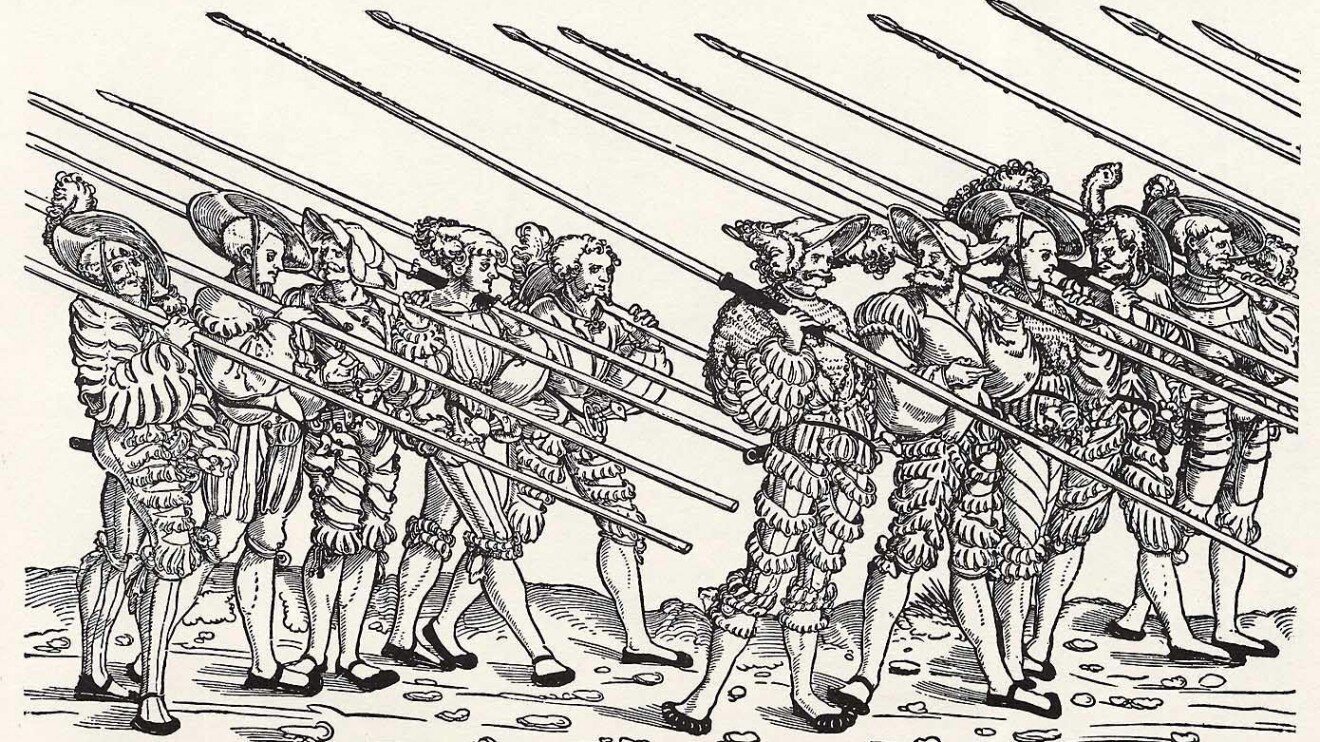
Landsknechts (German Landsknechte, from Land, "land," and Knecht, "servant") were elite German mercenaries of the Renaissance era (late 15th to early 17th centuries), known for their discipline, flamboyant dress, and effective battlefield tactics. They formed the backbone of the Holy Roman Empire's army and fought in Europe's key wars, including the Italian Wars, conflicts with the Ottoman Empire, and the Wars of Religion.
1. Origins and History
Background
- After Burgundian duke Charles the Bold's defeat by Swiss mercenaries (Reisläufer) in the 1470s, Emperor Maximilian I of Habsburg decided to build his own professional infantry force modeled on the Swiss.
- The first Landsknecht units were raised in the 1480s in southern Germany and Austria.
Golden Age (16th Century)
- Their influence peaked under the reign of Charles V of Habsburg.
- They fought in key battles:
- Pavia (1525) — the rout of the French and the capture of King Francis I.
- The Siege of Vienna (1529) — against the Ottomans under Suleiman the Magnificent.
- The Sack of Rome (1527) — mutinous Landsknechts and Spanish troops devastated the city.
- They fought for the Habsburgs as well as for other European rulers (France, Venice, the Protestants).
Decline
- By the late 16th century they were displaced by the more disciplined Spanish tercios.
- Their involvement in religious conflicts (such as the Thirty Years' War) undermined their reputation.
2. Organization and Structure
Recruitment
- Drawn from every walk of life: peasants, craftsmen, adventurous nobles.
- A regiment (Fähnlein) formed around a banner and numbered 300–400 men.
- A commander (Obrist) recruited soldiers through captains (Hauptleute).
Ranks and Pay
- Ordinary Landsknechts received standard wages.
- Doppelsöldner ("double-pay men") — elite fighters wielding two-handed swords (Zweihänder) or halberds.
- Arquebusiers — riflemen armed with early muskets.
Discipline
- Strict codes (Artikelsbriefe) punished looting and desertion.
- A provost (judge) had the authority to execute offenders.
3. Arms and Tactics
Main Weapons
- Pikes (13–16 ft) — formed into square blocks (Gevierte Ordnung), much like the Swiss.
- Halberds and two-handed swords — for breaking through enemy ranks.
- Arquebuses — for fire support.
Tactics
- Pikemen, arrayed in deep columns, formed the main striking force.
- Doppelsöldner hacked through enemy pikes to open gaps.
- Arquebusiers softened up the enemy before the assault.
4. Appearance and Culture
Clothing
- Bright, striped, slashed doublets (Pluderhosen) — a symbol of freedom and contempt for convention.
- Wide-brimmed feathered hats.
Camp Life
- A baggage train (Tross) followed the army, with families, merchants, and craftsmen.
- Women (Marketenderinnen) cooked and tended the wounded.
Reputation
- Considered the best infantry in Europe, but also notorious for brutality and looting.
- Enemies (the Swiss especially) often executed captured Landsknechts without mercy.
5. Notable Commanders
- Georg von Frundsberg ("Father of the Landsknechts") — a leading commander at Pavia.
- Niklas Graf Salm — hero of the defense of Vienna against the Turks.
- Florian Geyer — a knight who fought in the German Peasants' War.
6. Legacy
Military Influence
- They became the prototype for the standing armies of the early modern era.
- Their tactics influenced the Spanish tercios and Gustavus Adolphus's Swedish regiments.
In Culture
- Romanticized in literature and film (in movies about the Thirty Years' War, for instance).
- Their style of dress inspires modern subcultures (Renaissance fairs, steampunk).
Landsknechts were more than just mercenaries — they were a symbol of the 16th century's military revolution, blending professionalism, anarchy, and flamboyant style. Their era ended with the rise of state armies, but their legend lives on.