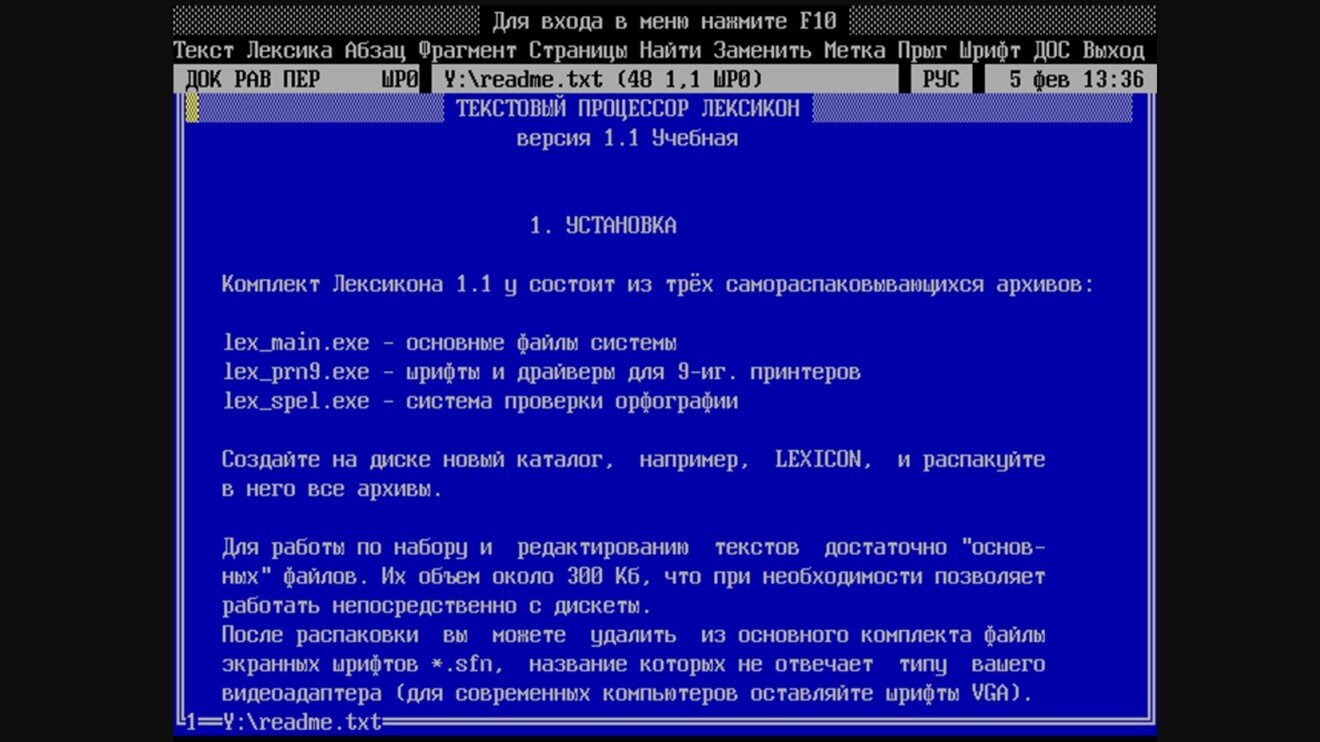
In the early 1990s, mentioning "Lexicon" in a Russian office required no explanation — it was the primary word-processing program used on personal computers.
History of its creation
"Lexicon" was created in the late 1980s at the Computing Center of the USSR Academy of Sciences by programmer Yevgeny Nikolayevich Veselov. It was the first fully functional Russian-language word processor, specially designed to handle Cyrillic text under the MS-DOS operating system.
The program appeared at a time when personal computers were only just beginning to make their way into Soviet and Russian organizations, and the problem of correctly displaying and printing Russian text was especially acute. Western word processors either did not support Cyrillic at all, or handled it extremely poorly.
The golden era: late 1980s to mid-1990s
By 1993, "Lexicon" had reached the peak of its popularity. By some estimates, it was installed on 95% of all Russian personal computers — a genuine monopoly in the processing of Russian-language text.
The program became the de facto standard across every kind of organization, from government agencies to commercial enterprises. Secretaries, typists, accountants, and managers all learned "Lexicon" as their primary tool for creating documents, letters, reports, and other texts.
Technical features
"Lexicon" was a revolutionary product for its time. Starting with version 2.0, it offered a WYSIWYG interface (What You See Is What You Get), meaning the on-screen image closely matched the printed result.
The program had a multi-window interface, allowing users to work on several documents at once. Users could move fragments of text between windows using the concept of a "pocket" — a forerunner of today's clipboard.
Especially notable was its built-in spell-checking system — the first for the Russian language. "Lexicon" also supported the languages of Russia's various peoples, including Yakut, making it a versatile tool for a multinational state.
Formatting and graphics
The program worked with both plain text files and its own format, adding formatting codes (starting with the byte 0xFF). Users could create tables using pseudo-graphic characters, and select and copy both linear and rectangular blocks of text.
"Lexicon" operated in both text and graphics screen modes, supported various encodings, and had its own screen and printer fonts. Notably, the program worked even on computers without Russian-language support built in, thanks to its own keyboard driver.
The end of an era
By the mid-1990s, the situation began to change dramatically. As Windows 3.1, and later Windows 95, spread, use of "Lexicon" declined rapidly. Its final version for MS-DOS was numbered 1.4.
Attempts to create Windows versions of "Lexicon" were unsuccessful. By that time, pirated copies of a Russified Microsoft Word had appeared on the market, offering far richer features and a modern interface.
Historical significance
"Lexicon" played a key role in the computerization of Russia and the countries of the former USSR. It served as a bridge between the era of typewriters and modern word processors, allowing an entire generation of users to master working with a computer.
For people who worked in the early 1990s, "Lexicon" remains a symbol of that era — a time of technological breakthrough, when personal computers were only just entering the everyday life of Russian offices and organizations.