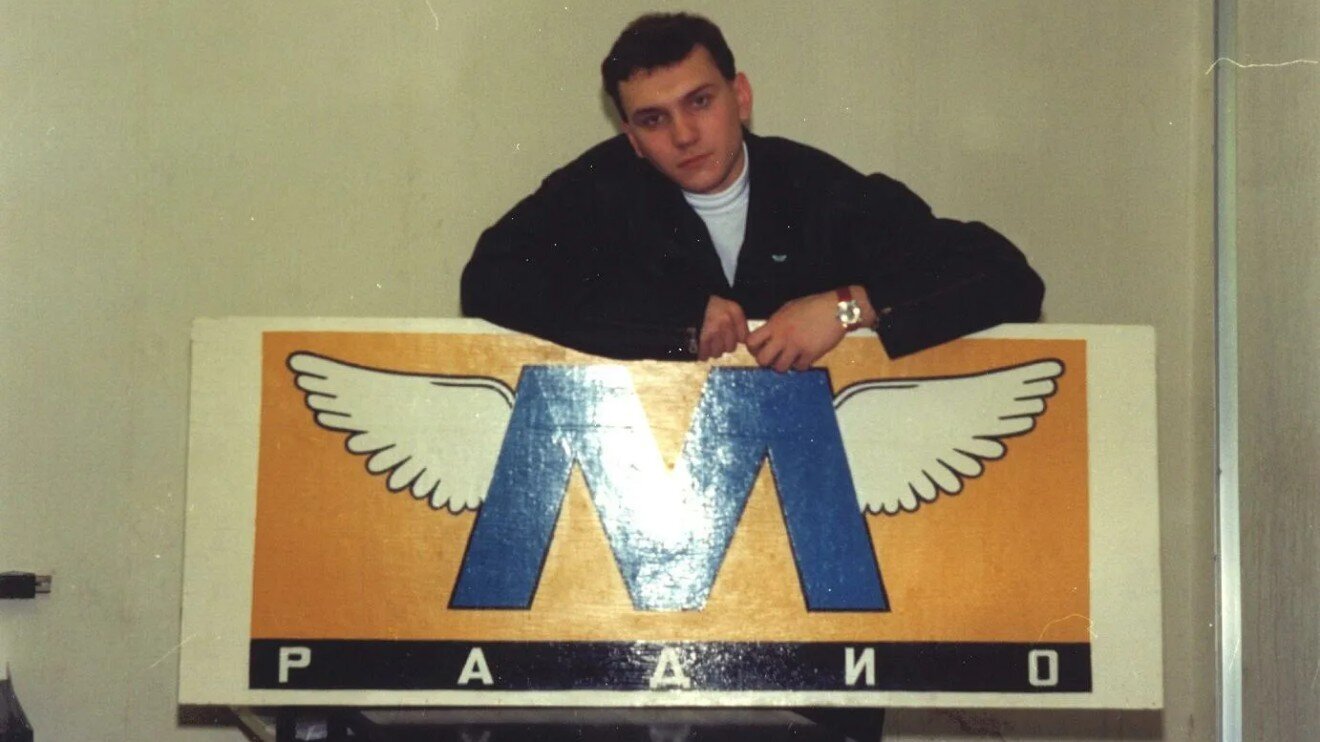
M-Radio was the first Russian-French commercial radio station, a symbol of a new era in the history of Russian broadcasting. It began transmitting on January 14, 1991, with an official birthday celebrated on February 28, 1991.
The station was created as a joint venture, with founders including the Union of Soviet Societies for Friendship and Cultural Relations with Foreign Countries, the All-Union Radio and Television Transmitting Station of the USSR Ministry of Communications, and the French company B-COM.
In 1993, M-Radio was at the height of its popularity, broadcasting at 71.3 MHz in the «lower» VHF band (OIRT standard). The station became a genuine symbol of the times — an era of change, freedom, and new possibilities, embodying the spirit of the early 1990s.
M-Radio became especially well known for its unique jingles (short audio idents), voiced by the French actor Alain Dorval, known for dubbing Sylvester Stallone and Arnold Schwarzenegger into French. Since Dorval didn't speak Russian, his jingle scripts were written out phonetically for him, producing a one-of-a-kind accent — many listeners mistakenly assumed the voice belonged to someone of Georgian origin.
M-Radio's famous jingles, instantly recognizable and memorable, became the station's true calling card:
- «My dog and I don't eat cat sausage. We listen to M-Radio.»
- «I looked for a bear in the taiga, I looked for a wolf in the forest, in Moscow I found M-Radio.»
- «Did you call M-Radio? Please hold for a response…»
- «I love taxi drivers. They listen to M-Radio.»
- «What eyes she had, and she was listening to M-Radio… I couldn't resist…»
- «I can do without a cigarette. All the better to hear M-Radio.»
- «Seventy-one point three megahertz. M-Radio.»
- «More vowels, fewer consonants. M-Radio.»
The station's history wasn't an easy one. In 1994, disagreements between the Russian and French sides led the Russian partners to register a parallel entity — a limited company called «M-Radio — New Wave Radio Program Editorial Office» — which ended French involvement. The station changed hands several times afterward and ultimately went off the air on January 6, 2000.
By the mid-1990s, M-Radio was losing popularity as its owners grew reluctant to invest in the station's development: no new technical equipment was purchased, and the station never obtained a license to broadcast in the «upper» VHF band, which, combined with a shrinking pool of radios still tuned to the «lower» band, sent the station's ratings falling. A characteristic problem for the station became frequent technical glitches playing back CDs, known colloquially as «the skipping discs.»
Despite its relatively short run, M-Radio left a vivid mark on the history of Russian broadcasting and in the memory of an entire generation of listeners.