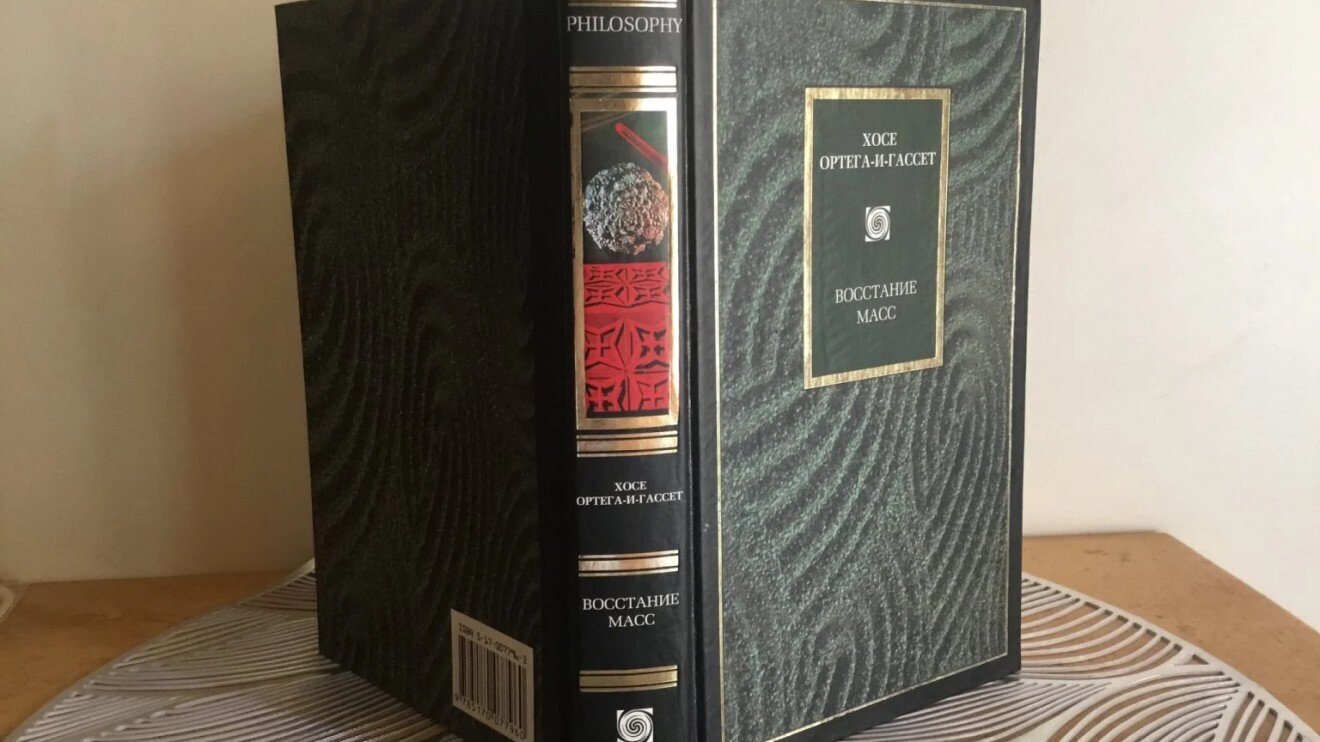
«The Revolt of the Masses» (Spanish: «La rebelión de las masas») is a famous philosophical treatise by the Spanish thinker José Ortega y Gasset, first published in 1930. It's one of the key works in twentieth-century philosophy, examining mass society and the crisis of European culture.
In the book, Ortega y Gasset introduces the concept of «mass man» — an averaged-out individual, stripped of individuality, marked by mediocrity, self-satisfaction, and an aggressive refusal to acknowledge authority. The philosopher contrasts this figure with a «select minority» — people demanding, above all, more of themselves, capable of intellectual and spiritual growth.
The book's central thesis is that the twentieth century saw mass man rise to power, taking control of public and political life despite lacking the cultural and spiritual preparation for that role. Ortega sees a serious threat to civilization in this and warns of the danger of totalitarianism.
The work is divided into two parts: «The Coming of the Masses» and «Why the Masses Intervene in Everything, and Why Their Intervention Is Always Violent.» The book is notable for its brilliant literary style and the depth of its philosophical analysis, combining sharp social criticism with historical parallels and cultural observation.
«The Revolt of the Masses» had a significant influence on the development of social philosophy and cultural studies, and many of Ortega's ideas (such as his critique of mass society and the concept of «mass man») remain relevant today.
José Ortega y Gasset (1883-1955)
José Ortega y Gasset was an outstanding Spanish philosopher, sociologist, essayist, and public figure, one of the major thinkers of the twentieth century. He was born May 9, 1883, in Madrid, to a family of publishers and journalists.
He was educated at a Jesuit college and at the University of Madrid, then continued his studies at German universities (Leipzig, Berlin, Marburg), where he came under the strong influence of the German philosophical tradition, particularly neo-Kantianism.
In 1910, Ortega was appointed to the chair of metaphysics at the University of Madrid and became one of Spain's most influential intellectuals. In 1923 he founded the influential journal «Revista de Occidente» («Western Review»), which became an important platform for spreading contemporary European ideas throughout the Spanish-speaking world.
Ortega's political views evolved from moderate liberalism to a critical stance toward both traditionalism and revolutionary movements. He was actively involved in Spanish public life and served as a deputy in the Constituent Cortes of the Second Republic (1931).
After the outbreak of the Spanish Civil War (1936), Ortega went into exile, living in Paris, the Netherlands, Argentina, and Portugal. He returned to Spain in 1945 but avoided direct participation in political life under the Franco regime. In 1948 he founded the Institute of Humanities in Madrid.
Alongside «The Revolt of the Masses,» Ortega y Gasset's most important works include «Meditations on Quixote» (1914), «The Dehumanization of Art» (1925), «What Is Philosophy?» (1929), «Around Galileo» (1933), «History as a System» (1935), and «Ideas and Beliefs» (1940), among others.
Ortega's philosophical legacy includes the concept of «ratiovitalism» (an attempt to synthesize rationalism and the philosophy of life), the theory of perspectivism («I am I and my circumstances»), historicism, and studies of mass culture and the problems of art. His ideas had a significant influence on existentialism, philosophical anthropology, and twentieth-century sociology.
José Ortega y Gasset died October 18, 1955, in Madrid, at the age of 72.