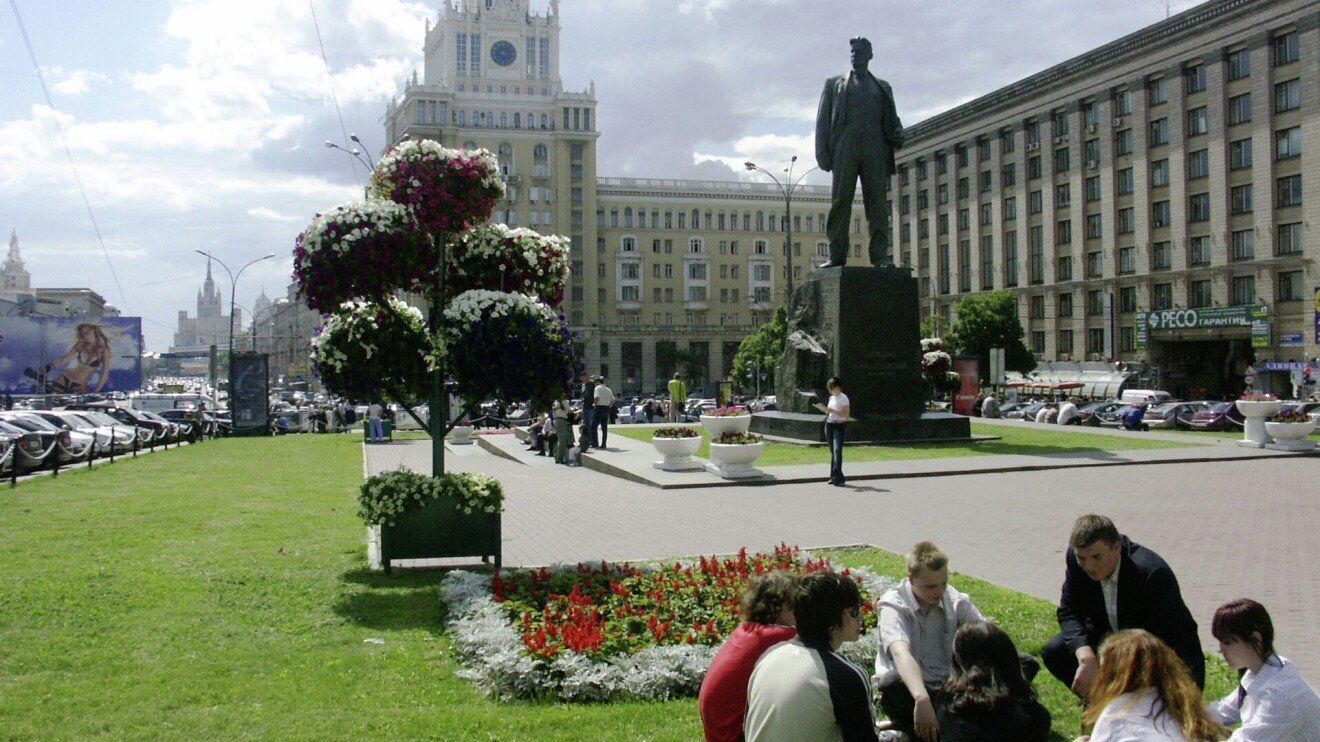
The novel mentions «Mayakovka» — the colloquial name for Mayakovsky Square in Moscow, which carried the great poet’s name from 1935 to 1992. It’s one of the capital’s most important transport hubs on the Garden Ring, where numerous streets converge and business activity concentrates.
Historical Legacy
Triumfalnaya Square (its official name since 1992) sits in the Tverskoy district of Moscow’s Central Administrative Okrug, on the Garden Ring, between Bolshaya Sadovaya, 1st and 2nd Brestskaya streets, 1st Tverskaya-Yamskaya Street, Oruzheiny Lane, Sadovaya-Triumfalnaya, and Tverskaya Street.
The history of this site stretches back to the 16th century, when the Tverskaya road passed through here — an important trade route to Tver and Novgorod. Under Fyodor Ioannovich, in 1592–1593, the walls of the Zemlyanoy Gorod (Earthen City) were built, and the Tverskiye Gates stood exactly on the site of the modern square.
The 18th-Century Triumphal Arches
The square took its name from the tradition of erecting triumphal arches at the Tverskiye Gates. The first arch was built in 1722, funded by Maria Stroganova, for the ceremonial entry of Peter the Great after the signing of the Treaty of Nystad with Sweden. Wooden triumphal arches were raised here repeatedly — for the coronations of Elizabeth Petrovna (1742), Catherine II (1762), and Paul I (1797), as well as to mark military victories.
The Architectural Ensemble by 1995
The Mayakovsky Monument
Since 1958, a monument to Vladimir Mayakovsky, by sculptor A.P. Kibalnikov, has stood at the center of the square. The monument became not just an architectural centerpiece but a gathering place for the creative intelligentsia — poetry readings were regularly held there, especially popular in the 1960s and ’70s.
The Tchaikovsky Concert Hall
On the south side of the square stands the famous Tchaikovsky Concert Hall, built in 1940 by architects D.N. Chechulin and K.K. Orlov. The building was erected on the site of the early-20th-century Aumont Theatre, which, after the revolution, had been given to Meyerhold. The hall remains one of Moscow’s most important concert venues.
The Hotel Peking
By 1995, the square’s architectural centerpiece was the Hotel Peking, built in 1955 to a design by D. Chechulin. This high-rise building, in the Stalinist Empire style, became a symbol of Soviet-Chinese friendship, even though relations between the two countries had already begun to cool by the time construction wrapped up. The hotel housed the restaurant of the same name, Peking, a popular meeting spot for the Moscow elite.
The Theater Quarter
Mayakovsky Square rightfully earned the nickname «Moscow’s second Theater Square.» By 1995, it was home to:
- The Moscow Satire Theatre — housed in the former Nikitin Brothers Circus building, built in 1911 by architects B.M. Nilus and A.M. Gurzhienko. The building’s distinctive dome survives from the original structure.
- The Mossovet Theatre — located behind the «Akvarium» garden
- The Tchaikovsky Concert Hall — the district’s largest concert venue
Transport Infrastructure
Mayakovskaya Metro Station
Mayakovskaya station, on the Sokolnicheskaya line, opened in 1938, even before the Concert Hall was completed. It’s one of the most beautiful stations in the Moscow Metro, designed by A.N. Dushkin. The station has two exits — a southern one (into the Concert Hall building) and a northern one (onto the northeastern corner of the square).
Bus Routes
Buses on routes M1, N1, N12, and E30 stopped at Mayakovsky Square, connecting it to various districts of Moscow. The square was an important transport hub, with streams of passengers flowing through it toward the city center and back.
The Traffic Tunnel
In June 1960, the first traffic tunnel on the Garden Ring route was built beneath the square. The tunnel measures 25.5 meters wide overall, consisting of two 10.5-meter lanes, two 0.75-meter service walkways, and a 3-meter-wide dividing wall. This engineering solution significantly relieved congestion at one of the busiest stretches of the Garden Ring.
Business Activity
Ministry Buildings
By 1995, important state institutions were located on the square. One building housed Russia’s Ministry of Economic Development (at the time, the Ministry of Economy of the Russian Federation), the successor to the USSR State Planning Committee (Gosplan). After the collapse of the USSR and the shift to a market economy, this agency played a key role in the country’s economic transformation.
In 1995, the ministry was handling matters of nationwide economic planning amid market reforms. The building on 1st Brestskaya Street became one of the centers where important economic decisions were made during the formation of the new Russia.
Commercial Infrastructure
Besides the Hotel Peking with its restaurant, various commercial establishments operated on and around the square. Down Tverskaya Street stood the restaurant Sofia, also popular among businesspeople and members of the creative intelligentsia.
The square drew entrepreneurs with its advantageous location — where important transport arteries crossed, ensuring high foot traffic and convenience for doing business.
Cultural Life
The Tradition of Poetry Readings
By the Mayakovsky monument, throughout the 1960s to ’80s, unofficial poetry readings were held regularly, becoming an inseparable part of Moscow’s cultural life. By 1995, this tradition continued, though not on the scale it had in previous decades.
Theatrical Life
The concentration of theaters made Mayakovsky Square an important cultural center. The Moscow Satire Theatre drew audiences with its sharp productions, and the Tchaikovsky Concert Hall remained one of the capital’s leading concert venues, hosting leading Russian and international performers.
Architectural Features
Stylistic Diversity
By 1995, the square’s architectural character represented a unique blend of different styles and eras:
- Early-20th-century Art Nouveau — surviving elements from the Aumont and Nikitin Brothers-era buildings
- 1930s Constructivism — Mayakovskaya metro station
- 1940s–50s Stalinist Empire style — the Tchaikovsky Concert Hall and the Hotel Peking
- 1950s–60s Soviet architecture — residential and administrative buildings
Planning Decisions
In the 1930s, the square underwent a radical reconstruction — the central garden was cut down, and the whole area was paved over. This decision was driven by the need to improve traffic flow at one of the key junctions on the Garden Ring.
Social Geography
A Draw for Businesspeople
In 1995, Mayakovsky Square attracted members of Russia’s emerging business class. Its proximity to central Moscow, developed transport infrastructure, presence of government institutions, and quality restaurants made it a convenient place for business meetings and negotiations.
The novel’s mention of «Mayakovka» as a place the protagonist starts «making regular trips» to, after switching to production, reflects the real situation of the time, when many entrepreneurs were seeking new opportunities, and the area around Triumfalnaya Square offered exactly that.
The Intelligentsia and Creative Circles
Despite the commercialization of the 1990s, the square retained its pull for members of the creative intelligentsia. Theaters, the concert hall, the tradition of poetry readings — all of this created a distinct atmosphere, setting Mayakovsky Square apart from the capital’s purely business districts.
Historical Continuity
By 1995, Mayakovsky Square represented a unique phenomenon in Moscow’s topography — a place where the history of the Russian capital showed up in concentrated form. From the 16th-century Tverskiye Gates of the Zemlyanoy Gorod to modern business centers — every era left its mark here.
The square’s 1992 renaming to Triumfalnaya became a symbol of historical change, but among ordinary Muscovites it was still called «Mayakovka,» reflecting entrenched tradition and cultural memory.
Conclusion
Mayakovsky Square in 1995 was a microcosm of a transitional era in Russian history. Here, old cultural tradition met new business activity, state institutions met private initiative, and architectural heritage from various eras met the needs of a rapidly changing city.
To understand the atmosphere of the time, it helps to picture the square not simply as a transport hub, but as a living space where the fates of people of different professions and interests crossed, where important decisions were made and new projects were born, where history and the present coexisted in an unbroken unity.