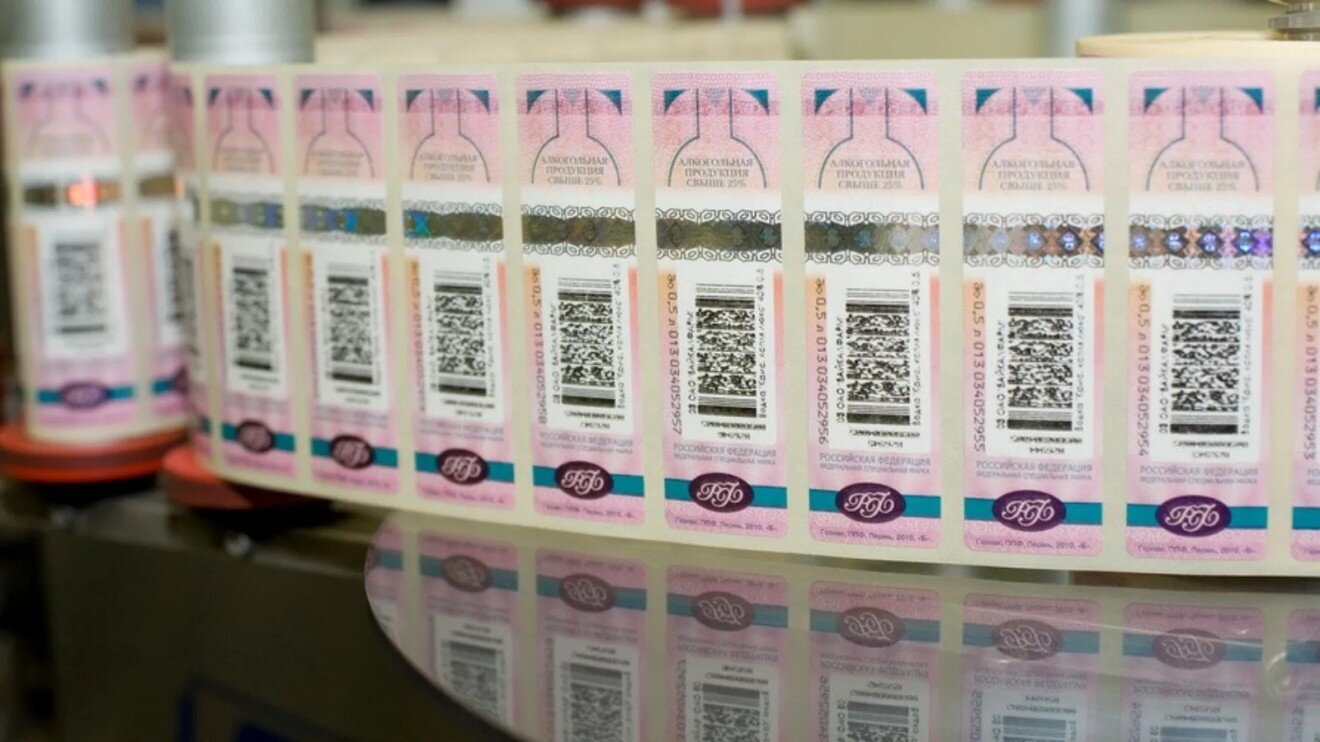
In 1993, Russian entrepreneurs encountered a new system of taxing alcohol products — the introduction of excise stamps. This measure became part of a broad tax reform undertaken by the young Russian state.
What excise stamps are
Excise stamps (excise bands) are special fiscal markers designed to confirm that excise tax has been paid on certain kinds of goods. They are counterfeit-resistant stickers or bands, applied to a product's packaging in such a way that the package can only be opened by tearing the stamp.
The word "bandage" (in the Russian sense of "band" here) comes from the French "banderole," meaning a sash or strip of paper wrapped around a package of goods. The system serves a dual purpose: guaranteeing tax payment to the state and protecting consumers from counterfeits.
Historical background
Excise stamps were nothing new in Russian history. In the Russian Empire, the banderole system was successfully used from the mid-19th century onward. An excise band for cigarettes, dated 1852, is known to exist. Such stamps were applied to:
- Strong alcoholic beverages
- Tobacco products
- Matches
- Refined sugar
- Playing cards
- Tea
In the USSR during the NEP period (the 1920s), excise bands were likewise issued for consumer goods. At first, old tsarist bands were used with Soviet overprints, and original Soviet stamps appeared later. With the end of NEP in the late 1920s, excise stamps fell out of use.
The legal basis in 1993
In 1993, the question of introducing excise stamps was actively discussed in government circles. The system was officially introduced by a Russian government resolution dated April 14, 1994, "On the Introduction of Excise Duty Stamps on the Territory of the Russian Federation," though preparatory work and discussion were already underway in 1993.
The need to introduce stamps was driven by several factors:
- The state budget's need for additional revenue
- The need to combat illegal alcohol production
- Protecting consumers from substandard products
- Controlling the circulation of excisable goods
Goods subject to stamping
Under the government's plans, mandatory stamping applied to:
- Food-grade alcohol
- Wine and spirits
- Tobacco and tobacco products
- Goods imported into Russian territory
Special attention was paid to alcohol products, as a source of significant tax revenue and an object of heightened government oversight.
The technical design of the stamps
Russian excise stamps were planned to have a high degree of counterfeit protection:
- Printing on special watermarked paper
- The use of security inks
- Microtext
- A unique serial number on each stamp
- Special adhesive compounds
The stamps were to be produced at specialized facilities, under the strictest security measures.
The distribution system
The plan called for a system in which producers of excisable goods would be required to purchase stamps from government agencies. The proposed principles included:
- Mandatory advance purchase of stamps by producers
- The option of installment payment under certain conditions
- Strict reporting on stamp usage
- A special procedure for returning unused stamps
Implementation problems
Already in 1993 it was clear that rolling out the excise stamp system would face serious difficulties:
Technical problems
- Insufficient production capacity for manufacturing the stamps
- The need to build a system of monitoring and accounting
- A lack of experience among government employees
Economic problems
- Additional costs for producers purchasing the stamps
- Higher production costs for goods
- The risk of rising prices for consumers
Organizational problems
- The need for coordination between various agencies
- Creating new administrative procedures
- Training enterprise staff in the new requirements
International experience
In developing the Russian system, the experience of other countries was studied. Different states used different approaches:
- The US and Canada — stamps sealing the product's packaging
- European countries — a banderole system, with bands wrapped around the packaging
- Bulgaria — a system of advance applications for purchasing stamps
Economic significance
Excise duties have traditionally made up an important share of government revenue. The excise on many goods can reach half, and sometimes even two-thirds, of their price. For Russia's 1993 budget, already under serious strain, introducing an effective excise-collection system was critically important.
Excise stamps were expected to help:
- Increase tax collection rates
- Shrink the shadow economy
- Provide additional budget revenue
- Improve oversight of excisable goods
Impact on business
For entrepreneurs working with alcohol products in 1993, the question of excise stamps became a key concern. They would need to:
- Study the new legal requirements
- Restructure their logistics
- Budget for additional costs
- Build working relationships with the tax authorities
Many entrepreneurs felt uncertain, given the lack of clear deadlines for the system's introduction and detailed instructions on how to apply it.
Regional variation
In 1993, the Russian Federation was still only in the process of forming a unified tax system. Different regions could have their own quirks in applying tax law, creating additional complications for businesses operating in multiple federal subjects.
What lay ahead
By the end of 1993, it was clear that the excise stamp system would be introduced, but the exact timeline and mechanisms had yet to be worked out. Entrepreneurs prepared for the change, understanding the new rules were inevitable.
A phased rollout of the system was planned:
- First — imported goods
- Then — domestic production of strong spirits
- Gradual expansion to other categories of goods
Conclusion
1993 was a turning point in the introduction of excise stamps in Russia. Although the official resolution was not adopted until April 1994, it was in 1993 that active preparatory work took place, various versions of the system were discussed, and the business community began preparing for the coming changes.
The introduction of excise stamps became an important part of building Russia's modern tax system, continuing the historical tradition of using fiscal stamps to control the circulation of excisable goods, a tradition that dated back to the Russian Empire.
For entrepreneurs of the time, this innovation meant not just additional costs and administrative procedures, but the chance to operate under more civilized, predictable conditions, where the rules of the market became the same for every participant.