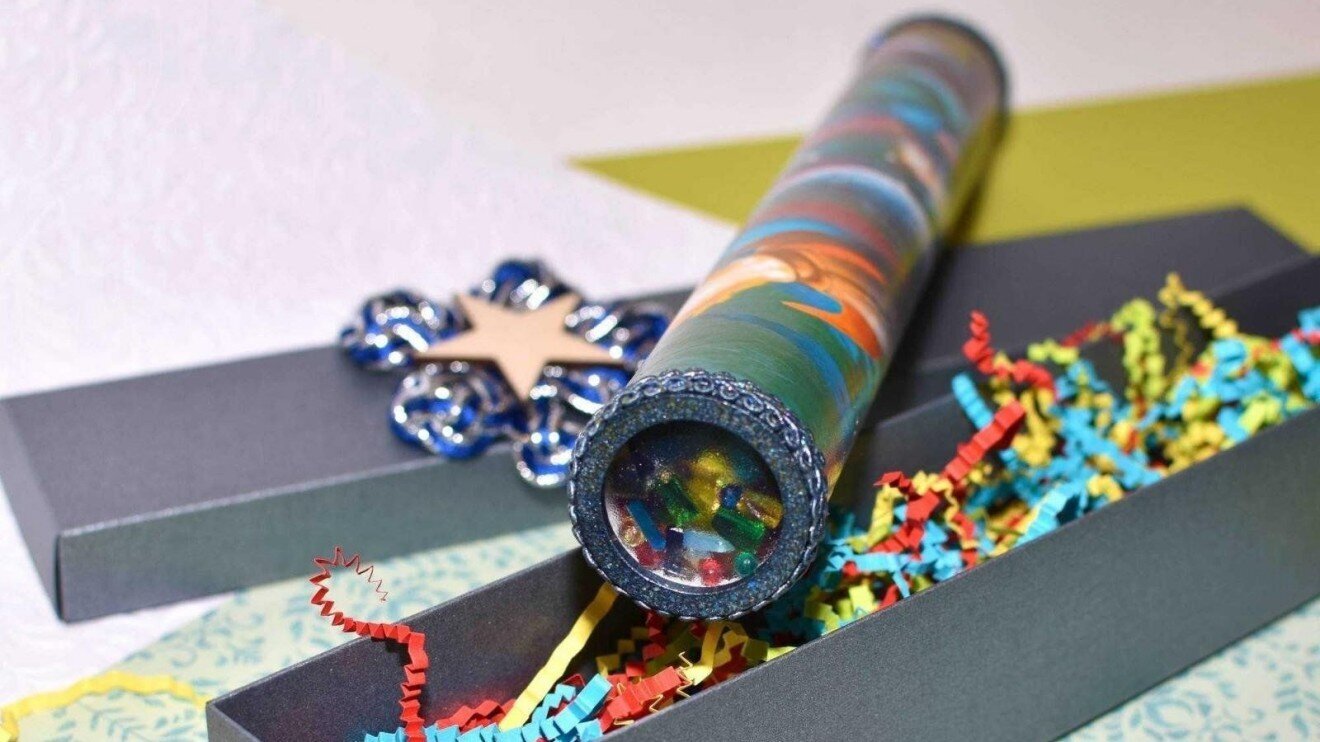
In the novel's text, the author juxtaposes two concepts — the mandala and the kaleidoscope — creating a metaphorical image of the events unfolding. This comparison is no accident: both phenomena involve creating ordered, symmetrical patterns out of chaotic elements.
The mandala: sacred geometry of the East
A mandala (Sanskrit mandala, "circle"; Tibetan "kilkhor," "center and circumference") is a symmetrical design carrying deep spiritual meaning in Buddhism and Hinduism. In its broadest sense, a mandala symbolizes the world, the universe, serving as a geometric expression of cosmic order.
Mentally visualizing a mandala, with an understanding of its structure, is an important part of meditative practice. It is not merely a beautiful pattern, but a complex spiritual diagram, every element of which carries a specific meaning.
Structure and symbolism
A typical mandala has a concentric structure. At its foundation is an outer circle, symbolizing the universe. Inscribed within it is a square, oriented to the cardinal directions, representing the material world. Within the square lies an inner circle — the dimension of deities, bodhisattvas, and buddhas.
The square between the circles carries special meaning: it is divided into four parts, each corresponding to a cardinal direction. On each side of the square are T-shaped openings, representing gates into the universe. A fifth part is the mandala's center, the point of absolute stillness and the source of all energies.
The mandala's color palette is likewise symbolic. Each color is associated with a particular direction, a particular buddha, a sense organ, sacred gestures (mudras), and mantras. This color coding creates a multi-layered system of correspondences, linking the cosmic and the human.
Its material forms
Mandalas can be two-dimensional or three-dimensional. They are made from a wide range of materials: embroidered on cloth, drawn in sand, made from colored powders, crafted from metal, stone, wood, and even dough. Especially striking are mandalas carved from butter, dyed in the appropriate ritual colors.
Mandalas decorate the floors, walls, and ceilings of temples. In the East, a mandala is so sacred that its creation is accompanied by special rituals, and it can itself become an object of worship.
Some mandalas are created specifically for rituals and ceremonies. For the Kalachakra initiation, for example, monks create extraordinarily complex mandalas out of colored powders, working on them for days or weeks. Once the ritual concludes, the mandala is ceremonially destroyed, symbolizing the impermanence of all things.
Practical uses
Mandalas were used for more than religious purposes. The construction of Hindu temples, Vedic altars, and even homes traditionally began with creating a mandala. They were used to consecrate temples and theaters, and for ordaining monks.
The ancient Indian thinker Chanakya (Kautilya), in his treatise "Arthashastra," describes the concept of the "mandala of states" — a political model based on mandala principles.
The kaleidoscope: optical symmetry of the West
The kaleidoscope (from Greek kalos, "beautiful"; eidos, "form"; scopeo, "I see") is an optical device for viewing colorful, symmetrical patterns. Though today seen mainly as a toy, its invention was the result of serious scientific research.
The history of its invention
The kaleidoscope was invented by the English physicist David Brewster during experiments with the polarization of light, in 1814–1815. In July 1817, Brewster patented his invention, which immediately won enormous popularity.
The kaleidoscope's success was phenomenal: more than two hundred thousand devices were sold in England and France in the first three months alone. Manufacturers could not keep up with the enormous demand, forcing Brewster to bring in numerous additional producers.
The novelty spread rapidly around the world. In Russia, the kaleidoscope appeared as early as 1818, as attested by an enthusiastic review from the fabulist Alexander Izmailov in the magazine "Blagonamerenny": "It is impossible to describe, in either verse or prose, what one sees in a kaleidoscope... What lovely patterns! Ah, if only one could embroider them onto canvas!"
Construction and how it works
A kaleidoscope is a tube 20–25 cm long and 34–45 mm in diameter. Its design is based on the principle of repeated reflection within a system of mirrors.
The rear end of the tube is closed off with frosted diffusing glass. Between it and a piece of clear glass lies a narrow compartment (about 5 mm), filled with loose, colored pieces of glass or plastic of arbitrary shape. The thickness of these pieces is chosen so they lie in a single layer, without overlapping each other.
The heart of the kaleidoscope is a prism made of 2 to 3 elongated mirrors, glued together with their reflective surfaces facing inward. In place of a third mirror, a piece of glass with a black matte surface is often used. It matters that the prism uses front-surface optical mirrors — this ensures a sharp image.
A viewing hole completes the construction. In kaleidoscopes with an equilateral prism, it is usually round, 10–12 mm in diameter. For ease of use, modern kaleidoscopes are often built with a rotating compartment, allowing the device to be held still against the eye.
The mathematics of symmetry
The beauty of kaleidoscopic patterns rests on strict mathematical principles. The main rule is the rule of wholeness: for all the reflections within the prism to be complete, without mutual overlap, the angle between the mirrors must equal 180°/n, where n is a natural number equal to or greater than two.
This angle is reflected around the full circle, producing a total number of angles equal to 2n. Through the alternation of un-reversed and reversed (mirror-flipped) angles, a star-shaped pattern forms, with a number of points equal to n.
In three-mirror kaleidoscopes, the rule of wholeness is fully satisfied only for certain combinations of angles: 60°+60°+60° (an equilateral prism), 90°+45°+45° (a right isosceles prism), and 90°+60°+30°.
Parallels and differences
The mandala and the kaleidoscope, despite differing in origin and purpose, share a striking resemblance. Both create ordered, symmetrical patterns; both rest on principles of central symmetry and the repetition of elements.
The mandala is a static image of cosmic order, created for spiritual contemplation and meditation. The kaleidoscope is a dynamic device, generating constantly shifting patterns for aesthetic pleasure. But in both cases, a harmonious whole is born out of the chaos of individual elements.
The psychological dimension
The Swiss psychologist Carl Jung identified the mandala as an archetypal symbol of human wholeness. In modern psychotherapy, the mandala is used as a means of achieving a fuller understanding of one's own self, a tool for self-knowledge and inner harmonization.
The kaleidoscope, for its part, fascinates through its ability to generate an endless variety of beautiful patterns from simple elements. This quality makes it more than a toy — it becomes a metaphor for the creative process, a symbol of how beauty can be born from the ordinary and the accidental.
A literary metaphor
In the context of the novel, comparing the day to a kaleidoscope, and individual events to mandalas, creates a layered metaphor. The kaleidoscope here is an image of rapidly changing, yet internally ordered, events. Every twist of fate creates a new pattern, but all of them obey a single underlying logic, like fragments inside the optical device.
The mandala, in this context, becomes a symbol of a single significant moment — complete, centered, carrying within it a reflection of the wider picture of events. It is an event-symbol, in which, as in a drop of water, the whole world is reflected.
The author thus draws on images of Eastern mysticism and Western optics to build a poetic metaphor, in which the chaos of life finds a hidden order and beauty.