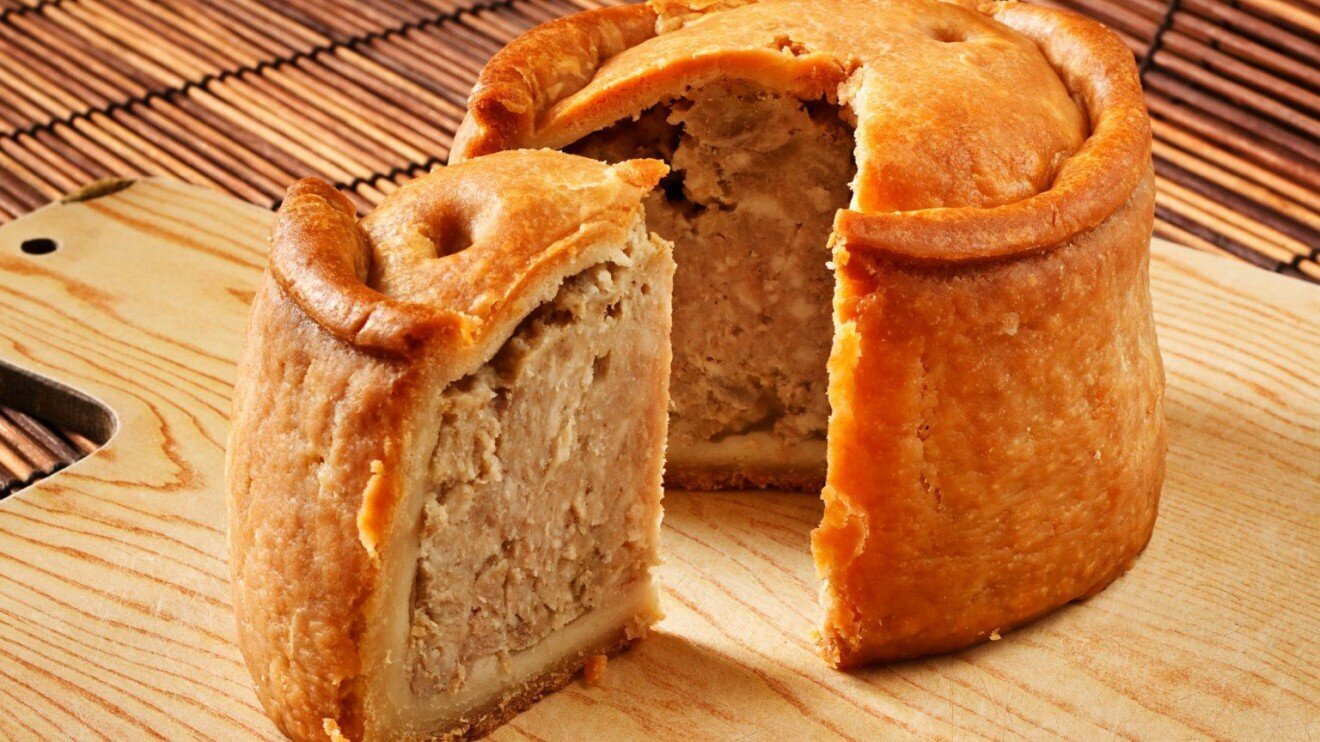
The Leicestershire pork pie, better known by the name Melton Mowbray, is one of the most recognizable symbols of British culinary tradition. It is a cold meat pie with a rich history reaching back to the eighteenth century, one that by the mid-1990s had become firmly established not just in English cuisine but as a popular dish in pubs across the United Kingdom.
Origins and history
The history of the Leicestershire pie is inseparable from the small town of Melton Mowbray in the county of Leicestershire, in the English Midlands. It was here, at the end of the eighteenth century, that the dish’s unique recipe took shape. Historical sources suggest that the pie’s practicality and nutritional value were first appreciated by the local gentry during fox hunts – a traditional English pastime of the upper classes.
Interestingly, the aristocracy took notice of the dish by watching their own stable hands and servants eat. Stable workers needed hearty food that traveled well, didn’t spoil for a long time, and could be eaten without reheating. The Melton Mowbray pie met all these requirements perfectly.
Since its first appearance, the recipe has undergone minimal changes, testament to how well the original method had been worked out. Traditional preparation techniques were handed down from generation to generation, preserving the dish’s authenticity for more than two centuries.
Preparation
The technology behind making a Leicestershire pie has several distinctive features that set it apart from other English meat pies. The chief one concerns how the meat is prepared: the pork isn’t run through a mincer but is chopped by hand with a knife, leaving fairly large pieces. This gives the filling a distinctive texture and preserves the meat’s natural flavor.
The pastry for the pie is made with hot water – a technique known as «hot water crust pastry.» This kind of dough becomes more pliable and can be shaped by hand without special molds or hoops. It’s precisely because of this hand-shaping that Melton Mowbray pies acquire their characteristic irregular, onion-like form – wider at the base, narrowing toward the top.
After baking, liquid aspic – a concentrated, spiced pork stock – is poured into the pie through a small opening. This is done because the meat expands during cooking and contracts as it cools, leaving gaps. The jelly fills those spaces, giving the pie a long shelf life and keeping the filling moist.
Appearance and serving
A finished Leicestershire pie has a golden-brown crust and a characteristic rounded shape, about 8 to 10 centimeters tall. In cross-section you can clearly see chunks of gray meat interspersed with translucent jelly. It’s precisely that gray, rather than pink, color of the meat that marks a genuine traditional pie, since it indicates the use of fresh, unprocessed pork.
In British pubs of the mid-1990s, the Leicestershire pie was usually served as a hearty snack or a light lunch. It was served cold, cut into thick slices, often accompanied by homemade pickles, pickled onion, mustard, or fresh salad. It was also popular paired with English ales or strong dark beers such as stout.
Cultural significance in the 1990s
By the mid-1990s the Leicestershire pie had become firmly established in British pub culture and an integral part of «pub food» – the traditional pub kitchen. This was a period of an interesting paradox: on the one hand English cuisine was criticized for its blandness and poor quality, while on the other, traditional dishes like the Melton Mowbray pie were enjoying a renaissance.
Pubs, especially in central London, actively featured the Leicestershire pie on their menus as a symbol of «genuine English cooking.» This was especially relevant given the growing interest in regional culinary traditions and the desire to preserve cultural identity in an age of globalization.
For many pub-goers, the Melton Mowbray pie represented not just food but a kind of journey into the past, a connection to historical roots and ancestral tradition. The dish embodied notions of «good old England» – simple, honest, and substantial.
Regional variations
Although the classic Melton Mowbray recipe remained unchanged, the 1990s saw various spinoffs gain popularity. The «gala pie» was a favorite – a festive version in which chicken was added to the pork, and a whole hard-boiled egg was placed at the center. Sliced open, such a pie showed concentric rings: a yellow yolk at the center, ringed by white, then by the meat filling.
Another popular variety was the «picnic pie» – usually smaller, its filling enriched with apples, cranberries, pickled cucumbers, or bits of bacon. Sometimes the solid top crust was replaced with a lattice of pastry, leaving the filling partly exposed.
The economics of the pie
In the mid-1990s, producing Leicestershire pies was an important branch of the British food industry. Alongside large manufacturers supplying national supermarket chains, there were plenty of small family businesses that kept to traditional methods.
Pies made in Melton Mowbray itself and its surrounding area were especially prized, since their makers could use local pork and follow historically established recipes. These pies cost more than the mass-produced product but enjoyed steady demand among gourmets and connoisseurs of traditional cooking.
Nutritional value and consumption
The Leicestershire pie is a rather calorie-dense dish – on average, 100 grams of the product contains around 350 to 400 kilocalories. Its high protein content (about 15 to 18%) and fat content (25 to 30%) make it extremely filling, which is exactly what secured its popularity as a substantial snack.
Traditionally the pie was eaten during the day – at lunch or as a late weekend breakfast. In pubs it was often ordered by patrons wanting «a proper bite to eat» without planning a full meal. Thanks to its long shelf life (up to a week in the fridge), the pie was also convenient for eating at home.
Conclusion
By the mid-1990s the Leicestershire pork pie had become firmly established as one of the symbols of British culinary tradition. The dish successfully combined historical authenticity, practicality, and excellent flavor. In the setting of a pub like London’s «Swan,» ordering a Melton Mowbray pie was more than just a food choice – it was a kind of statement of allegiance to English tradition and cultural values.
This dish’s popularity in British pubs of the 1990s reflected broader cultural trends of the time – the drive to preserve national identity in an era of growing globalization, and the search for authenticity in a world of mass production and standardization.