In the novel, the character ironically invokes the mathematical concept of infinitesimals to explain a shortfall in warehouse inventory. This reference isn't accidental — it reflects the spirit of the early 1990s, when the chaos of the transitional period gave rise to attempts to dress up everyday problems in pseudo-scientific language.
What infinitesimals are
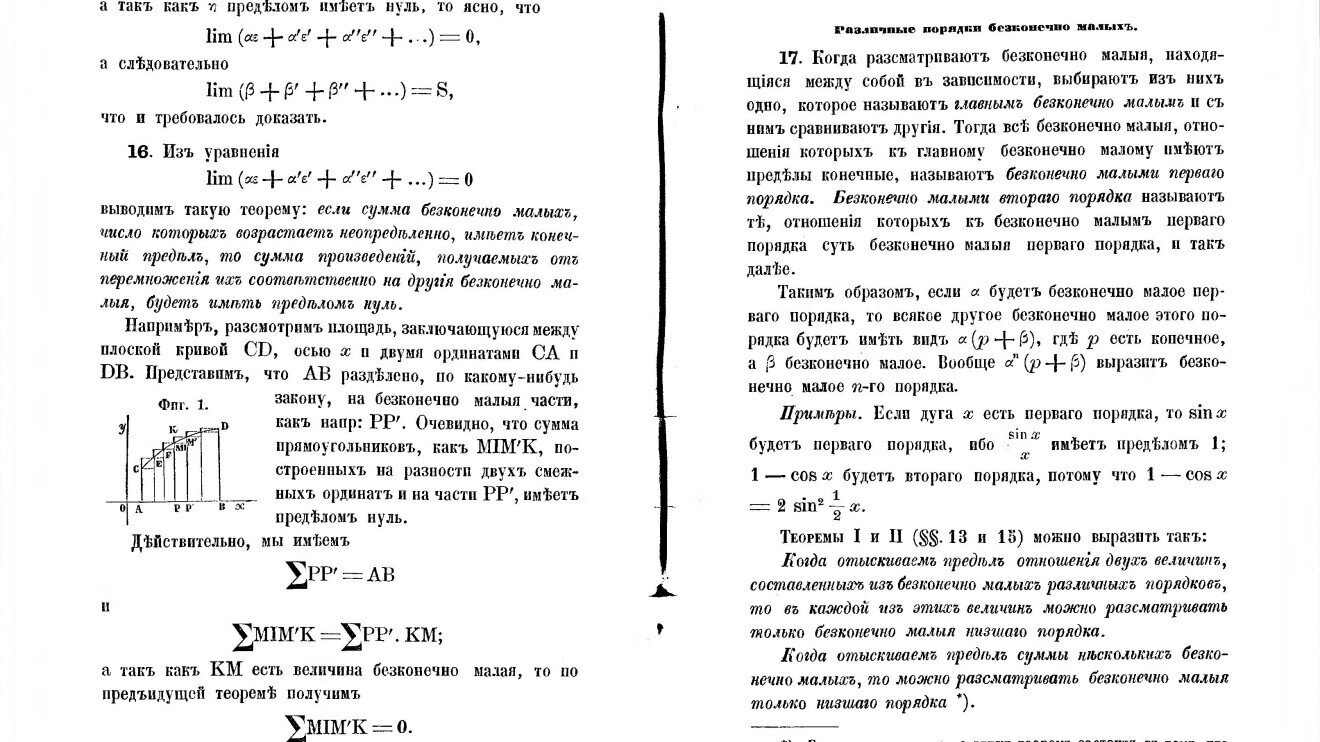
An infinitesimal, in mathematics, is a function or sequence whose limit equals zero. In simpler terms, it's a quantity that, as it changes, becomes smaller than any given positive number, while never actually equaling zero.
A classic example is the sequence 1/n, as n approaches infinity. At n = 1,000, we get 0.001; at n = 1,000,000, we get 0.000001, and so on. The quantity approaches zero but never reaches it.
A historical drama
The history of infinitesimal mathematics is a genuine intellectual drama of the 17th-18th centuries. When Newton and Leibniz developed differential and integral calculus, they worked with concepts that seemed logically contradictory.
The English philosopher and bishop George Berkeley was an especially fierce critic of the new calculus in his pamphlet "The Analyst" (1734). He called infinitesimals "ghosts of departed quantities" and asked: how can one speak of a ratio between things that have no magnitude at all?
"He who can digest a second or third fluxion... need not, methinks, be squeamish about any point in divinity"
A paradox of effectiveness
Remarkably, despite its shaky logical foundations, calculus worked brilliantly. 18th-century mathematicians got correct results using "illegitimate" operations on poorly defined concepts. Berkeley explained this as errors canceling each other out — one inaccuracy correcting another.
It wasn't until the early 19th century that French mathematician Augustin Cauchy managed to rigorously ground calculus through the concept of the limit, with German mathematician Karl Weierstrass finally settling the matter.
The irony in the novel's context
In 1993, when the novel is set, invoking infinitesimals sounds especially witty. The character, explaining a shortfall of 240 bottles out of 350,000 shipped (less than 0.07%), appeals to a mathematical concept that was itself, for a long time, a source of debate over what should count as negligibly small.
An interesting fact
In the mid-20th century, non-standard analysis emerged, proving that the original approach using actual infinitesimals was mathematically sound after all. It turns out 18th-century mathematicians were intuitively right — they just couldn't rigorously prove it.
Philosophical subtext
Using the concept of infinitesimals in an everyday context reflects an age-old human tendency to dress up practical problems in scientific-sounding language. In the chaotic Russia of the early 1990s, where the old systems of control and accounting were collapsing, such intellectual flourishes were especially fitting.
The mathematics of infinitesimals became a metaphor for relativity: what counts as significant, and what can be dismissed as negligible, often depends on the scale of observation and the observer's point of view.