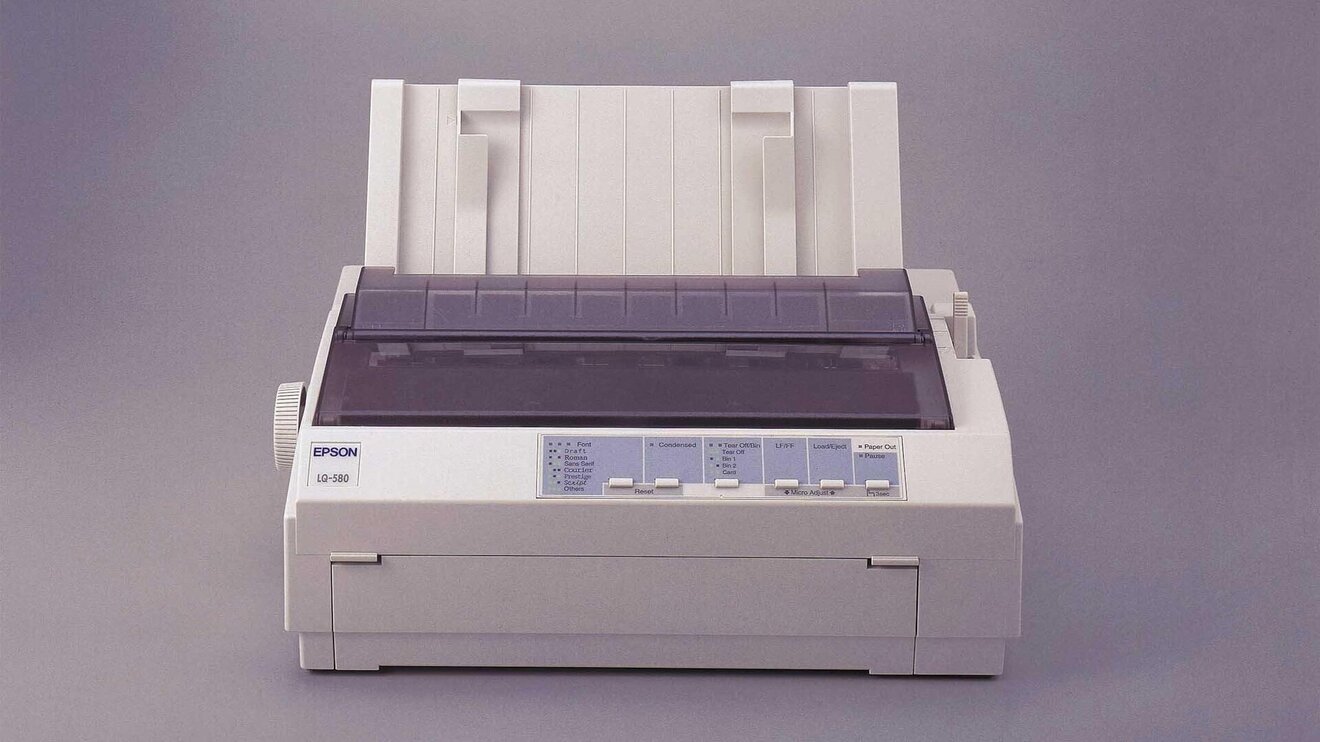
In 1993, amid economic chaos and rapid computerization, dot-matrix printers remained one of the key tools of office work. Their clatter rang out in banks, government offices, research institutes, and even the first private firms. Unlike expensive laser printers, which were only just beginning to appear in Russia, dot-matrix machines were affordable, low-maintenance, and could print on multi-layer forms — a critical feature in an era of paper-heavy bureaucracy.
How It Worked
A dot-matrix printer formed characters not with a single solid impression, but through pinpoint strikes through an inked ribbon. A print head with 9 or 24 pins moved along the line, leaving impressions on the paper. The more pins, the higher the print quality.
Speed was measured in CPS (characters per second):
- 9-pin models (Epson FX, Citizen) — up to 300 CPS (fast, but coarse).
- 24-pin models (Epson LQ, Star) — up to 180 CPS, but with nearly typeset-level sharpness.
How They Were Used in 1993
- Noise was the dot-matrix printer’s main curse. Their racket drowned out office conversation, and some institutions even installed soundproofing covers.
- Paper came as perforated rolls or loose sheets, often of poor quality. Tractor feed (toothed wheels engaging the perforation) was more reliable, but individual sheets had to be loaded by hand.
- The ink ribbon was a scarce resource. People rewound it by hand, and once the ink ran out, they’d slip in carbon paper to squeeze out the last of the dye.
- Color printing was an exotic rarity. Some models (the Epson LQ-2550) supported CMYK ribbons, but the colors quickly muddied into a brownish mess.
Where They Were Used
- Banks and government offices — printing payment orders, statements, and reports.
- Research institutes — printing out data from mainframes.
- Exchanges and commercial firms — the first price lists and contracts.
- The postal service and railways — printing tickets and receipts.
Why did dot-matrix printers survive into the age of inkjets?
- Working with carbon copies — only impact printing could strike through several layers at once.
- Cheapness — a ribbon cost pennies compared to a cartridge.
- Reliability — a printer could churn out millions of pages without breaking down.
Conclusion
In 1993, the dot-matrix printer was more than a piece of equipment — it was a symbol of the transition from Soviet bureaucracy to a new digital world. Its clatter and screech accompanied Russian business’s first steps, and its simplicity and durability made it the last stronghold of the «iron» age before the arrival of laser and inkjet technology.