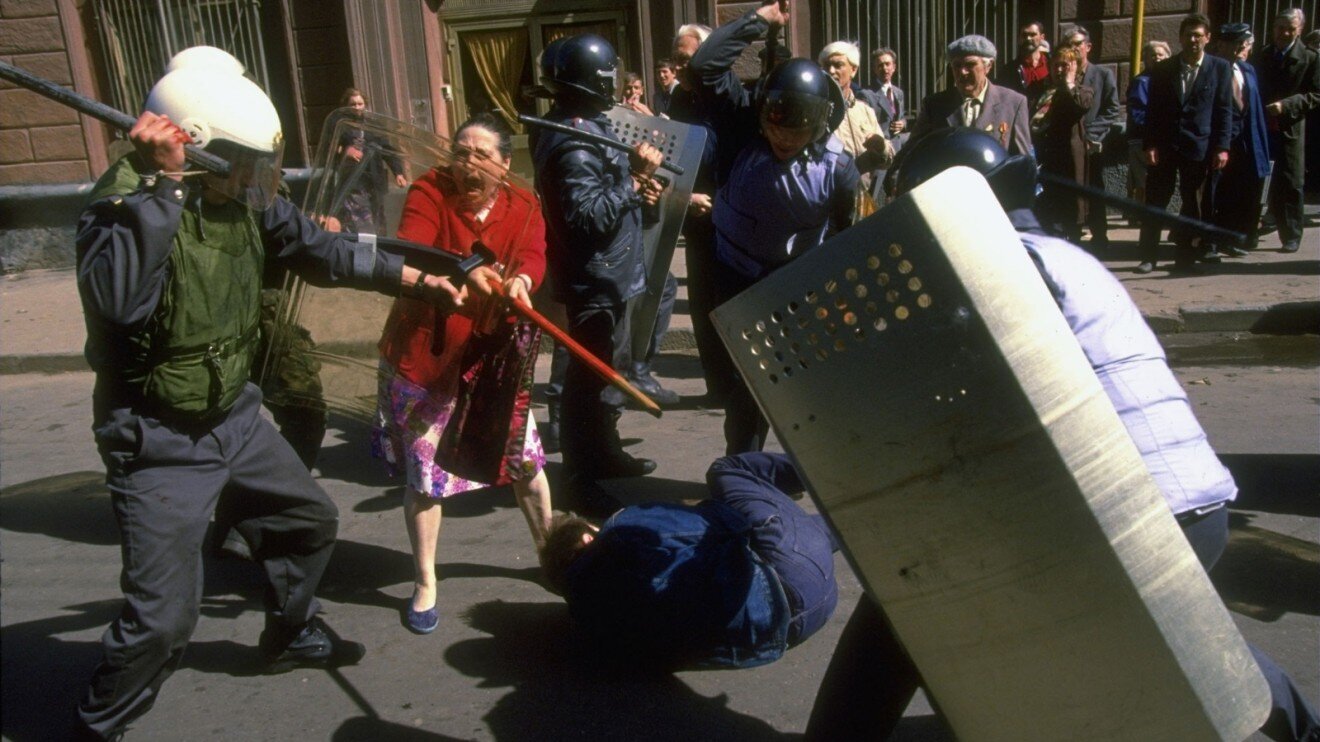
The events of May 1, 1993, in Moscow became one of the most dramatic episodes in the standoff between supporters and opponents of President Boris Yeltsin, amid an acute political crisis in Russia.
Background to the Conflict
By the spring of 1993, Russia’s political situation had reached a breaking point. The standoff between President Yeltsin and the Supreme Soviet, led by Ruslan Khasbulatov, had paralyzed the machinery of government. Amid this, opposition forces — the Communist Party of the Russian Federation, the «National Salvation Front,» and the «Working Russia» movement — planned to use the traditional May Day demonstration as a platform for protesting the government’s economic policy.
What made the situation especially sharp was that many demonstrators were drawn from the very same democratic intelligentsia that had recently backed Yeltsin in his fight against the Communist nomenklatura. Now, faced with the realities of Yegor Gaidar’s «shock therapy» — hyperinflation, evaporating savings, mass unemployment — they found themselves in the ranks of the opposition.
A Ban on the Traditional Route
Moscow city authorities, anticipating possible unrest, refused to approve the traditional May Day march route from Kaluzhskaya Square to Manezhnaya Square. Instead, organizers were offered a route only as far as the Krymsky Bridge, which was seen as an attempt to keep demonstrators away from the city center and the Kremlin.
That decision became the catalyst for the conflict. The demonstration’s organizers — among them prominent political figures like Viktor Anpilov (leader of «Working Russia») and Stanislav Terekhov — announced their intention to ignore the ban and march to Red Square.
A Bloody Clash
On the morning of May 1, around five thousand people gathered on Kaluzhskaya Square. Among them were not only members of left-wing parties, but ordinary citizens unhappy with the government’s economic policy. When the column of demonstrators began moving along Leninsky Prospekt, police tried to block the road with trucks.
What happened next was a genuine shock to contemporaries. Demonstrators broke through the police barricades, seizing shields and batons from law-enforcement officers. In response, riot police counterattacked. The clash’s tragic climax was the death of riot-police sergeant Vladimir Toloknev, crushed by one of the trucks the demonstrators had seized.
Water cannons only briefly cooled the rioters’ fervor. More than 200 people were injured to varying degrees, many hospitalized.
The Symbolic Weight of the Events
The May 1993 events became a symbol of the deep rift running through Russian society. Many demonstrators — members of the intelligentsia who had, not long before, enthusiastically backed democratic reforms — now found themselves on the other side of the barricades. The novel’s line about a character who had «fought for intelligentsia ideals foaming at the mouth at rallies in Luzhniki, and now… got a nightstick to the teeth from the cops» captures precisely the tragedy of a generation that had believed in a quick, painless transition to democracy and a market economy.
The events of May 1, 1993, were a prelude to the even more dramatic events of that October, when the standoff between president and parliament reached its climax. The bloody May Day showed that Russia’s political crisis went beyond an elite standoff and touched broad segments of the population.
Historical Assessment
Contemporary historians see the May 1993 events as an important stage in the formation of new Russian statehood. On one hand, they demonstrated society’s unreadiness for a peaceful resolution of political conflict. On the other, they showed that Russia’s democratic institutions weren’t yet strong enough to guarantee civilized dialogue between government and opposition.
To understand the atmosphere of 1993, it’s important to remember that this was a period when not only political institutions but an entire system of values was collapsing. People who, just yesterday, had believed in «universal human values» and «a return to the civilized world» suddenly found those values colliding head-on with the reality of everyday life.