The Alcohol Invasion: Cheap Imports in Early-1990s Russia
Alcohol Liberalization, 1992–93
In 1992, the Russian government scrapped the state monopoly on alcohol sales, triggering an avalanche of cheap imported liquor from abroad. This decision, part of the broader economic liberalization, had dramatic consequences for the Russian alcohol market and for society at large.
The sudden opening of the border to alcohol imports, amid economic chaos and virtually no quality control, meant the Russian market filled up with products of dubious origin and quality. Many of these drinks were produced specifically for export to the former USSR and didn’t meet the standards used in Western countries.
Bols
A famous Dutch liqueur brand dating back to 1575. But what sold in early-1990s Russia wasn’t the original Dutch Bols liqueurs, but cheap knockoffs, often manufactured under license in Eastern Europe. The real Lucas Bols company is indeed one of the oldest liquor makers in the world, but the products reaching the Russian market were a considerably stripped-down version.
Cin&Cin
A Polish vermouth made at the Ambra S.A. plant under license from the German company Sektkellerei Schloss Wachenheim. These drinks were marketed as «Italian wines with botanical ingredients,» but were in fact a cheap imitation of classic vermouths. The brand had been created specifically for the Eastern European market as a budget alternative to prestige labels.
The Vodka Expansion
Popov
Especially ironic was the American vodka Popov, sold in the U.S. as a cheap «Russian» vodka with the image of St. Basil’s Cathedral on the label. In fact it was an American product made by the drinks conglomerate Diageo, one that carried a reputation in the U.S. itself as a low-quality «college kid’s» vodka. This «pseudo-Russian» vodka showing up on the Russian market became a symbol of the era’s absurdity: a country that had traditionally produced quality vodka was now importing an American imitation of its own national drink.
Sparkling Wines and Their Substitutes
«Spumante» is the generic name for Italian sparkling wines, which in 1990s Russia became a catch-all term for any cheap, fizzy alcoholic drink. Genuine Italian spumante is a quality sparkling wine, but what reached the Russian market was mostly cheap counterfeits or low-quality equivalents, often made in Moldova, Bulgaria, or elsewhere in Eastern Europe.
Social Consequences
The mass import of cheap, dubious-quality alcohol coincided with the depths of the socioeconomic crisis. The ready availability of cheap alcohol, against a backdrop of rapid impoverishment, drove up alcoholism and the death toll that came with it. Demographers point to exactly this period as the start of a catastrophic drop in Russian men’s life expectancy.
Smuggling and the «Gray» Import Trade
Amid economic chaos and weak state institutions, a large share of alcohol imports moved semi-legally or outright illegally. Entrepreneurs like the novel’s Zhorik would bring in whole truckloads of alcohol «on spec,» often without the required licenses or quality certificates. Any real system of oversight was effectively absent, letting in products that would never have been allowed on shelves in Western countries.
Residents of border regions and port cities were especially active in this trade, with the means to buy alcohol wholesale in neighboring countries. Shuttle trading in alcohol became a survival strategy for many people amid the economic collapse.
Cultural Context
The appearance of Western alcohol brands on the Russian market, however watered-down, was part of the broader Westernization of consumer culture. For many Russians, buying imported alcohol was a way of buying into «the Western way of life,» even when the quality of the drink itself left a lot to be desired. Attractive labels and foreign names created an illusion of prestige and quality sorely lacking amid the general shortage and poor quality of domestic goods.
Popov: A Vodka Nobody Talks About
Summary of an English-language review of bottom-shelf liquor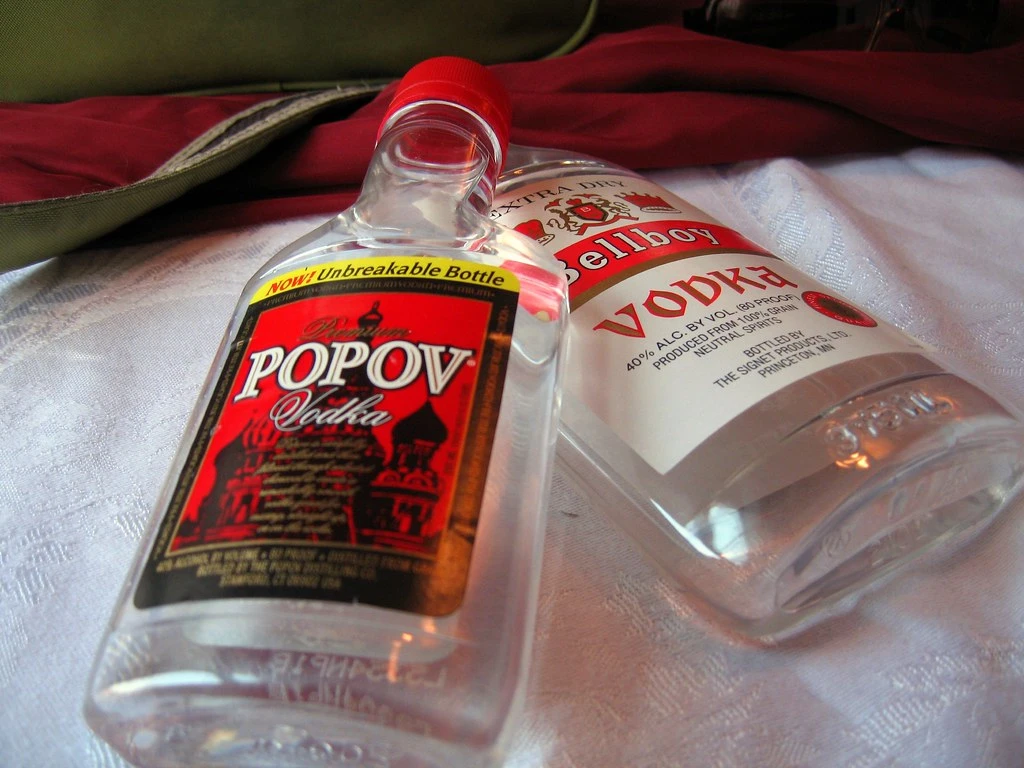
One English-language survey of bottom-shelf vodkas singles out Popov as an especially dismal case, noting that even its basic history — where it’s distilled, how the name was chosen — is oddly hard to pin down.
Popov is made by the British drinks giant Diageo, though you won’t find that fact advertised anywhere. According to the review, when author A. J. Baime, writing a book on the personalities behind the liquor industry, asked Diageo for background on the brand, a company representative reportedly told him they had «no idea who Popov was.»
A history of vodka summarizes Popov’s own production description in just a few words: grain, single distillation, charcoal filtering. That’s essentially the entire official account — a vodka that, by the review’s account, seems to treat its own backstory as a closely guarded corporate secret.
Lacking any real brand history to go on, the review instead collects a handful of the running jokes that have attached themselves to Popov over the years:
- Some upscale restaurants supposedly keep a bottle around not to serve, but to polish the silverware.
- Drinkers joke that running it through a household water filter a few times makes it marginally more tolerable.
- When Popov first switched to plastic bottles, the label reportedly advertised the change as a selling point in itself: an «unbreakable bottle.»
- Comedian Doug Stanhope has joked for years about being «sponsored» by Popov against his will, until the company gets around to sending him a cease-and-desist.
On the Taste
The review doesn’t have much good to say about how it actually tastes, describing the aftertaste and the next-day hangover as the vodka’s real signature — a fairly predictable result, it suggests, of settling for the cheapest possible distillation process.
The final insult: per the review, Popov isn’t meaningfully cheaper than a dozen other bottom-shelf vodkas that are noticeably less unpleasant — so unless even a mid-range bottle is genuinely out of reach, there’s little reason to reach for it.