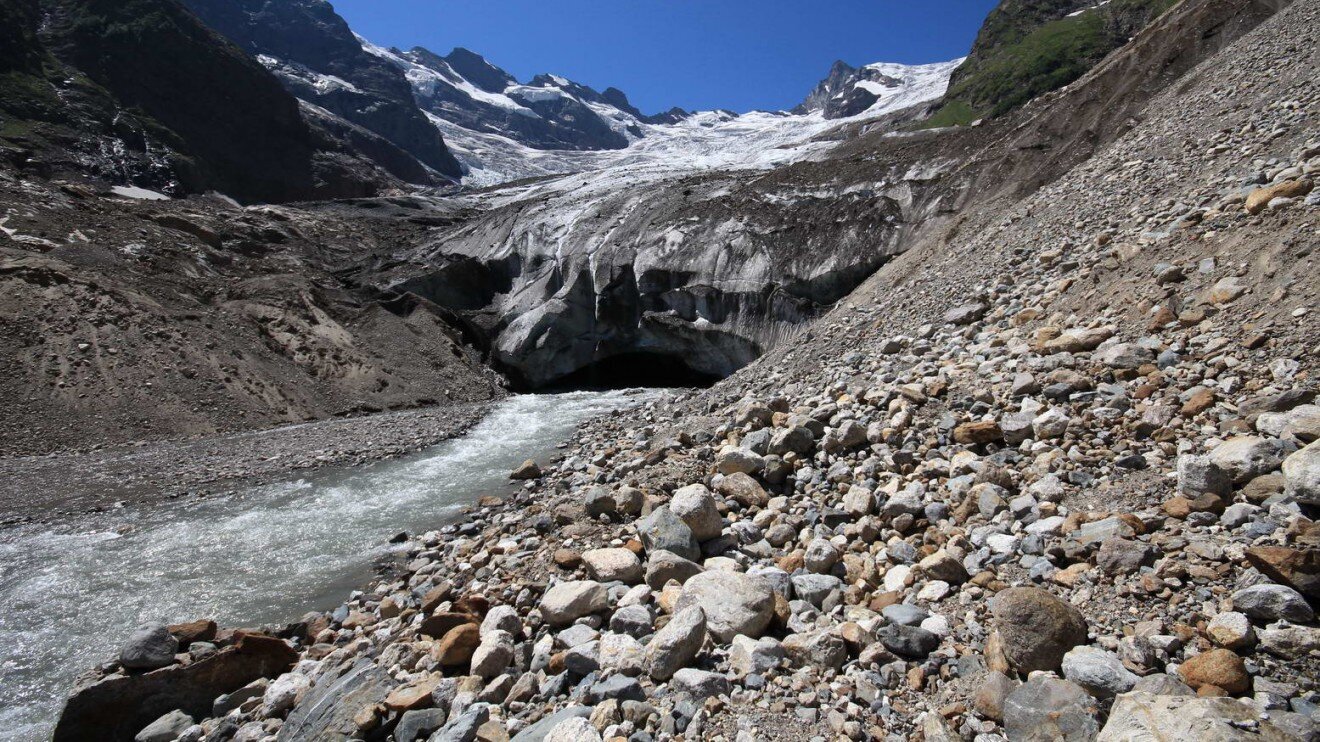
Moraines are geological formations consisting of deposits of various types of debris, carried and accumulated by glaciers. These deposits range from enormous boulders several hundred meters across down to fine clay particles, produced as moving ice grinds down rock.
The main types of moraines
- Ground (basal) moraines — form beneath a glacier and contain rock fragments carried at its base. Once the glacier melts, these moraines form broad layers across the plain.
- Lateral moraines — form along the edges of glaciers, moving along with them.
- Medial moraines — form where two lateral moraines merge, carried by separate glaciers coming together.
- Terminal moraines — deposits that form at a glacier’s leading edge, marking its farthest advance. They often form ridges and hills, frequently becoming natural barriers for glacial lakes.
There are also special forms of moraine deposits:
- Erratic boulders — large rock fragments carried by a glacier over great distances and left behind in «foreign» places.
- Drumlins — elongated hills made of boulder clay, shaped by the movement of the ice.
History of the Term
The term «moraine» was first used to describe the ridges and hills formed by boulders and fine debris at the ends of glaciers in the French Alps. Over time, the concept broadened to include any deposits left behind by glaciers, including ancient tillites — layers of boulder clay formed by prehistoric glaciations.
Where Moraines Occur
Ground moraines are found across territory once covered by ancient glaciers, such as North America (the US, Canada), Northern Europe (Finland, Sweden, Poland), and northern Russia. These deposits create complex landscapes dotted with lakes and marshes, tracing the footprint of ancient glaciation.
Moraines matter for studying the history of ice ages, since their location and structure help reconstruct ancient climate changes and glacier movement.