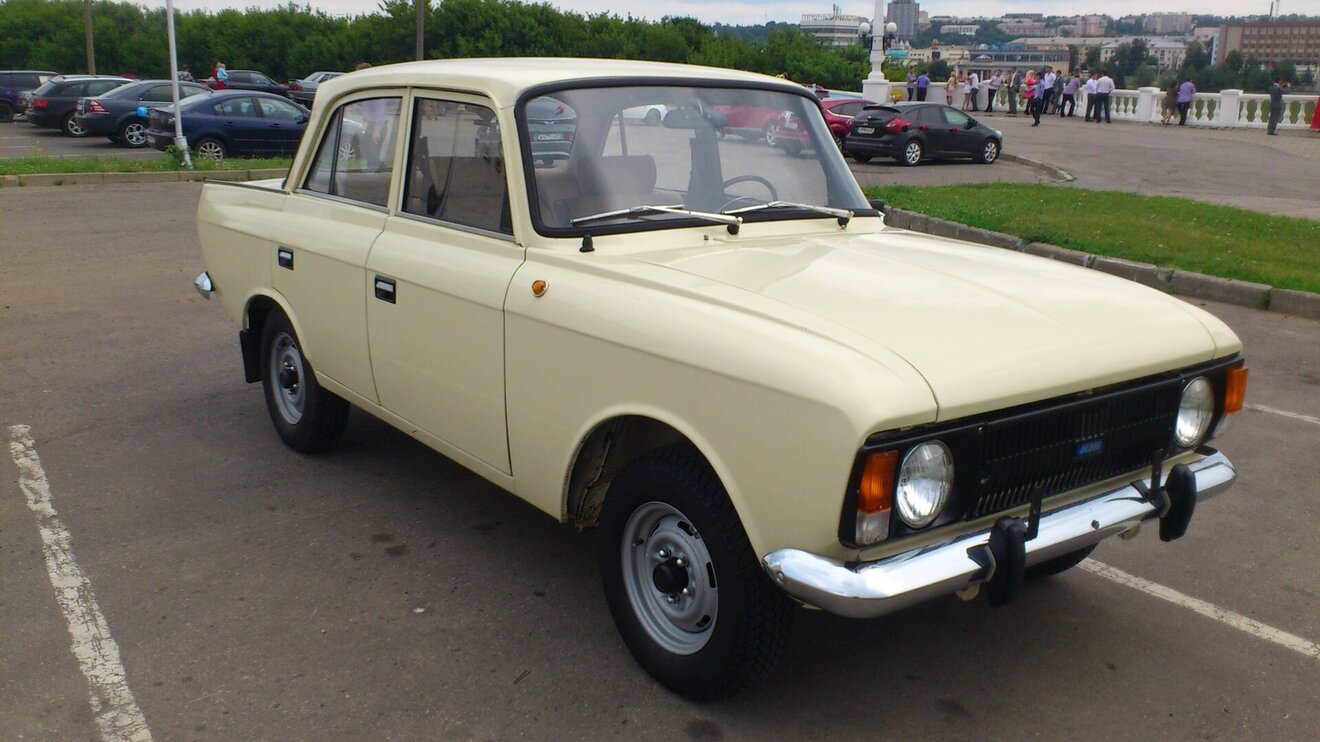
In the early 1990s the Moskvich-412 family of cars, particularly those built in Izhevsk, acquired the nickname «margarine» thanks to the characteristic creamy-yellow body color that really did resemble a block of margarine.
Where the nickname came from
The popular nickname «margarine» attached itself to the Moskvich-412 because of one of its commonest body colors — a pale yellow or cream that genuinely looked like margarine. Cars in that shade were especially common among the output of the Izhevsk automobile plant, whose color range was more limited than Moscow’s AZLK.
By 1993, when the novel takes place, most of the Moskviches on the roads were the 412, since it was the marque’s most numerous and longest-running model. The Izhevsk plant went on producing the 412 right up to the end of the 1990s, whereas Moscow’s AZLK had switched to the modernized 2140 as early as 1976.
Technical features
The Moskvich-412 was a rear-wheel-drive small-class car with a 1.5-liter overhead-camshaft engine producing 75 horsepower. The model’s chief distinction was its UZAM-412 engine, modern for its day, with an aluminum cylinder head and hemispherical combustion chambers.
The car was notable for the simplicity of its construction, its reliability and its indifference to operating conditions. The engine would run on ordinary oils of the AS-8/M-8B type, unlike the more demanding Zhiguli. That made the Moskvich popular with owners, especially in the countryside and at the dacha.
Weak points
The Moskvich-412’s principal defect was its four-speed gearbox, inherited from earlier models. Statistically, ten percent of gearboxes failed to survive even 63,000 kilometers, substantially worse than the VAZ figures.
The engine, for all its power, had poor pulling ability at low revs and required frequent gear changes in town. Full output arrived only above three or four thousand revolutions per minute.
The Moskvich-412 in the early 1990s
By 1993 the Moskvich-412 remained one of the commonest cars in Russia. Many families had received theirs back in Soviet times through the distribution system, or had bought them second-hand. Simple construction and available spare parts made them a popular choice for dacha owners and novice drivers.
The characteristic engine note, the handling quirks and the appearance made the Moskvich a recognizable part of the Russian car population of the time. Despite the arrival of more modern foreign cars, many people went on driving Moskviches because they were reliable and easy to repair in an unstable economy.