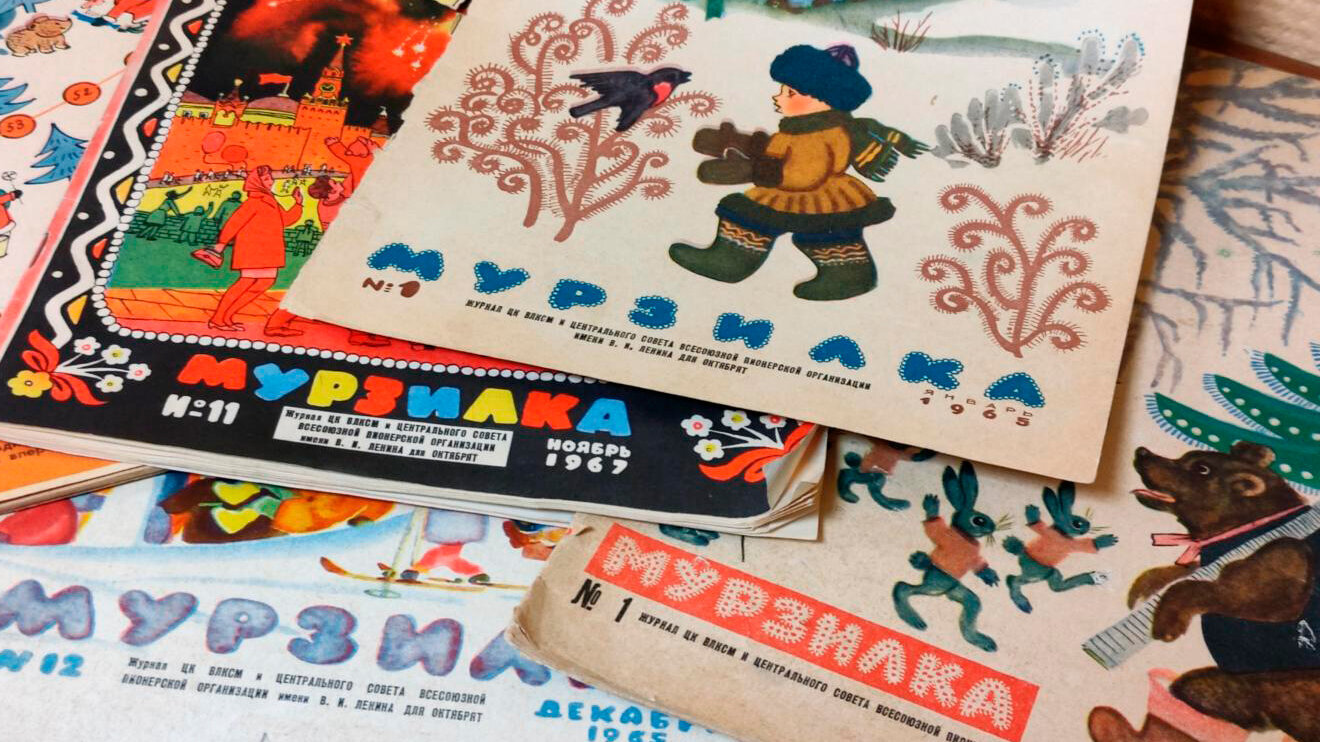
Murzilka, the magazine mentioned in the text as a symbol of children’s reading, was one of the most widely circulated and influential children’s periodicals in the USSR and Russia.
History and the Origin of the Name
Murzilka began publication on May 16, 1924, in Moscow, as a supplement to Rabochaya Gazeta. Its initial print run was just 20,000 copies, but over time the publication grew into a mass phenomenon of Soviet culture. At its peak, in the 1960s–80s, circulation exceeded five million copies — a staggering figure reflecting its enormous popularity.
The magazine’s name has an interesting backstory, with two main theories. According to the first, the magazine was named after a puppy — a character from stories by children’s writer A. A. Fyodorov-Davydov. In his story «Murzilka’s First Day,» which opened the magazine’s first issue, Murzilka is the fourth puppy of a dog named Zhuchka, named by a locksmith named Stepan.
An alternative version, put forward by historian L. Dobrinskaya, traces the name to a much earlier tradition. In 1877, a magazine called Zadushevnoye Slovo began publishing in St. Petersburg, featuring an elf character named Murzilka — dressed in a colored jacket and knitted cap, putting on airs in a tailcoat, top hat, and pointy-toed shoes. The name derived from the Tatar word «murza» (a title of nobility), with the suffix «-ilk» lending it a mildly mocking tone.
The Soviet Era
In the Soviet period, Murzilka became more than a children’s magazine — it was an important tool for raising the next generation. Until 1991, it was the official magazine of the Komsomol Central Committee and the Central Council of the All-Union Lenin Pioneer Organization, aimed at children ages 6 to 12 — the «Little Octobrists,» the youngest age group in the Soviet system of children’s organizations.
For its contribution to raising children, the magazine was awarded the Badge of Honor in 1974, underscoring its recognized importance at the state level.
The evolution of the Murzilka character himself deserves special mention. After stories about the puppy Murzilka stopped running in 1926, artist Aminadav Kanevsky created a new image in 1937 — a fluffy yellow creature in a red beret, a scarf around his neck, and a camera slung over his shoulder. With some modifications, this image became the magazine’s symbol and a familiar character to millions of Soviet children.
Literary Significance
Murzilka played an important role in the development of Soviet children’s literature. Such distinguished writers as Samuil Marshak (who found his footing as a children’s poet in its pages), Sergei Mikhalkov, Elena Blaginina, Boris Zakhoder, Agniya Barto, and Nikolai Nosov all began their careers in its pages — names that make up the golden fund of Russian children’s literature.
The magazine wasn’t limited to fiction. It also ran popular-science articles, material about the Pioneer movement, and educational columns. Especially popular were mystery-adventure serials, such as «The Twelve Agents of Yabeda-Koryabeda,» which ran from 1977 to 1983, pitting the evil sorceress Yabeda-Koryabeda against Murzilka.
The Transitional 1990s
The 1990s were a turning point for the magazine, as for the whole country. After the USSR’s collapse in 1991, Murzilka lost its state backing and its status as the official publication of the Komsomol and the Pioneer organization. Until 1992, it was published by Molodaya Gvardiya before passing to new management structures.
Starting November 17, 1993, the magazine was published by the closed joint-stock company «Editorial Office of the Magazine Murzilka» (later reorganized as an LLC). During this period, the publication defined itself as a «monthly magazine for children,» maintaining continuity with the Soviet era while adapting to new realities.
By the mid-1990s, when the novel in question is set, Murzilka was going through hard times. Circulation had dropped sharply compared to the Soviet period, when it was measured in millions of copies. The economic hardships of the transition, competition from Western publications, and shifting reader preferences all posed serious challenges for the traditional children’s magazine.
The Cultural Weight of the Reference
Mentioning Murzilka in the context of a novel set in 1996 carries deep symbolic meaning. For the generation raised in the USSR, this magazine was synonymous with childhood, innocence, and carefree ease. When a character says the guys read «Murzilka, best case, and even that’s not certain,» it underscores their immaturity and unreadiness for life’s harsh realities.
In the 1990s, Murzilka was perceived as a symbol of a bygone era, when life seemed simpler and easier to understand. A childhood spent reading this magazine stood in stark contrast to the brutal reality of the «wild ‘90s,» where young people, barely grown up, found themselves in dangerous situations.
Recognition and Records
Despite the hardships of the transitional period, the magazine not only survived but earned international recognition. In 2011, Murzilka was entered into the Guinness Book of World Records as the longest continuously published children’s magazine. This underscores the publication’s unique standing in the world of children’s periodicals.
In 2014, the magazine’s staff received the Russian Federal Government Prize in the field of mass media, «for preserving the finest traditions of Russian children’s literature, a significant contribution to raising the younger generation, and in honor of the magazine’s 90th anniversary.»
Today
In the 21st century, Murzilka transformed into a full-color glossy publication while preserving its traditions. It continues to publish the best examples of contemporary Russian children’s literature, along with columns on Russian art, history, and nature, plus educational and developmental content.
Natalia Dmitrievna Kholendro has served as the magazine’s chief artist since 1994, ensuring continuity of its artistic traditions. Its pages feature both classics of children’s literature — Yakov Akim, Sergei Mikhalkov, Irina Tokmakova — and contemporary authors like Andrei Usachev, Marina Druzhinina, and Anastasia Orlova.
So the mention of Murzilka in a novel set in 1996 precisely captures the spirit of the era and serves as a metaphor for childhood naiveté set against the brutal reality of a transitional time. Having survived nearly a century, the magazine remains both witness to and participant in the changes in Russian society, preserving a connection between generations through children’s literature.