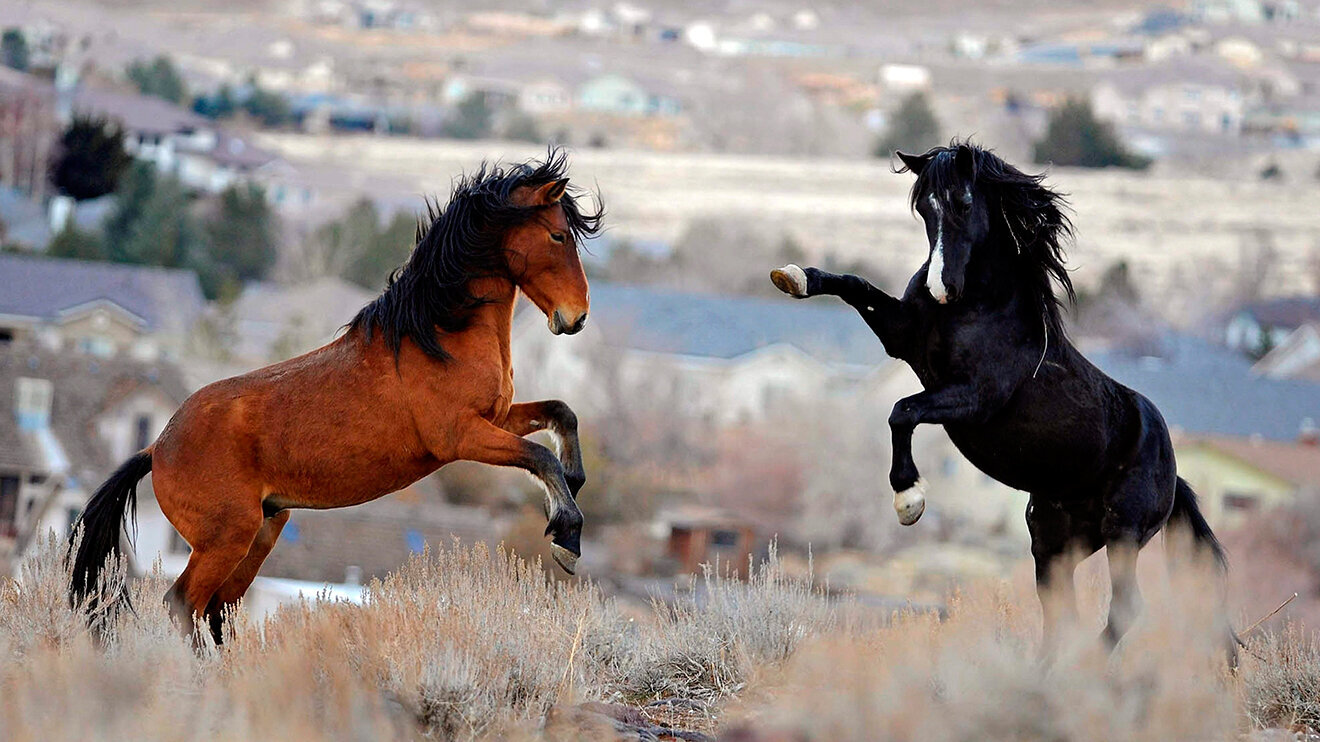
The mustang (from Spanish mestengo/mesteño — literally "mixed" or "stray") is a feral domestic horse that became a symbol of freedom in the culture of many peoples.
The origin of mustangs
Mustangs are descended from domestic horses brought to the New World by European colonists in the 16th century. Many of these horses, for various reasons, broke away from people and went feral: some fled from pastures, others gained their freedom after losing a rider in battle. This is how mustang populations formed — hardy, fast, and undemanding horses.
The word "mustang" traces back to the Latin root mixtus (mixed). The Spanish word mestengo (used in Mexico), mesteño, or mostrenco, means "stray animal," "wild," or "ownerless." The term later entered American English, where it was transformed into "mustang."
Interesting fact
In the 19th century, roughly 2 million mustangs roamed the American prairies. By the 1960s, hunting had nearly wiped them out.
Distribution and current status
Historically, mustangs were found both on the prairies of North America and on the pampas of South America. In the 19th century, large numbers of semi-wild horses roamed Argentina and Paraguay. These horses, also called cimarrones, descended from a handful of Andalusian stallions and mares left behind in 1537.
By the early 20th century, the mustang population in the New World had grown to around 2 million head. However, intensive hunting (for meat and hide) and the expansion of cattle pasture led to a sharp decline in their numbers. In 1971, mustang hunting was banned in the United States, and by the early 1980s their population had recovered to more than 50,000.
Today mustangs are found in the states of California, Arizona, Utah, Nevada, and Wyoming. Populations of feral horses also exist in Eurasia, including in Russia — in the area of the Manych-Gudilo nature reserve and on some islands of the Kuril chain.
Characteristics of mustangs
Mustangs are known for their endurance, speed, and undemanding nature. Most stand 142–152 cm at the withers (14–15 hands) and rarely exceed 163 cm (16 hands). Under the pressure of natural selection, only the strongest, most resilient traits have been preserved in these horses.
Mustang coloring can be anything, but dun coloring and so-called "primitive markings" are especially common — a dark stripe along the spine, horizontal stripes on the legs, and a dark "mask" on the muzzle, all characteristic of ancient horse breeds.
Mustangs in culture
Mustangs became a symbol of freedom and independence in the culture of many peoples. They are the heroes of literary works, such as Mayne Reid's novel The Headless Horseman (1865), Ernest Thompson Seton's story "The Pacing Mustang" (1930), and many others. Films have been made based on these works, including the full-length animated feature Spirit: Stallion of the Cimarron (2002).
In a metaphorical sense, "mustangs" is often used for freedom-loving, independent people unwilling to submit to generally accepted norms and constraints.
In the context of the novel
The use of the mustang image in a novel about Russia in 1993 is symbolic. That period was seen by many as an age of freedom after the collapse of the USSR — an untamed freedom, sometimes dangerous, but alluring all the same. The comparison to mustangs underscores a drive for independence, a refusal to submit to the system, and a readiness to take risks for the sake of freedom. The image of the mustang fuses the romance of wild nature with an anxious sense of uncertainty — traits characteristic of the Russian 1990s.