The dialogue between Fyodor and Zhorik reflects real criminal schemes widespread in early-1990s Russia, at a time when the vehicle registration system was undergoing radical change.
Historical context: a changeover in paperwork
The conversation takes place on July 4, 1993 — right in the middle of the transition in the car registration system. Just two weeks earlier, on May 18, 1993, the Russian government had adopted Resolution No. 477, "On the Introduction of Vehicle Passports," which radically changed the procedure for registering cars.
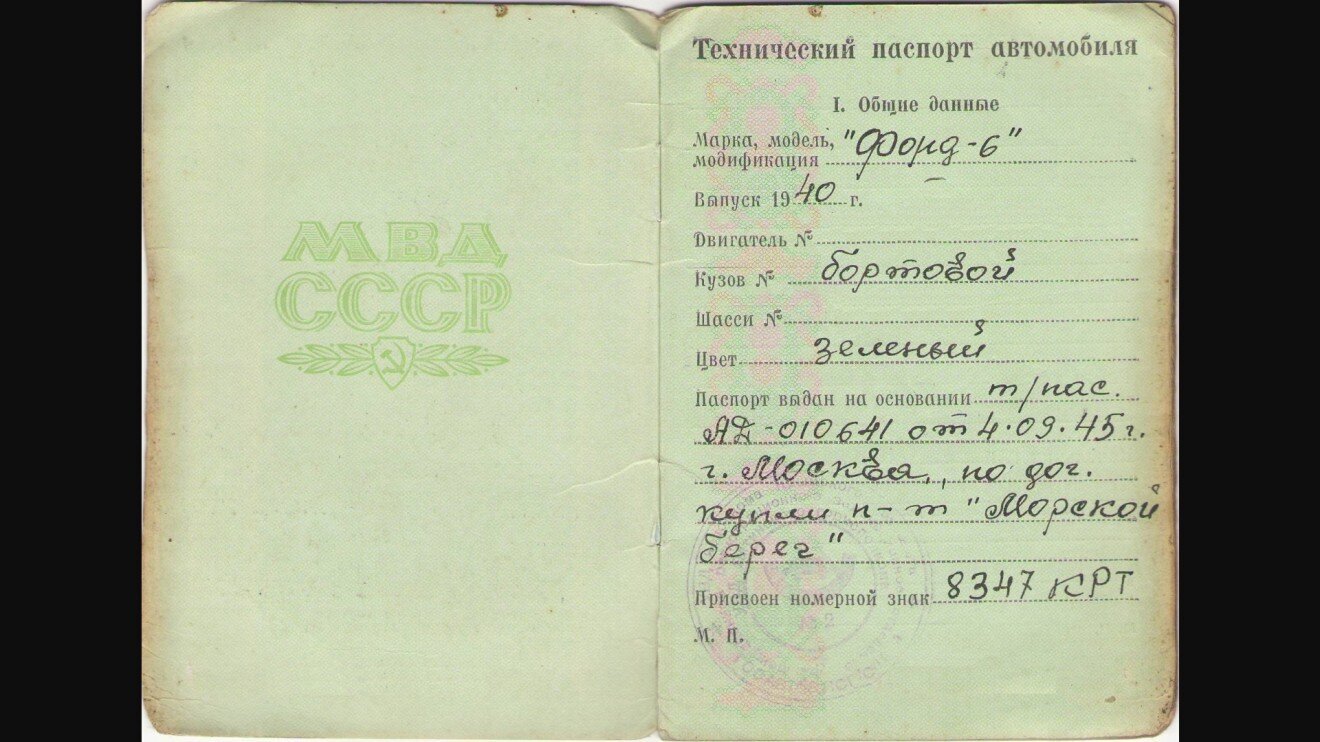
Before 1993, the USSR and Russia used a system of technical passports (tekhpasports) — documents that combined the functions of a modern vehicle passport (PTS) and a registration certificate. Starting July 1, 1993, a fundamentally new, two-tier paperwork system was introduced.
How the criminal scheme worked
Fyodor's remark that "no one has a clue when the tekhpasport for the one-twenty-four is coming" reflects a genuine problem of the transitional period. The VAZ-2124 (a "Zhiguli" variant) fell into the paperwork gap right at the moment the system changed, creating legal loopholes for fraudsters.
The criminal scheme described in the text worked as follows:
- Stealing a car — criminals would steal a functioning car of a particular make and model
- Finding a "donor" — they would buy, for a minimal price, a badly damaged car of the same make and model, but with clean paperwork
- Re-stamping the numbers — the engine and body numbers from the wrecked "donor" were re-stamped onto the stolen car
- Legalization — the stolen car was sold off as the repaired "donor," complete with genuine documents
Why the scheme worked so well in 1993
The transitional period created ideal conditions for this kind of fraud, for several reasons:
Paperwork chaos. The simultaneous existence of old tekhpasports and new PTS documents created confusion within the traffic police. Officers could not always quickly verify the authenticity of documents in different formats.
Weak databases. Centralized electronic databases did not yet exist. Verifying a document's authenticity was done mostly by eye, making it easier to get away with forged or "re-stamped" numbers.
Gaps in the law. The new legislation had not yet had time to cover every possible situation, especially for cars caught in transition between the old and new registration systems.
The technical side of re-stamping numbers
Changing a vehicle's identification numbers required certain skills and equipment. The engine number, located on the cylinder block, and the body number, stamped on a designated panel, were mechanically removed, after which new numbers were applied using stamps or engraving tools.
A well-done re-stamping job was practically undetectable on a surface inspection, especially given that in 1993, traffic police officers had no modern means of metal analysis or of detecting signs of mechanical tampering.
The economics of it
Fyodor's mention of specific models is no accident. In 1993, the difference in price between a wrecked car with paperwork and a stolen, functioning car could be 10 to 15 times over. This made the scheme extremely profitable, with relatively low risk of getting caught.
The phrase "you can run it" points to the existence of informal channels for checking cars — likely through connections within the traffic police or among car resellers — a characteristic feature of the auto market of the time.