The History of the Museum’s Creation
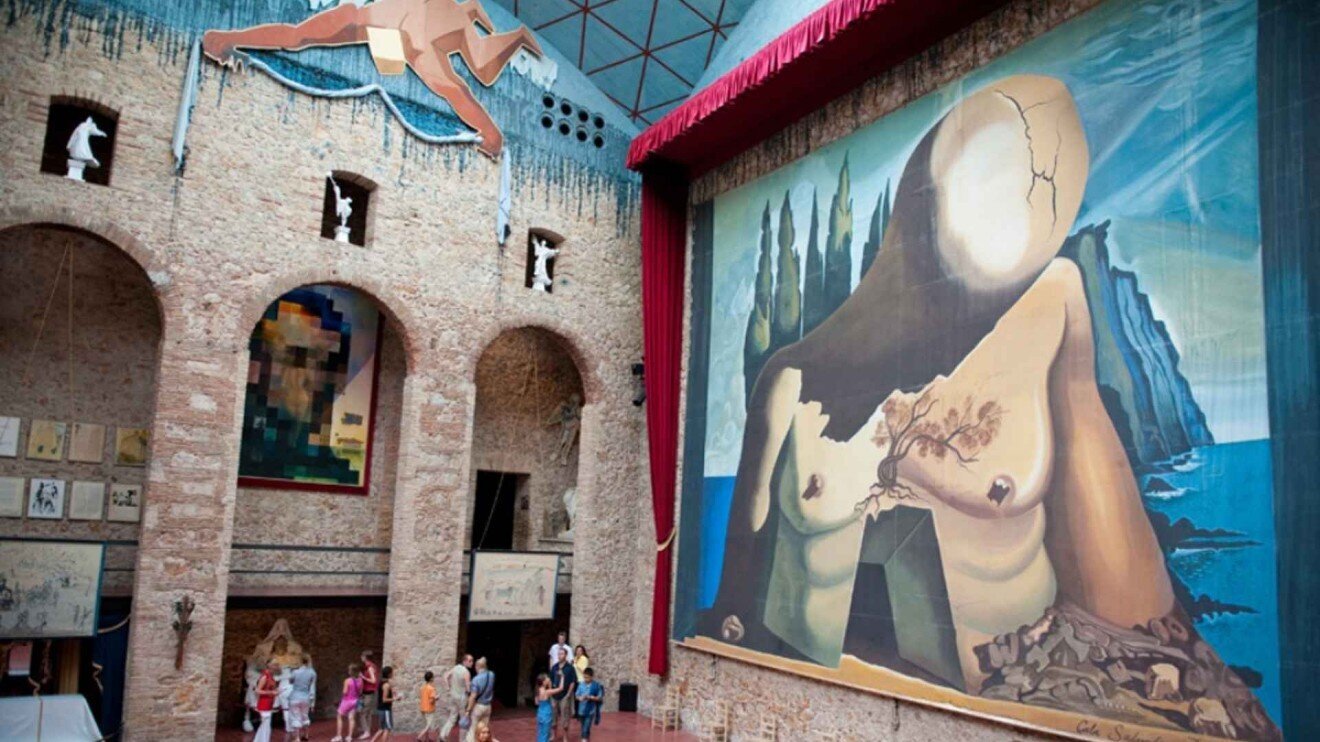
The Dalí Theatre-Museum in the Catalan city of Figueres is a unique creation of the great surrealist, one he himself called his last work. The museum officially opened on September 28, 1974, though the story of its creation began much earlier.
The museum’s central building is the former town theater, built in 1849 by architect Josep Roca i Bros. It was here, in 1918, that fourteen-year-old Dalí first exhibited his work at a group show alongside artists Josep Bonaterra Gras and Josep Muntö Puig. The theater was destroyed during the Spanish Civil War — set on fire by National Guard soldiers in February 1939.
The Birth of the Idea
One summer evening, Dalí noticed the pockmarked brickwork of the ruined theater. Inspecting the ruins alongside artist Joaquim Bech de Careda, he was struck by the building’s architecture and initially proposed using the site for musical performances. The proposal went nowhere.
The turning point came in May 1961, when Dalí told the mayor of Figueres, Ramon Guardiola, and his trusted photographer Melitó Casals of his intention to build an unusual museum there. Despite the artist’s enthusiasm, he had to wait a full decade before his dream started to take shape.
An Interesting Fact
Dalí originally planned to exhibit only reproductions of his works in the museum, insisting: «Photographs have one advantage: they’re better than the original works.» But under pressure from the authorities, he had to agree to give the museum his original paintings.
Architectural Features
The silhouette of the Theatre-Museum became a symbol of international pop art. Its geodesic dome, built by architect Emilio Pérez Piñero in January 1973, is instantly recognizable. The roof over the museum’s stage used a glass-and-steel structure inspired by the work of American designer Richard Buckminster Fuller.
Over the course of 1984, the building’s walls were gradually covered with loaves of peasant bread. The rhythmic repetition of the loaves was meant to produce an effect similar to the shell-covered mansion Casa de las Conchas in Salamanca, or the Italian Palazzo dei Diamanti. Dalí had already tried this technique in the mid-1950s on his house in Cadaqués, reflecting his reverence for bread.
The Symbolism of Bread
As Dalí himself put it: «Bread has been one of the oldest fetishistic and obsessive subjects in my work; it is the number one thing I’ve remained most faithful to.»
Eggs as a Symbol
The giant eggs decorating the building are a recurring symbol in Dalí’s work. Ampurdà eggs, especially the yellow ones, are famous for their quality and prized on local markets.
Expanding the Complex
On October 12, 1983, the neighboring Gorgot house was joined to the theater, and the ensemble came to include a tower (now known as the Galatea Tower) and part of the town’s medieval walls. The Galatea Tower later became the artist’s final residence.
After the artist’s death, the Gala-Salvador Dalí Foundation acquired the building adjoining the Galatea Tower. The structure was converted into a museum gallery, which, since 2001, has housed the jewelry collection Dalí designed for Owen Cheatham.
The Museum’s Collection
The museum holds the largest and most varied collection of the great surrealist’s work, built around his own personal collection. Visitors can see famous pieces such as:
- «The Spectre of Sex Appeal» (1932)
- «Portrait of Gala with Two Lamb Chops Balanced on Her Shoulder» (1933)
- «Basket of Bread» (1945)
- «Galatea of the Spheres» (1952)
Alongside the paintings, the museum displays sculptures, three-dimensional collages, and other unusual works by the great Catalan artist.
The Mae West Room
One of the museum’s most memorable installations is the room shaped like the face of American actress Mae West. Between 1934 and 1935, the artist turned the actress’s face, taken from a retouched photograph, into a living room. In his conception, the artist went further than usual: he built the face-room in three dimensions.
The red couch shaped like scarlet women’s lips is the central element of this installation. A stunning combination of giant wigs, pointillist paintings, nostrils fitted with burning logs, and a lip-shaped couch creates an unforgettable surrealist space.
Other Artists in the Collection
The Dalí Museum also displays a number of works by other artists from Dalí’s own collection, ranging from El Greco to Marcel Duchamp, along with works by Dalí’s friends Antoni Pitxot and Evarist Vallès.
A special place in the collection belongs to two works by William-Adolphe Bouguereau — «The Bather» (1870) and «After the Bath» (1875) — demonstrating the range of the great surrealist’s artistic tastes.
Salvador Dalí’s Crypt
Per the artist’s own instructions, he was buried at the museum with full honors on January 25, 1989. The genius’s dying wish — to merge with this museum tailored to his own measure — was entirely in character.
Salvador Dalí’s embalmed body rests in a crypt beneath the dome, per the artist’s own wishes. The upper part of the crypt is capped with a white marble gravestone, set into the floor of the hall beneath the glass dome.
Many visitors, strolling across the slab, have no idea Dalí’s body lies beneath it. It’s the master’s final surrealist joke — even after death, he continues to surprise and mystify the public.
The Museum’s Philosophy
«I want my museum to be a single block, a labyrinth, a giant surrealist object. It will be an absolutely theatrical museum. Those who come here will leave with the feeling of having dreamed a theatrical dream.»
The Museum’s Uniqueness
The Dalí Theatre-Museum isn’t simply a collection of artworks, but a unified artistic work created by the master himself. Every element of the building, from the geodesic dome to the loaves of bread on the walls, is part of one overarching concept.
The museum is a grand installation, where architecture, painting, sculpture, and theatricality merge into a single whole. It’s a place where reality and dream, life and death, art and the everyday intertwine in the true spirit of Surrealism.
Visiting the museum isn’t an ordinary look at an exhibition, but an immersion into Dalí’s world of fantasies and visions, a journey through the labyrinths of his mind. Every visitor becomes a participant in a grand theatrical performance that continues even after its creator’s death.
The Jewelry Collection
Since 2001, the museum has held the jewelry collection Dalí designed for Owen Cheatham. Works in pearl, ruby, sapphire, gold, and diamond fittingly crown a quixotic undertaking whose idea came to Dalí one summer evening as he watched the reflection of the bell tower of St. Peter’s gradually vanish in a drying puddle.
This collection demonstrates the universality of Dalí’s genius — his ability to work in any material and create masterpieces across the most varied art forms.
Conclusion
The Dalí Theatre-Museum in Figueres remains one of the most unusual and striking museums in the world. It’s a place where art breaks free of traditional expectations and becomes part of life itself. Here, every visitor can touch Dalí’s genius and feel like part of his surrealist universe.
The museum continues to live and grow, staying true to its creator’s vision — to be a «giant surrealist object» that gives visitors the sensation of a «theatrical dream.» It’s not just a museum, but a living work of art that continues to surprise and inspire people from around the world.