The song's content and meaning
The song is a lyrical narrative told from the point of view of a sixteen-year-old young man walking home to his hometown along the ring road. It's not just a story about the way home — it's a manifesto of a generation standing on the threshold of change.
The song's hero embodies the image of a Soviet young man of the late 1980s: he keeps pace with his times and his country, is actively involved in sports, leads a healthy lifestyle, criticizes capitalism, and supports the policy of détente.
The central theme of the piece is the promise to "live a new way now" — not just for himself, but for his hometown, his neighborhood, and the whole country. This phrase, used as the title, became a kind of slogan of the perestroika era, when young people sought change and believed in the possibility of renewing society.
The symbolism of the title
The song's alternate title — "Lyubertsy" — refers to the town outside Moscow that, in the 1980s, became a symbol of working-class youth and the informal youth movement. The Lyubertsy "gopniks" (muscle-bound toughs) and their subculture were well known throughout the USSR, which gave the song extra recognizability.
The history of the founding of Lyube
The idea of forming the band belongs to composer and producer Igor Matvienko, who in 1987 was working at the "Rekord" popular-music studio. In his mind, the concept of a new musical group took shape — one radically different from the familiar late-Soviet pop-variety scene.
The band's concept
Matvienko envisioned a group whose work would be close to the national-patriotic direction, with elements of:
- • Russian folklore
- • Military themes
- • The bard-song (author's song) tradition
- • Lyrical works
- • Rock music with elements of folk song
Nikolai Rastorguev — an unexpected choice
The role of vocalist and frontman was taken on by Nikolai Rastorguev, who at that point had years of experience in the bands "Leysya, Pesnya," "Shestero Molodykh," "Rondo," and "Zdravstvuy, Pesnya." His candidacy, however, was far from obvious.
Igor Matvienko recalled
"Among others, a young, well-fed man named Nikolai Rastorguev showed up, who by his looks didn't fit the rock-band format at all. The genre called for lean, gaunt musicians, and here was this strapping fellow… But he learned the songs and came to the second audition. He sang really brilliantly. In the end, Kolya convinced me he was exactly what the band needed, and he was right."
Several songs from the repertoire of the ensemble "Zdravstvuy, Pesnya" ("Dyadya Vasya" and "Tyotya Doktor"), as performed by Rastorguev, later made it onto Lyube's first album.
The band's birth: January 14, 1989
Recording of the first songs began on January 14, 1989, at the "Zvuk" studio under the direction of Andrei Lukinov. This date is considered the official birthday of the band Lyube.
The band's original lineup
- Nikolai Rastorguev — vocals
- Alexei Gorbashov — guitar (from the band "Mirage")
- Viktor Zastrov — guitar
- Anatoly Kuleshov — tenor (chorus)
- Alexei Tarasov — bass (chorus)
- Igor Matvienko — composer, artistic director
The first songs
The first tracks recorded were:
- • "Lyubertsy" ("We'll Live a New Way Now")
- • "Batka Makhno"
Later recorded and later popular: "Dusya-Agregat," "Atas," "Ne Gubite, Muzhiki," and others.
The origin of the name "Lyube"
Nikolai Rastorguev himself came up with the band's name. The word "lyube" was familiar to him from childhood, and comes from the Ukrainian "lyube." In youth slang, it meant "any old thing, whatever," reflecting the group's intention to work across various genres and sing for everyone.
Songwriters and composers
Most of the music for the band was written by Igor Matvienko, who also acted as producer and arranger. The lyrics for the debut songs were created by two talented poets:
Alexander Shaganov
A poet who had already made a name for himself working with the rock band "Chyorny Kofe" (the song "Vladimirskaya Rus'") and with Dmitry Malikov (the song "Do Zavtra"). His lyrics were noted for their depth and philosophical take on contemporary life.
Mikhail Andreyev
A poet from Tomsk, who had previously written for Matvienko's group "Klass" and the Leningrad group "Forum." His verse was noted for its imagery, and its closeness to folk art.
Mikhail Andreyev recalled
"I came to Moscow to receive the Lenin Komsomol Prize, and decided to meet with Igor Matvienko at a rehearsal of a very promising band. I gave them my song 'Kletki' and decided to see what would come of it. I arrived early and sat down on a windowsill to wait, and there was a young man sitting there, cracking sunflower seeds. We got to talking. That was young Kolya Rastorguev."
First performances and recognition
Lyube's first tour began in late March 1989. Concerts were held in Pyatigorsk and Zheleznovodsk, but brought no success — the halls were nearly empty. It was a tough start for the new band.
The touring lineup (1989)
- Nikolai Rastorguev — vocals
- Alexander Nikolayev — bass guitar
- Vyacheslav Tereshonok — guitar
- Rinat Bakhteyev — drums
- Alexander Davydov — keyboards
The television breakthrough
A real breakthrough came thanks to several landmark appearances:
October 14, 1989
A performance on the quiz show "What? Where? When?" with the song "Roulette"
December 1989
An appearance on Alla Pugacheva's "Christmas Meetings"
1990
Laureate of the "Song of the Year" festival with the track "Atas"
The birth of a stage image
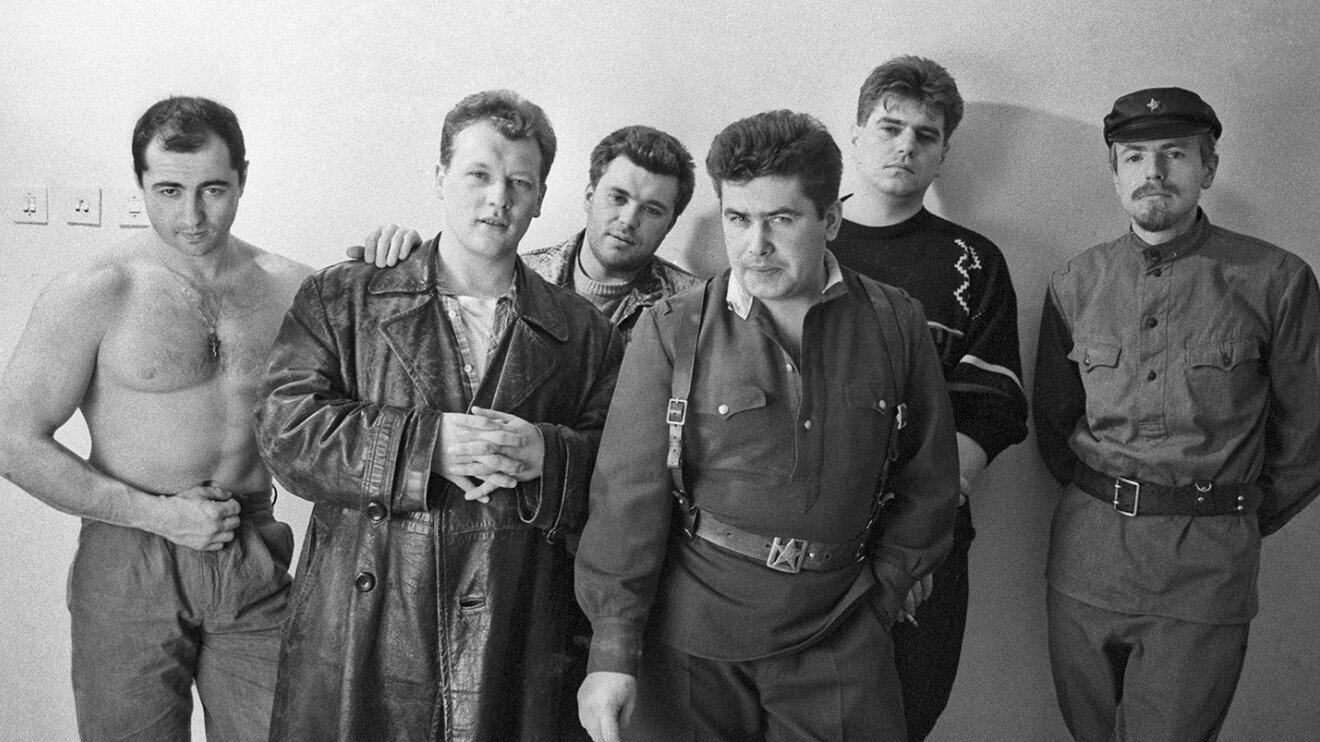
It was at Alla Pugacheva's "Christmas Meetings" that Nikolai Rastorguev's famous stage image in military uniform was born. The idea belonged to Pugacheva herself, who said during rehearsal: "What did people wear after the war? Zheglov, Sharapov… tunics, boots." A uniform of the 1939 model was rented from the Soviet Army Theater for performing "Atas" and "Ne Gubite, Muzhiki."
The first album and commercial success
In 1989, the first cassette album, "We'll Live a New Way Now", was released, including 14 of the band's songs. The album opened with Rastorguev's own words:
"Hi, friends! My name is Nikolai Rastorguev, I'm the lead singer of the band 'Lyube,' and now you're about to hear our band's first album…"
Between the songs were audio interludes (intros) with information about the band, the songwriters, and the recording studio. With the release of this album, Igor Matvienko founded his own production company, and Lyube became its first act.
The track listing of "We'll Live a New Way Now" (1989)
The album included songs that became classics of Russian rock music:
- • We'll Live a New Way Now (Lyubertsy)
- • Batka Makhno
- • Atas
- • Ne Gubite, Muzhiki
- • Dusya-Agregat
- • Dyadya Vasya
- • Tyotya Doktor
- • Stantsiya Taganskaya
- • Kletki
- • Za Tebya
- • Tak Vsegda
- • Noch'
- • Roulette
- • Yolki-Palki
Commercial success
In its first three years, the band gave around 800 concerts, drawing more than three million people. This was a phenomenal result for the Russian rock scene of the time.
Musical style and features
It's hard to pin the band Lyube down to any single style, since the musicians drew on elements of various genres in their work:
Musical elements
- Rock music — the foundation of the sound
- Russian folk song — melodic elements
- The bard-song tradition — the lyrical component
- Chanson — thematic motifs
- Soviet song — ideological content
- Pop music — commercial appeal
Performance features
- Vocal delivery with frequent use of backing vocalists
- Extended choral parts in some tracks
- A brutal delivery — hard rhythms, the intensity of rock-folklore
- National-patriotic themes
- Elements of military song and folklore
Stage image
The band originally performed in black tank tops and checked trousers, matched with brutal music. Lyube kept up this image until the song "Ne Valyay Duraka, Amerika!" ("Don't Play the Fool, America!"), after which the band shifted to military themes and put on tunics.
Cultural significance and influence
"We'll Live a New Way Now" became not just a musical hit, but a cultural phenomenon, reflecting the mood of an entire generation at the turn of the 1980s and 1990s.
Social context
The song appeared during perestroika, when Soviet society was going through fundamental change. The promise to "live a new way" resonated with the public mood.
Youth culture
The image of the sixteen-year-old hero of the song became a symbol of Soviet youth striving for change, and believing in the possibility of the country's renewal.
A musical revolution
The band Lyube showed that rock music could be patriotic and accessible to a wide audience, without losing its energy and contemporary edge.
Legacy
The band's debut song laid the groundwork for all of Lyube's subsequent work, and defined its place in the history of Russian popular music. The phrase "we'll live a new way now" became a catchphrase, still used in various contexts today as a symbol of the aspiration for change and renewal.
Conclusion
"We'll Live a New Way Now" became the starting point for one of the most successful and influential bands in the history of Russian popular music. It captured the spirit of a time when the country stood on the threshold of fundamental change, and young people believed in the possibility of building a better future.
Created at a turning point in history, this song remains relevant today, reminding us that the aspiration for change and renewal is an eternal need of the human spirit. The history of Lyube began with this song, and it will forever remain a symbol of a time when it seemed that everything really could be changed for the better.
"We'll Live a New Way Now" — not just a song, but the manifesto of a generation that believed in the possibility of change and was ready to take responsibility for the future of its country.