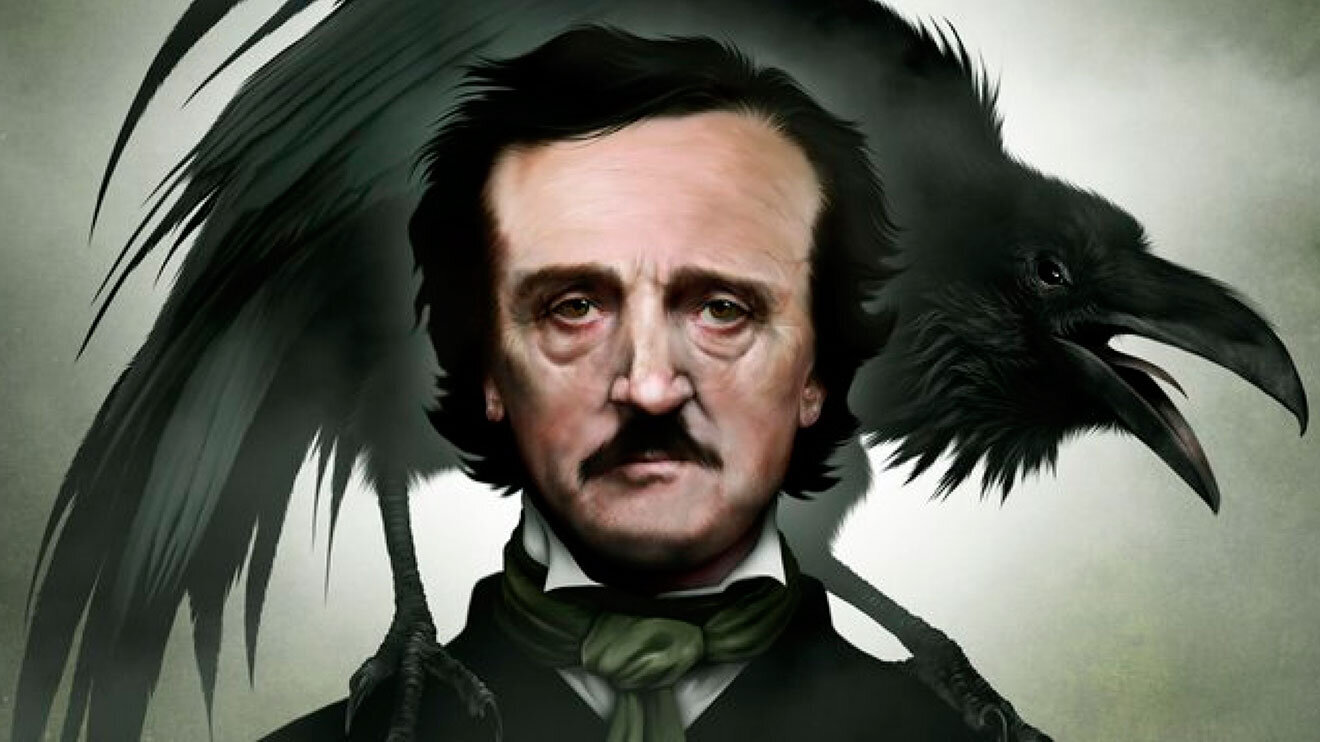
One of the most famous works in the history of world literature
«The Raven» is a poem by the American writer Edgar Allan Poe, first published in 1845.
History of Its Creation and Publication
«The Raven» first appeared on January 29, 1845, in the New York newspaper the «Evening Mirror.» It was soon reprinted in the «American Review» under the pseudonym «Quarles.» The poem brought Poe the recognition he had long sought, though it did little to relieve his financial troubles.
Poe worked on the poem for several months, carefully choosing every word and refining its rhythmic structure. In his essay «The Philosophy of Composition» (1846) he described the making of «The Raven» in detail, claiming to have followed a methodical approach to composing the poem — though many scholars regard the essay more as a retrospective rationalization of the creative process.
Content and Meaning
The poem tells of an unnamed narrator tormented by the loss of his beloved Lenore. At midnight in December, a talking raven flies into his room. To every question the narrator asks, the bird answers with a single phrase: «Nevermore.» Bit by bit, the exchange with the raven becomes an exploration of grief, madness, and hopelessness.
The Poem’s Principal Themes
The recurring word «Nevermore» became a symbol of the inescapability of fate and the impossibility of recovering what has been lost. The raven in the poem serves as a messenger from another world, a symbol of death and otherworldly forces.
Artistic Features
«The Raven» is marked by virtuosic technique. Poe used a complex rhyme structure, internal rhymes, alliteration, and assonance to create a hypnotic effect. The poem is written in trochaic octameter with the refrain «Nevermore» closing each stanza.
The musicality of the verse, its brooding atmosphere, and its symbolism made «The Raven» one of the key works of the Romantic era and shaped the development of symbolism in world poetry.
Influence on Culture
The poem has had an enormous influence on world culture. «The Raven» has been translated into many languages, including celebrated Russian renderings by Konstantin Balmont and Valery Bryusov. The image of the raven croaking «Nevermore» has become a cultural archetype, appearing throughout literature, film, and music.
A Biographical Note on the Author
Edgar Allan Poe (January 19, 1809 – October 7, 1849) was an American writer, poet, literary critic, and editor, and a leading figure of American Romanticism. He is credited with shaping the modern detective story and the genre of psychological fiction.
Poe was born in Boston to a family of actors. Orphaned in early childhood, he was taken in by the wealthy merchant John Allan, though never formally adopted. His relationship with his foster father was difficult and eventually ended in a complete break.
Poe’s life was marked by hardship and tragedy. He attended the University of Virginia but was forced to leave because of debt. He served in the army and worked as an editor at various magazines, but was constantly beset by financial trouble. In 1836 Poe married his cousin Virginia Clemm, who was just thirteen at the time. Her death from tuberculosis in 1847 was a devastating blow.
Poe himself died on October 7, 1849, in Baltimore, under circumstances that remain mysterious. The exact cause of his death is still debated.
Poe’s body of work includes poems, short stories, one novel, and literary criticism. He is regarded as the founder of the detective genre and a master of the Gothic tale and psychological fiction. Among his best-known works, besides «The Raven,» are «The Fall of the House of Usher,» «The Gold-Bug,» «The Murders in the Rue Morgue,» and «The Masque of the Red Death.»
Poe’s literary influence is immense — his work shaped the Symbolists, the Decadents, the Surrealists, and countless other writers and poets. Edgar Allan Poe remains one of the most enigmatic and influential figures in the history of world literature.
The Raven
Once upon a midnight dreary, while I pondered, weak and weary,
Over many a quaint and curious volume of forgotten lore—
While I nodded, nearly napping, suddenly there came a tapping,
As of some one gently rapping, rapping at my chamber door.
“’Tis some visitor,” I muttered, “tapping at my chamber door—
Only this and nothing more.”
Ah, distinctly I remember it was in the bleak December;
And each separate dying ember wrought its ghost upon the floor.
Eagerly I wished the morrow;—vainly I had sought to borrow
From my books surcease of sorrow—sorrow for the lost Lenore—
For the rare and radiant maiden whom the angels name Lenore—
Nameless here for evermore.
And the silken, sad, uncertain rustling of each purple curtain
Thrilled me—filled me with fantastic terrors never felt before;
So that now, to still the beating of my heart, I stood repeating
“’Tis some visitor entreating entrance at my chamber door—
Some late visitor entreating entrance at my chamber door;—
This it is and nothing more.”
Presently my soul grew stronger; hesitating then no longer,
“Sir,” said I, “or Madam, truly your forgiveness I implore;
But the fact is I was napping, and so gently you came rapping,
And so faintly you came tapping, tapping at my chamber door,
That I scarce was sure I heard you”—here I opened wide the door;—
Darkness there and nothing more.
Deep into that darkness peering, long I stood there wondering, fearing,
Doubting, dreaming dreams no mortal ever dared to dream before;
But the silence was unbroken, and the stillness gave no token,
And the only word there spoken was the whispered word, “Lenore?”
This I whispered, and an echo murmured back the word, “Lenore!”—
Merely this and nothing more.
Back into the chamber turning, all my soul within me burning,
Soon again I heard a tapping somewhat louder than before.
“Surely,” said I, “surely that is something at my window lattice;
Let me see, then, what thereat is, and this mystery explore—
Let my heart be still a moment and this mystery explore;—
’Tis the wind and nothing more!”
Open here I flung the shutter, when, with many a flirt and flutter,
In there stepped a stately Raven of the saintly days of yore;
Not the least obeisance made he; not a minute stopped or stayed he;
But, with mien of lord or lady, perched above my chamber door—
Perched upon a bust of Pallas just above my chamber door—
Perched, and sat, and nothing more.
Then this ebony bird beguiling my sad fancy into smiling,
By the grave and stern decorum of the countenance it wore,
“Though thy crest be shorn and shaven, thou,” I said, “art sure no craven,
Ghastly grim and ancient Raven wandering from the Nightly shore—
Tell me what thy lordly name is on the Night’s Plutonian shore!”
Quoth the Raven “Nevermore.”
Much I marvelled this ungainly fowl to hear discourse so plainly,
Though its answer little meaning—little relevancy bore;
For we cannot help agreeing that no living human being
Ever yet was blessed with seeing bird above his chamber door—
Bird or beast upon the sculptured bust above his chamber door,
With such name as “Nevermore.”
But the Raven, sitting lonely on the placid bust, spoke only
That one word, as if his soul in that one word he did outpour.
Nothing farther then he uttered—not a feather then he fluttered—
Till I scarcely more than muttered “Other friends have flown before—
On the morrow he will leave me, as my Hopes have flown before.”
Then the bird said “Nevermore.”
Startled at the stillness broken by reply so aptly spoken,
“Doubtless,” said I, “what it utters is its only stock and store
Caught from some unhappy master whom unmerciful Disaster
Followed fast and followed faster till his songs one burden bore—
Till the dirges of his Hope that melancholy burden bore
Of ‘Never—nevermore’.”
But the Raven still beguiling all my fancy into smiling,
Straight I wheeled a cushioned seat in front of bird, and bust and door;
Then, upon the velvet sinking, I betook myself to linking
Fancy unto fancy, thinking what this ominous bird of yore—
What this grim, ungainly, ghastly, gaunt, and ominous bird of yore
Meant in croaking “Nevermore.”
This I sat engaged in guessing, but no syllable expressing
To the fowl whose fiery eyes now burned into my bosom’s core;
This and more I sat divining, with my head at ease reclining
On the cushion’s velvet lining that the lamp-light gloated o’er,
But whose velvet-violet lining with the lamp-light gloating o’er,
She shall press, ah, nevermore!
Then, methought, the air grew denser, perfumed from an unseen censer
Swung by Seraphim whose foot-falls tinkled on the tufted floor.
“Wretch,” I cried, “thy God hath lent thee—by these angels he hath sent thee
Respite—respite and nepenthe from thy memories of Lenore;
Quaff, oh quaff this kind nepenthe and forget this lost Lenore!”
Quoth the Raven “Nevermore.”
“Prophet!” said I, “thing of evil!—prophet still, if bird or devil!—
Whether Tempter sent, or whether tempest tossed thee here ashore,
Desolate yet all undaunted, on this desert land enchanted—
On this home by Horror haunted—tell me truly, I implore—
Is there—is there balm in Gilead?—tell me—tell me, I implore!”
Quoth the Raven “Nevermore.”
“Prophet!” said I, “thing of evil!—prophet still, if bird or devil!
By that Heaven that bends above us—by that God we both adore—
Tell this soul with sorrow laden if, within the distant Aidenn,
It shall clasp a sainted maiden whom the angels name Lenore—
Clasp a rare and radiant maiden whom the angels name Lenore.”
Quoth the Raven “Nevermore.”
“Be that word our sign of parting, bird or fiend!” I shrieked, upstarting—
“Get thee back into the tempest and the Night’s Plutonian shore!
Leave no black plume as a token of that lie thy soul hath spoken!
Leave my loneliness unbroken!—quit the bust above my door!
Take thy beak from out my heart, and take thy form from off my door!”
Quoth the Raven “Nevermore.”
And the Raven, never flitting, still is sitting, still is sitting
On the pallid bust of Pallas just above my chamber door;
And his eyes have all the seeming of a demon’s that is dreaming,
And the lamp-light o’er him streaming throws his shadow on the floor;
And my soul from out that shadow that lies floating on the floor
Shall be lifted—nevermore!
On Its Russian Translations
«The Raven» has been rendered into Russian several times; the two best known and most frequently reprinted translations are by the Symbolist poets Konstantin Balmont (1894) and Valery Bryusov — each shaping how generations of Russian readers encountered Poe’s poem, and each reading, in its own way, as much a work of its translator’s own poetics as a rendering of the original.