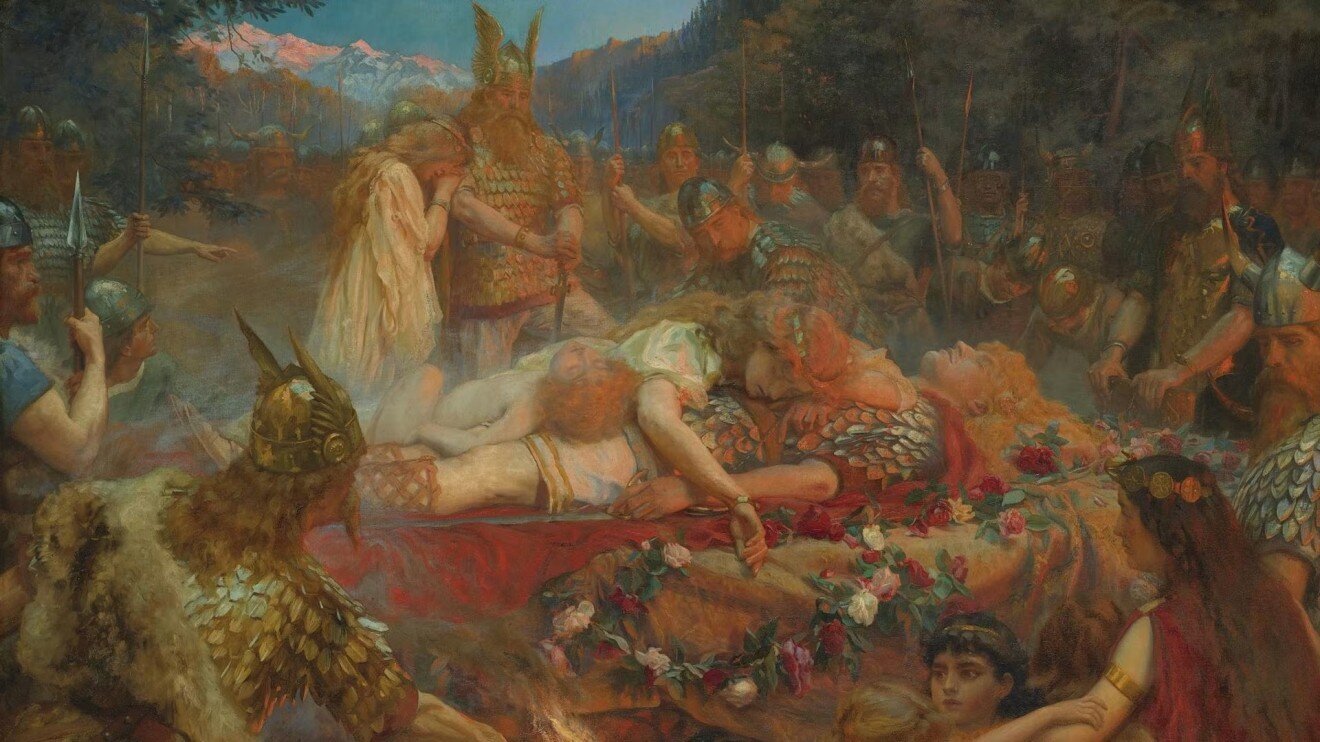
The expression «Nordic corpse» is a curious interweaving of the historical realities of ancient Scandinavian burial rites and a Soviet cinematic tradition that fixed the notion of «Nordic character» in the popular mind through the cult film «Seventeen Moments of Spring.»
Origins of the Concept: the Nordic Race in Anthropology
The term «Nordic race» was introduced into scholarly use by the Russian-French anthropologist Joseph Deniker in the early twentieth century. He characterized it as «a tall race of slender, well-proportioned build, with fair, sometimes wavy hair, light eyes, pink skin, and a dolichocephalic skull.» Soviet anthropology preferred the term «northern race» because of the geographic vagueness of the original concept.
Characteristic traits of this anthropological type were said to include dolichocephaly (an elongated skull shape), tall stature, and fair hair and eyes. The type was found across Northern Europe — among Finns, Swedes, Norwegians, northern Germans, the Dutch, the English, western Estonians and Latvians, as well as among northwestern Russians, northern Karelians, the Komi, and part of the Erzya.
Viking Burial Traditions: the Dead Among the Living
Understanding what might be meant by a «Nordic corpse» is impossible without turning to the rich burial tradition of the ancient Scandinavians. Death in the world of the Vikings was not the final end of existence, but rather a transition to another state, requiring particular ritual procedures.
Fear of the Unquiet Dead
Despite the Vikings’ warlike traditions, their beliefs contained an element of fear toward death and everything connected with it. It was believed that an improperly buried corpse would fail to find its place in the afterlife and might return to the living as a revenant or draugr — a wandering ghost.
A draugr posed a particular threat: it might visit its descendants, foretelling the death of another family member or other misfortunes. To avoid such troubles, the burial ceremony had to be carried out correctly, providing the deceased with everything needed for the afterlife.
The Ship Burial Ritual
Vikings were typically buried in a burial ship. Offerings and sacrifices were made to the deceased in keeping with their earthly status and occupation. Free farmers received weapons and harness, craftsmen a full set of tools, and women were given jewelry and household implements.
Food, drink, animals, and thralls (slaves) were also placed in the grave, so that all of it would continue to serve their masters in the afterlife. After cremation, a mound of stones was raised over the remains and covered with earth and turf. The resulting barrow was considered the dwelling of the deceased.
Ibn Fadlan’s Account
A unique description of Viking burial rites was left by the Arab traveler Ahmad ibn Fadlan in the tenth century. He described the funeral of a chieftain of the Rus (presumably from a Swedish tribe) during his expedition along the Volga trade route.
After the chieftain’s death, he was temporarily buried while new garments were sewn for him. One of his slave women volunteered to share the afterlife with him. Ten days later the body was exhumed, and the ceremony was conducted by an old woman representing the «angel of death.»
The chieftain’s ship was hauled ashore and set upon a wooden platform. A bed, cushions, intoxicating drinks, fruit, and a musical instrument were placed aboard. The body was laid out with all his weapons and offerings. Horses, a rooster, and a hen were sacrificed, and finally the slave woman, who was to accompany her master into the afterlife.
Cremation and the Symbolism of Fire
It was common to burn bodies on a funeral pyre at temperatures of up to 1,500°C — far hotter than modern cremation. Such a pyre left only a few charred bones and molten metal. Pyres were built so that the column of smoke would be as massive as possible.
According to Snorri Sturluson’s «Prose Edda,» Odin decreed that «all the dead must be burned on a pyre together with their belongings.» It was believed that «the higher the smoke of the funeral pyre rises into the air, the higher in the sky the one being burned will be, and the richer he will be there, the more goods burn with him.»
Death as a Sexual Act
A distinctive feature of the Scandinavian burial tradition was the notion of death as a sexual union between the deceased and death’s escort — the goddess Hel, or Rán with her nine daughters. These allegories appear in the earliest poems, such as the ninth-century «Ynglingatal,» which states that a king lies in the «embrace of Hel.»
Picture stones on Gotland associated with death often took the form of phallic symbols two to three meters tall. Forty white phallus-shaped stones, found mostly in southwestern Norway and dated to the fifth century, were set atop burial mounds, symbolizing the link between life and death.
The Funeral Ale and the Completion of the Earthly Journey
On the seventh day after death, a «sjáund» was held — a funeral ale with the drinking of intoxicating beverages (a sumbel). Only after this ceremony could heirs lay claim to an inheritance, and if the deceased had been head of the family, authority within the family would pass on. Such rites are attested on runestones across Scandinavia.
The Afterworlds of Norse Paganism
According to Norse pagan tradition, a properly buried person went on to one of several afterworlds:
Helgafell — a sacred mountain where the dead led the same life as on earth. It was usually the mountain nearest to the community, considered so sacred that one had to wash one’s face before looking toward it.
Hel — the realm for those who died of old age or illness. Under Christian influence, Hel came to be depicted as a grim place, though there is evidence of lavish feasts held there too. Some warriors, before dying, pierced themselves with a spear to trick Hel and gain entry to Valhalla instead.
Valhalla — Odin’s hall, to which the valkyries gathered half of the warriors slain in battle. There they prepared for Ragnarök, fighting one another and rising again each day.
Fólkvangr — the domain of the goddess Freyja, where the other half of the fallen warriors went.
«Seventeen Moments of Spring»: the Nordic Character in Soviet Cinema
An entirely different context was given to the word «Nordic» by the Soviet TV film «Seventeen Moments of Spring» (1973), where the phrase «character: Nordic, composed» became a cult quote familiar to virtually every viewer in the USSR.
Stirlitz’s Dossier
The character profile of the protagonist, Max Otto von Stirlitz, read: «A true Aryan. Character: Nordic, composed. Maintains good relations with colleagues. Performs his official duties impeccably. Merciless toward the enemies of the Reich. An excellent athlete: Berlin tennis champion. Unmarried; never observed in any compromising liaisons.»
Many characters among the Nazi leadership in the film received similar profiles. The standard template ran: «A true Aryan. Character: Nordic, composed. Merciless toward the enemies of the Reich. A good family man; no compromising liaisons.»
Variations on the Nordic Character
The film presented a whole gallery of variations on the Nordic type:
Schellenberg was given the profile «Nordic, bold, firm.» Rolf — «Nordic, bold.» Stirlitz and Müller — «Nordic, composed.» Krüger — «Nordic, firm.» Eismann and Holtoff received the more modest assessment: «character approaching Nordic, steady.»
These profiles came to be seen as a parody of Nazi racial theory, though within the film itself they were originally presented without irony, as part of its documentary-style pastiche.
Jokes and Folklore
The film’s popularity spawned a great many jokes playing on the theme of the Nordic character. A classic example:
«Müller decides to test his staff. He summons Schellenberg: ‘Name any number.’ ‘Well, let’s say 32.’ ‘Why not 23?’ ‘Because 32!’ Müller writes: ‘Character: Nordic, steady.’ He summons Kaltenbrunner: ‘Name a number.’ ‘67.’ ‘Why not 76?’ ‘Well, 76 works too.’ Müller writes: ‘Character close to Nordic.’ He summons the next man: ‘Name any number.’ ‘33!’ ‘Why not… Ah, it’s you, Stirlitz!’»
Such jokes poked fun both at the absurdity of Nazi racial theory and at the bureaucratic system of character profiles in general.
The Semantic Field of the «Nordic Corpse»
In modern Russian, the expression «Nordic corpse» combines several layers of meaning. On one hand, it refers to the archaeological realities of Viking burial rites, in which the dead continued to play an important role in the life of the community. On the other, it is an ironic label for a person of markedly reserved, cold demeanor, traceable back to cinematic clichés.
The Dead Among the Living
In the Scandinavian tradition, the boundary between the world of the living and the dead was quite fluid. Dead ancestors continued to influence the fates of their descendants, while improperly buried corpses might return as draugar. Burial mounds were seen as dwellings of the dead, not merely places of rest.
Burial ships uncovered by archaeologists show that, at the time of interment, they were fully functional vessels that had been used for their intended purpose. Finds in various Scandinavian museums demonstrate the high level of shipbuilding of the era.
Ritual Stillness
A feature of many burial rites was the ritual stillness of the deceased during the period of preparation for burial. The chieftain’s body described by ibn Fadlan lay in a temporary grave for ten days while new garments and the necessary funerary items were prepared.
This stillness was not mere waiting — it carried sacred meaning, allowing the soul to prepare for its passage into the other world. During this period the deceased was in an intermediate state between life and death, which made him especially powerful and dangerous.
The Cinematic Nordic Character
Striving for historical accuracy in its depiction of Nazi Germany, Soviet cinema reproduced actual phrasing from Third Reich documents. «Character: Nordic, composed» did in fact appear in the profiles of German officers during the war.
A Standard of Coldness
In «Seventeen Moments of Spring,» the Nordic character was presented as the standard of German discipline and self-restraint. Stirlitz, possessing such a character, displayed complete self-control in any situation, which made him an ideal intelligence officer.
This cold restraint, taken to its absolute extreme, gave rise to the association with a corpse — a living person behaving as though dead: without emotion, without needs, without spontaneous reactions.
The Irony of History
The paradox is that Nazi racial theory, which actively employed the concept of the «Nordic race,» rested to a considerable degree on pseudoscientific notions. The actual bearers of this anthropological type in antiquity possessed a rich emotional and spiritual culture, as attested by their burial rites and mythology.
Modern Interpretations
In contemporary Russian speech, a «Nordic corpse» can denote a person displaying extreme emotional coldness, an absence of natural needs and reactions. This state may be either deliberately cultivated (as a form of self-control) or pathological.
The Psychological Aspect
From a psychological standpoint, «Nordic corpse» behavior can indicate deep depression, emotional burnout, or a defensive reaction to trauma. Refusal of food, drink, natural needs, and social interaction are all signs of a serious disruption of vital functions.
At the same time, the cultural tradition of admiring «Nordic reserve» can lead to the romanticizing of such states, particularly in literature and art.
Literary Use of the Image
In fiction, the image of the «Nordic corpse» allows for the creation of a character balanced on the border between life and death. Such a figure can embody various authorial ideas — from a critique of the inhumanity of totalitarian regimes to an exploration of extreme states of the human psyche.
A Metaphor for Alienation
The «Nordic corpse» becomes a metaphor for the alienation of modern man — alive but not living, physically present yet emotionally and spiritually absent. This condition is especially characteristic of turning points in history, when familiar values and points of reference collapse.
Archaeological Evidence
Excavations of Viking burials have provided unique evidence of their conceptions of death. Finds at Oseberg, Gokstad, and other sites show that the burial ships were not symbolic but real vessels, on which the dead were meant to set sail into the afterlife.
The richness of grave goods shows that death was regarded not as an end but as a transition to a new form of existence. The dead remained part of society, influencing the lives of their descendants through the system of burial mounds and memorial rites.
Burial Mounds as Dwellings of the Dead
Viking burial mounds were not merely places of interment — they were considered actual dwellings of the dead. The Borre mounds in Vestfold belonged to the Yngling dynasty, and at Jelling, Harald Bluetooth raised a mound in honor of his parents and himself, which included a burial hall.
These monuments served not only as homes for the dead but also as testimony to the social standing of their descendants. Powerful clans demonstrated their strength through ancestral burial grounds, creating entire necropolises.
Conclusion: the Living Dead of Culture
The concept of the «Nordic corpse» unites ancient conceptions of death as a distinct state of being with modern cultural stereotypes about northern reserve. In a literary context, this image allows for the exploration of liminal states of human existence — between life and death, presence and absence, engagement and alienation.
From the burial ships of the Vikings to the character profiles from the film about Stirlitz, the «Nordic corpse» remains a powerful cultural symbol, reflecting human fears and fantasies about death, identity, and belonging to a particular tradition.