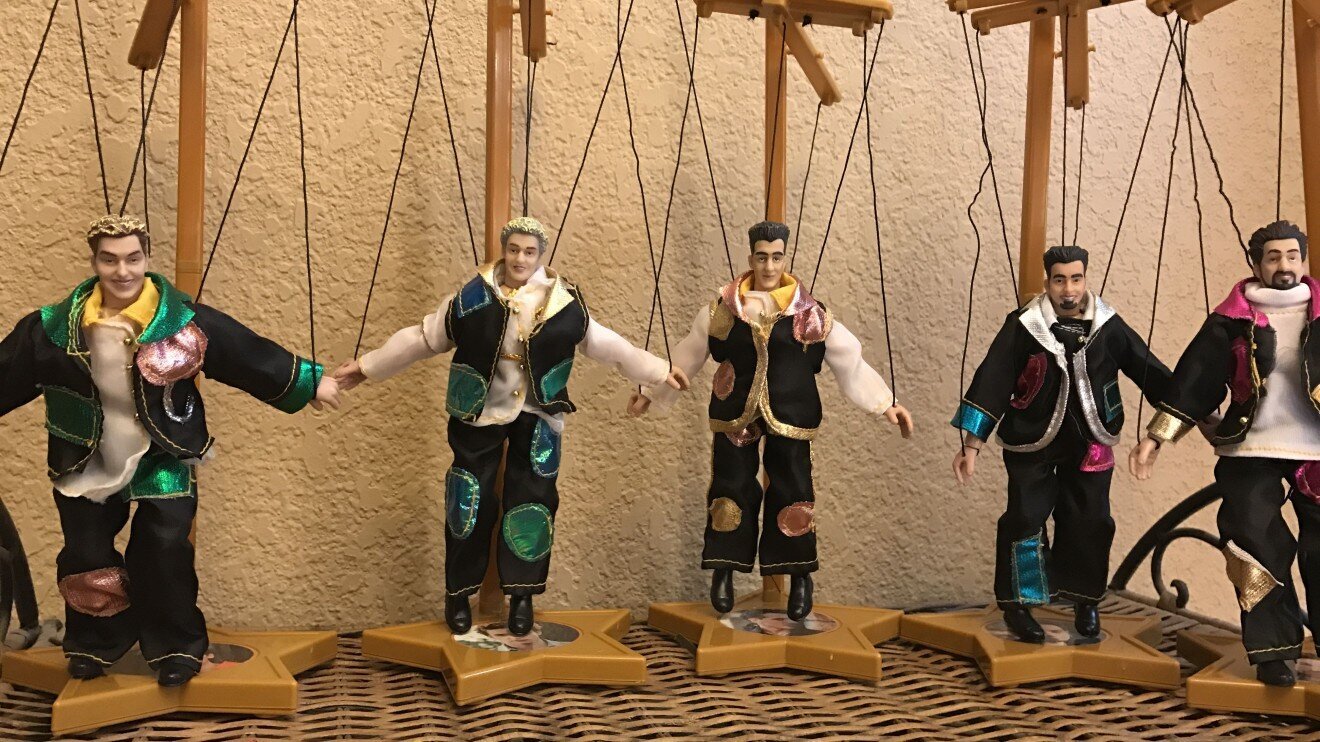
A marionette is a puppet controlled from above by strings, wires, or rods. The word itself comes from the French «marionnette,» meaning «little Mary» — in the Middle Ages such puppets often depicted biblical scenes involving the Virgin Mary.
Origins
Puppet theater is one of the oldest forms of performing art. Archaeologists have found evidence of string puppets used as far back as Ancient Egypt, around 2000 BCE. Wooden figures on strings back then imitated various work processes, such as kneading bread dough.
In Ancient Greece, puppets were called «neurospasta» — literally «moved by strings.» Aristotle, in his treatise «On the Movement of Animals,» compared the movements of living creatures to automatic puppets: «The motions of animals can be compared to those of automatic puppets, which are set moving by the smallest impulse.» Even the great Archimedes, according to his contemporaries, worked with marionettes.
Interestingly, archaeologists have found clay and bone dolls with movable limbs in ancient burial sites. Some had an iron rod sticking out of the head — exactly the way marionettes are still controlled in modern Sicily. Whether these were toys or theatrical puppets remains a matter of debate.
Regional Traditions
Sicilian Puppet Theater
The Sicilian «Opera dei Pupi» is a unique tradition recognized by UNESCO as an item of humanity’s intangible cultural heritage. Sicilian marionettes are among the simplest to operate. They’re carved from wood and have a sturdy rod running through the whole body into the head. That rod, plus a single string tied to the arm, lets the puppeteer fully control the character’s movements.
Performances are often based on chivalric romances, especially the «Song of Roland» and other Frankish poems. The same stories decorate the sides of Sicilian carts — the link between folk-art forms shows up everywhere.
Czech Marionettes
In Czech lands, marionette theater played a special role in preserving national culture. Under Austro-Hungarian rule, when German dominated official culture, puppet shows performed in Czech helped keep the native language and traditions alive.
Czech marionettes come in two types: with a central rod (like the Sicilian ones, but more complex) and fully string-controlled — the hardest to operate. Master Miroslav Trejtnar is considered a recognized authority in traditional Czech puppetry.
Burmese Marionettes
In Burma (Myanmar), the «Yoke thè» marionette theater is a highly developed art. A traditional troupe must include 27 characters: a king, a prince and princess, ministers, various animals (horse, elephant, tiger, monkey, parrot), and comic characters.
Burmese marionettes are strikingly complex — male characters are worked with 18 strings, female ones with 19. Even so, each puppet is handled by a single puppeteer, requiring real virtuosity. Performances are usually accompanied by a traditional «hsaing waing» orchestra.
German and Austrian Traditions
In Germany, the famous «Augsburger Puppenkiste» has staged both fairy-tale and serious productions since 1948. Starting in 1953, the theater began filming television series, including the popular «Jim Button and Luke the Engine Driver» and «Urmel from the Ice.»
The Salzburg Marionette Theatre in Austria, founded in 1913 by Professor Anton Aicher, specializes in opera. It stages «Die Fledermaus,» «The Magic Flute,» and ballets like «The Nutcracker.» The productions are aimed at adult audiences, though children are welcome too.
Construction and Control
Types of Control Rigs
British type: a vertical rod with crossbars that the strings attach to. Usually nine strings are used — one for each knee, arm, and shoulder, two for the head, and one for the lower back. A removable bar controls the legs.
American type: a horizontal bar with perpendicular elements for the arms, shoulders, and back. A smaller plate for the head strings hangs below the main bar. This type is also used for four-legged animals.
Asian type: a rounded rectangular plate with a short handle, with all the strings hanging from its outer edge. Control comes from pulling individual strings in turn.
Materials and Construction
Marionettes are traditionally carved from linden — a light, soft wood. The head can be papier-mâché or carved from wood. Modern makers also use plastic and other lightweight materials.
Marionette sizes range from a few centimeters up to 2–3 meters tall. Large puppets require several puppeteers or special mechanical rigs.
Marionettes in Film and Television
The 20th century gave marionettes new life through film and television. In 1947, the American show «Howdy Doody» introduced television marionettes to a young audience.
In the 1950s, Bil Baird and Cora Eisenberg created numerous television marionette shows. They were also responsible for the famous «The Lonely Goatherd» puppet scene in «The Sound of Music.»
In Britain, the BBC built an entire «Television Puppet Theatre» at Lime Grove Studios (1955–1964). Programs aired under the umbrella title «Watch With Mother» and included «Whirligig,» «The Woodentops,» «Andy Pandy,» and others.
A special place belongs to Gerry Anderson, who in the 1960s created «Fireball XL5,» «Stingray,» and the famous «Thunderbirds.» Anderson developed the «Supermarionation» technique, which let puppets move their lips in sync with pre-recorded dialogue.
In 2004, «South Park» creators Matt Stone and Trey Parker made «Team America: World Police,» deliberately using a crude technique with visible strings, calling it «super crappy-mation.»
Symbolic Meaning
The image of the marionette carries deep symbolic weight in culture. The puppet on strings became a metaphor for dependency, unfreedom, and mechanical behavior. A «marionette person» is someone with no will of their own, acting on someone else’s orders.
In 20th-century literature, existentialists in particular used this image to describe the alienation of modern man. Doll-like, mechanical movements symbolized the loss of the human in a person, the reduction of the individual to an object of manipulation.
At the same time, the marionette is also a symbol of the actor’s craft, of the ability to breathe life into inanimate material. The greatest puppeteers reach such a level of skill that audiences forget about the strings and believe in the characters’ independent life.
Use in Psychotherapy
In the late 20th century, Russian psychologists I. Ya. Medvedeva and T. L. Shishova developed a method called «dramatic psychoelevation» for correcting children’s behavior. The method’s main tool is puppet theater, which lets a child act out difficult life situations through puppet characters.
Working with marionettes helps overcome psychological barriers, develop empathy, and learn to express emotions. A child can say through a puppet what they don’t dare say for themselves.
The Marionette as an Artistic Image
In theater and dance, the reverse trick often appears — a live actor imitates a marionette’s movements. In the ballet «The Nutcracker,» Petipa introduced a prince character turned into a wooden doll by an evil fairy. The dancer has to convey angular, mechanical movement.
In breakdancing, the «Puppet» style is based on imitating the movement of a marionette on strings. The dancer creates the illusion that their body is a puppet controlled by an invisible puppeteer.
The Art Today
Today the art of marionettes is enjoying a renaissance. Modern technology allows for complex control mechanisms, LED lighting, and sound effects. Some theaters experiment with radio-controlled elements.
Puppet-theater festivals are held around the world. The Union Internationale de la Marionnette (UNIMA) brings together professionals from different countries. Russia is home to famous puppet theaters — the Obraztsov Theatre in Moscow, the Great Puppet Theatre in St. Petersburg, and various regional theaters.
New generations of puppeteers are developing traditional techniques, creating original characters, and experimenting with the form of performance. The art of marionettes remains alive and evolving, while staying connected to centuries-old traditions.
Conclusion
A marionette is not just a puppet on strings, but a complex cultural phenomenon uniting craft and art, tradition and innovation. From ancient Egyptian wooden figures to today’s high-tech performances, marionette theater continues to captivate audiences of every age.
The image of the puppet on strings is deeply rooted in the human mind as a symbol of dependency and unfreedom, but at the same time as an embodiment of humanity’s creative power — the ability to breathe life into lifeless matter. In that duality lies the special, enduring appeal of the art of marionettes.