On September 27 Yeltsin finally renounced any compromise, declaring that he was against the simultaneous early elections of president and people’s deputies proposed by the Congress. The positions of the two sides became irreconcilable.
On September 29 the president formed a Central Election Commission for the State Duma elections under the chairmanship of N. T. Ryabov, effectively ignoring the decisions of the Supreme Soviet.
On October 2 Vice President Alexander Rutskoy, formally acting head of state by the parliament’s decision, signed a decree dismissing Viktor Chernomyrdin as chairman of the government. The decree had no practical consequences — the government continued to obey Yeltsin.
The situation changed fundamentally in the first days of October. On October 3 supporters of the Supreme Soviet went on the offensive: they seized the Moscow mayor’s building on Novy Arbat and attempted to storm the Ostankino television center. At least 46 people died in the fighting at Ostankino.
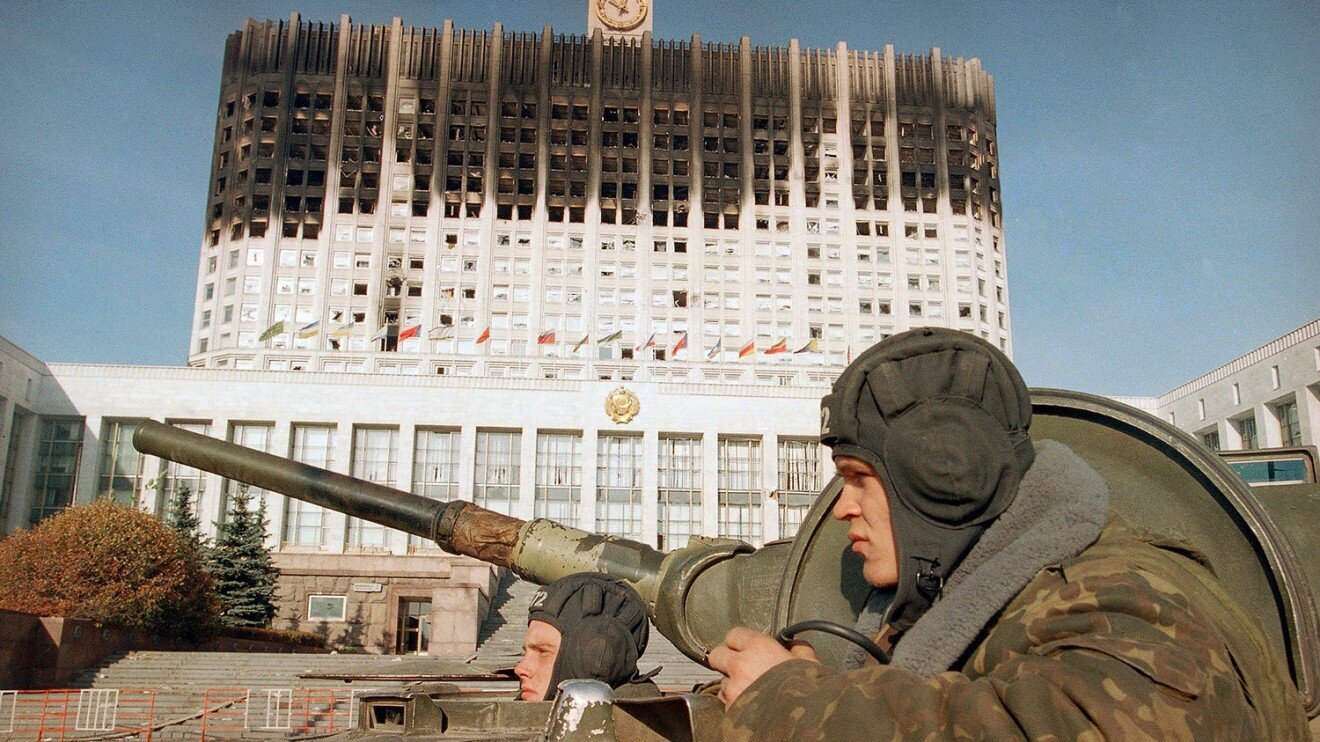
These events gave Yeltsin his pretext for decisive action. On the night of October 3–4 he declared a state of emergency in Moscow. On the morning of October 4 the storming of the House of Soviets (the White House) began, with armor and artillery. Live on the radio station Ekho Moskvy, Rutskoy called on military pilots to bomb the Kremlin and the Interior Ministry building.
By the evening of October 4 the resistance had been crushed. Rutskoy, Supreme Soviet speaker Ruslan Khasbulatov and other leaders of the parliamentary opposition were arrested and placed in the Lefortovo remand prison. The official death toll was around 150, including passers-by.
The liquidation of the Soviet system of power
Having suppressed the resistance, Yeltsin set about liquidating the Soviet system of power entirely. On October 7 the Moscow City Council and the district soviets of Moscow were dissolved, and Prosecutor General V. G. Stepankov was removed from office in violation of the Constitution. His place was taken by A. I. Kazannik.
The same day saw the dismissal of the heads of regional administrations who had opposed Decree No. 1400: Viktor Berestovoy (Belgorod region), Vitaly Mukha (Novosibirsk region), Pyotr Sumin (Chelyabinsk region), Alexander Surat (Amur region) and others.
Under pressure, Valery Zorkin was forced to resign as chairman of the Constitutional Court, having been threatened with criminal prosecution for «providing legal cover for a constitutional coup.» On October 9 Yeltsin terminated the powers of all Soviets of People’s Deputies across the country, from the republican down to the village level.
The adoption of a new Constitution
In parallel with the demolition of the old system, a new one was being built. On October 11 elections to the Federation Council were called; on October 15 a nationwide vote on the draft of a new Constitution was set for December 12.
On November 9 the draft Constitution was published in Rossiyskiye Vesti and Rossiyskaya Gazeta. On December 12 the nationwide vote took place, with 58 percent of participants voting for the Constitution. Elections to the Federation Council and to the first State Duma were held at the same time.
On December 25, 1993 the new Constitution was published in Rossiyskaya Gazeta and came into force, sealing the victory of presidential over parliamentary power.
Amnesty and unsettled questions
On February 23, 1994 the new State Duma adopted a resolution amnestying the participants in the October events. Most of those arrested accepted the amnesty (Rutskoy excepted), though without admitting guilt.
Serious doubts subsequently arose about the honesty of the December 12 vote. A. A. Sobyanin, an analyst in the presidential administration, suggested large-scale falsification, arguing that no more than 46 percent of the electorate had actually taken part, against the official figures. These accusations were never officially investigated.
By the end of 1993, then, a new political system with a strong presidency had been established in Russia, and the Soviet system had passed definitively into history. The price of that change was high — hundreds dead and a deep split in society.