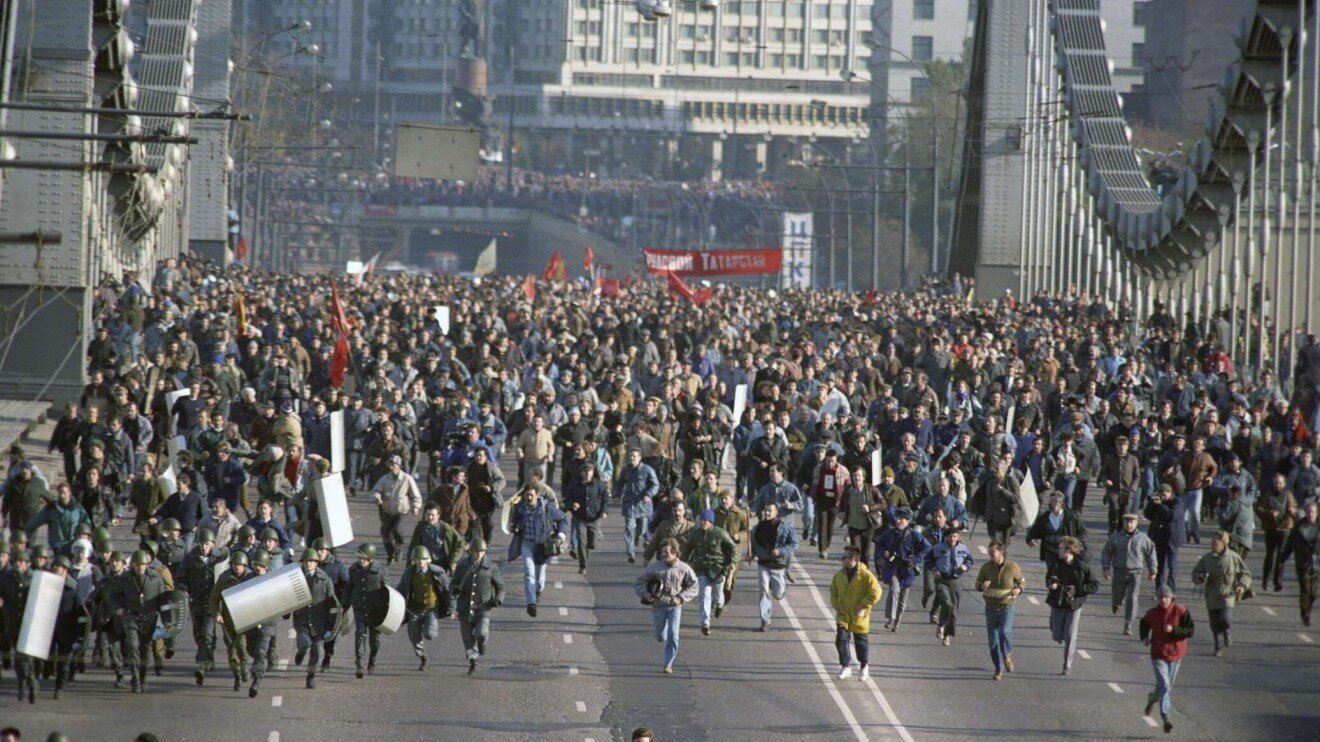
The events of the last days of September and the first days of October 1993 were the climax of the confrontation between President Boris Yeltsin and the Russian Supreme Soviet, headed by Ruslan Khasbulatov and Vice President Alexander Rutskoy.
Escalation (September 27–28)
By the end of September the situation around the White House had reached its critical point. On September 27 the pass regime for entering the Supreme Soviet building was tightened to the maximum — reinforced police and OMON detachments blocked every approach to the parliament. That same day Boris Yeltsin, in an interview with the Ostankino television company, categorically declared his unwillingness to compromise and rejected the possibility of simultaneous early elections for president and deputies.
A symbolic act was the cutting of the government communication line to Valery Zorkin, chairman of the Constitutional Court, which effectively isolated him from any possibility of coordinating with the regions.
On the night of September 27–28 the authorities took decisive measures to blockade the territory around the White House completely. Officers of the Moscow police headquarters, supported by servicemen of the Dzerzhinsky Division and using street-washing trucks and barbed wire, created an impenetrable cordon. The conflict zone expanded to the size of the entire former Krasnopresnensky district — an operation of unprecedented scale for central Moscow.
An attempt at constitutional settlement
On September 28 the Constitutional Court, in the person of Valery Zorkin, made a last attempt at a legal settlement of the crisis. The court demanded the suspension both of Yeltsin’s Decree No. 1400 and of all acts of the Congress of People’s Deputies adopted after 8:00 p.m. on September 21. It was an attempt to return the situation to a legal footing and force both sides to the negotiating table.
The Constitutional Court also demanded that the use of force and any restriction of constitutional freedoms, including freedom of the press, be excluded, and proposed convening a meeting of regional leaders to determine election dates.
First blood (September 28–29)
On the evening of September 28 came the first serious clashes between security forces and supporters of the parliament on Druzhinnikovskaya Street. In the dispersal of the demonstrators a traffic police officer, Vladimir Reshtuk, was fatally wounded — the first fatality of the constitutional crisis, a foretaste of the tragic events of October.
On September 29 the authorities widened the blockade, cordoning off the Moscow City Council building. Colonel General Albert Makashov, speaking from the balcony of the White House, announced a readiness to open fire to kill without warning if the barrier line were breached — a statement that raised the temperature considerably.
That day saw the first organized attempts to break through to the White House. Around 300 demonstrators led by the former USSR people’s deputy Viktor Alksnis tried to «break through to the White House» but were pushed back by police. All rallies in support of the Supreme Soviet were brutally suppressed by OMON — 106 people were detained over the course of the day.
The Church as mediator
Against the background of mounting confrontation, Patriarch Alexy II of Moscow and All Russia came forward with an offer of church mediation. He proposed the St. Daniel Monastery as neutral ground for negotiations and appealed to both sides not to allow bloodshed.
On September 30 both sides accepted the Patriarch’s proposal, which gave a last hope of a peaceful resolution.
Failed negotiations (October 1)
On the night of September 30 to October 1, talks were held at the Mir Hotel between representatives of the opposing sides. The Congress was represented by Ramazan Abdulatipov and Veniamin Sokolov, the president by Sergei Filatov, Oleg Soskovets and Yuri Luzhkov.
The result was Protocol No. 1, providing for a staged settlement: first the voluntary disarmament of the House of Soviets in exchange for the restoration of utilities, then political guarantees. By morning, however, the Presidium of the Supreme Soviet had effectively rejected the protocol, declaring that the question of weapons could not be considered separately from the general political settlement.
The Congress denounced Protocol No. 1 and formed a new working group headed by Yuri Voronin. In parallel, three-way talks began at the Patriarch’s residence with representatives of the president, the Supreme Soviet and the Constitutional Court.
Last attempts (October 2)
On October 2 Alexander Rutskoy took his last symbolic actions, issuing a decree dismissing Prime Minister Viktor Chernomyrdin and other members of the government. The decree had no practical consequences but demonstrated the irreconcilability of the positions.
That same day large-scale clashes broke out on Smolenskaya Square between supporters of the Supreme Soviet and law enforcement. Demonstrators blocked the Garden Ring and threw up a barricade, setting fire to tires and planks. OMON was unable to take the barricade, and the police leadership was forced into negotiations, reaching an agreement on a peaceful dispersal by 11:00 p.m.
Twenty-four police officers and five civilians were injured in the clashes — a foretaste of the tragic events of the following day.
Historical note
The events of September 27 – October 2, 1993 were the last attempt at a peaceful resolution of the constitutional crisis. Despite the efforts of the church leadership and the Constitutional Court, the two sides’ positions remained irreconcilable. The collapse of the negotiations and the escalation of the street confrontation made a forcible resolution inevitable, leading to the tragic events of October 3–4, 1993.
On September 27 Yeltsin finally renounced any compromise, declaring that he was against the simultaneous early elections of president and people’s deputies proposed by the Congress. The positions of the two sides became irreconcilable.
On September 29 the president formed a Central Election Commission for the State Duma elections under the chairmanship of N. T. Ryabov, effectively ignoring the decisions of the Supreme Soviet.
On October 2 Vice President Alexander Rutskoy, formally acting head of state by the parliament’s decision, signed a decree dismissing Viktor Chernomyrdin as chairman of the government. The decree had no practical consequences — the government continued to obey Yeltsin.