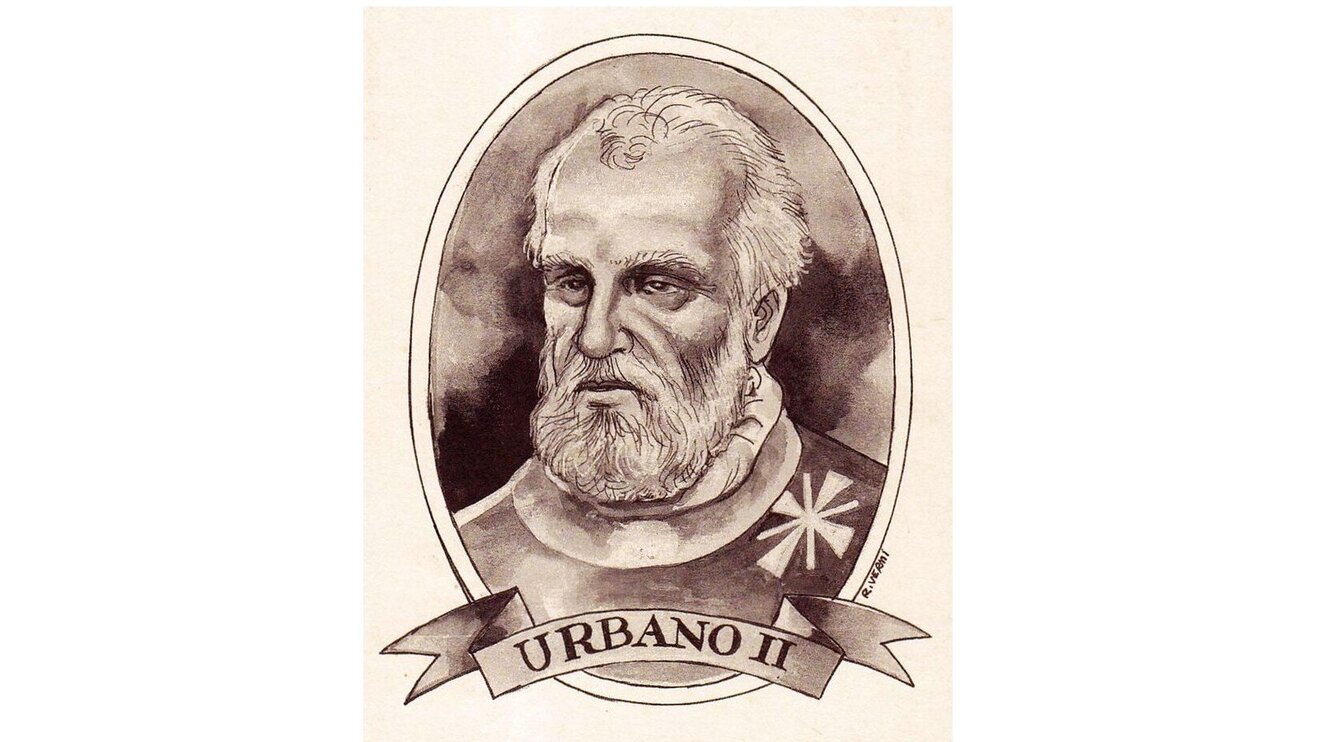
Initiator of the Crusades and one of the most influential pontiffs of the Middle Ages
Origins and Early Years
Blessed Urban II (Latin: Urbanus PP. II), born Eudes (Odo) de Châtillon-sur-Marne, was born around 1035–1042 in the county of Champagne, not far from Paris. His father was Milo de Châtillon, his mother Ennelina de Montfort, pointing to the future pope’s aristocratic origins.
Educated at Reims under St. Bruno, Eudes showed an early inclination toward religious life. He became prior of the influential Abbey of Cluny — a center of monastic reform — which shaped his subsequent church career and his commitment to the ideals of church renewal.
Key Dates
- c. 1035–1042 — born
- c. 1080 — Cardinal-Bishop of Ostia
- 1088 — elected pope
- 1095 — Council of Clermont
- 1099 — death
The Path to the Papal Throne
Around 1080, Pope Gregory VII appointed Eudes Cardinal-Bishop of Ostia, a recognition of his abilities and his devotion to the Gregorian reforms. He was one of the most prominent and active supporters of church reforms aimed at strengthening the Church’s independence from secular power.
From 1084, Eudes served as papal legate in Germany, where he put Gregory VII’s policies into practice amid a bitter conflict with Emperor Henry IV. Gregory VII trusted him so completely that he named him among his possible successors.
After Gregory VII’s death in 1085, Desiderius, abbot of Monte Cassino, was elected pope as Victor III. But his reign was brief, and in March 1088, at Terracina, a small gathering of cardinals and other prelates unanimously elected Eudes pope, under the name Urban II.
The Gregorian Reforms
The Gregorian Reforms were an 11th-century movement to renew the Church, named for Pope Gregory VII. Its main goals: combating simony (the buying of church offices), enforcing clerical celibacy, and freeing the Church from secular control, especially over the appointment of bishops (investiture).
His Papacy
Urban II continued the policies of his predecessor Gregory VII, but with greater flexibility and diplomatic finesse. From the very start of his pontificate, he had to contend with the presence in Rome of the antipope Clement III, which complicated his position.
Over the course of several councils held in Rome, Amalfi, Benevento, and Troia, the Pope consistently upheld the fight against simony and defended the papacy’s right to investiture, continuing his standoff with Emperor Henry IV.
Political Alliances
Urban II pursued an active policy of building alliances against Emperor Henry IV:
- He approved the marriage of Countess Matilda of Tuscany to Welf V, an opponent of the emperor
- He supported Prince Conrad in his revolt against his father, Henry IV
- He crowned Conrad King of Italy in Milan in 1093
- He emerged victorious from his struggle with King Philip I of France, whom he excommunicated for adultery
The Investiture Controversy
Under Pope Urban II, the struggle over the right to appoint secular and church rulers intensified. The roots of the Investiture Controversy lie precisely in Urban II’s papacy and his standoff with Emperor Henry IV. At stake was the fundamental question of who had the right to install bishops — the king or the pope.
This struggle shaped the character of relations between church and secular power for centuries to come and became one of the defining conflicts of the Middle Ages.
The Crusades: a Turning Point in History
Urban II’s most significant act was proclaiming the Crusades. As historians note, the Pope faced numerous problems: war with Germany, conflicts in France, the struggle against an antipope, and the pushback of Christians in the East. A mass pilgrimage might solve several of these problems at once.
The Council of Piacenza (March 1095)
Urban II’s crusading movement first took shape at the Council of Piacenza in March 1095. There, Urban II received an envoy from Byzantine Emperor Alexios I Komnenos, seeking help against the Muslims. That moment became the starting point for organizing a massive military undertaking.
The Council of Clermont (November 1095)
At the Council of Clermont, held in November 1095, Urban II’s sermon became, perhaps, the most consequential speech in all of European history. He called on the people of France to wrest the Holy Land from the Turks by force.
«To all who go there, henceforth, upon their death, absolution from sin shall be granted. Let those go into battle against the infidel — a battle that shall yield plunder in abundance — who were once accustomed to warring against their fellow believers, against Christians... That land flows with milk and honey. Let those who were once robbers, who fought against their brothers and kinsmen, now become soldiers. Whoever is wretched here will grow rich there.»
The Pope’s speech was punctuated by cries from the audience of «Dieu le veut!» («God wills it!»). Inspired by the speech, the listeners swore to free the Holy Sepulchre from the Muslims. Those who wished to join the campaign sewed a red cross to their clothing. Urban II donated his own cassock for the purpose. This is the origin of the name «crusaders.»
Participants’ Motives
- Religious: liberating the Holy Land
- Spiritual: absolution from sin
- Economic: land and plunder
- Social: a change in status
- Political: expanding influence
Consequences of the Call
- A mass movement across Europe
- The start of the age of the Crusades
- A shift in the geopolitical map
- Cultural and trade exchange
- Strengthened papal power
Organizing the Crusading Movement
The Pope sent letters to Europe’s most influential rulers, calling on them to take up arms against the Muslims. His calls were heard — mid-tier European princes and feudal lords were interested in seizing land and plunder overseas, and the promise of absolution provided the perfect justification for launching a war against the Muslims.
And so the Pope’s sermon launched a new chapter of European history — the age of the Crusades, which lasted nearly two centuries and fundamentally reshaped relations between East and West.
Sicilian Policy
Far more complicated was the Pope’s struggle to bring Campania and Sicily back under Christian control, territories that had, by then, been held in succession by Byzantium and the Aghlabid and Fatimid emirs. His man in Sicily was the Norman ruler Roger I.
In 1098, after the siege of Capua, Urban II granted Roger extraordinary powers, some of which the Pope refused to extend to any other European ruler:
- Freedom to appoint bishops
- The right to collect church revenues and forward them to the Pope
- Authority to judge church disputes
Roger effectively became the Pope’s legate in Sicily. Roger’s wife, Adelaide del Vasto, brought in settlers from the Po Valley to colonize eastern Sicily.
The Consequences of the Sicilian Policy
As a secular ruler, Roger seemed like a reliable ally, since he was merely the vassal of his relative, the Count of Apulia, who was himself a vassal of Rome. That made it seem safe for the Pope to grant Roger these extraordinary powers. Later, however, they led to a bitter struggle with Roger’s heirs — the Hohenstaufen dynasty.
Death and Legacy
Urban II died on July 29, 1099, two weeks after the crusaders captured Jerusalem — but before the news reached Italy. Symbolically, the pope who had launched the Crusades died almost at the very moment their main goal was achieved — the liberation of the Holy City.
He was beatified in 1881. His feast day is July 29. Pope Urban II is buried at the Benedictine Abbey of the Holy Trinity in Cava de’ Tirreni.
Achievements
- Initiator of the Crusades
- Continued the Gregorian reforms
- Strengthened papal power
- Diplomatic skill
- Organized the Christian Reconquista
Historical Significance
- Reshaped East-West relations
- Launched the age of the Crusades
- Strengthened the papacy’s role in Europe
- Influenced feudal relations
- Cultural and trade exchange
Urban II in Historical Perspective
Pope Urban II remains one of the most contradictory figures of the Middle Ages. On one hand, he was a talented diplomat and reformer, who managed to strengthen the papacy’s position under the most difficult political conditions. On the other, his call for the Crusades set off a chain of conflicts whose consequences were felt for centuries.
His words — that «those who go will receive absolution from sin,» that «whoever is wretched here will grow rich there» — became a formula that motivated thousands of people to set off for distant lands in search of salvation for their souls and worldly prosperity. These words reflect the complexity of an era in which religious motives were tightly intertwined with economic and political interests.
Urban II managed to unite a fragmented Europe around a shared goal, creating the ideological foundation for a massive military undertaking. His work marks the transition from the early to the High Middle Ages, when the papacy reached the peak of its political influence.
Remembering Pope Urban II
Today, Urban II is remembered above all as the initiator of the Crusades — a phenomenon that radically altered the course of European and world history. His figure remains a subject of scholarly debate, as historians try to understand the motives and consequences of his decisions.
A monument to Pope Urban II stands in Clermont-Ferrand, where he delivered his famous speech calling for the liberation of the Holy Land. The monument serves as a reminder of how a single speech can change the course of history.