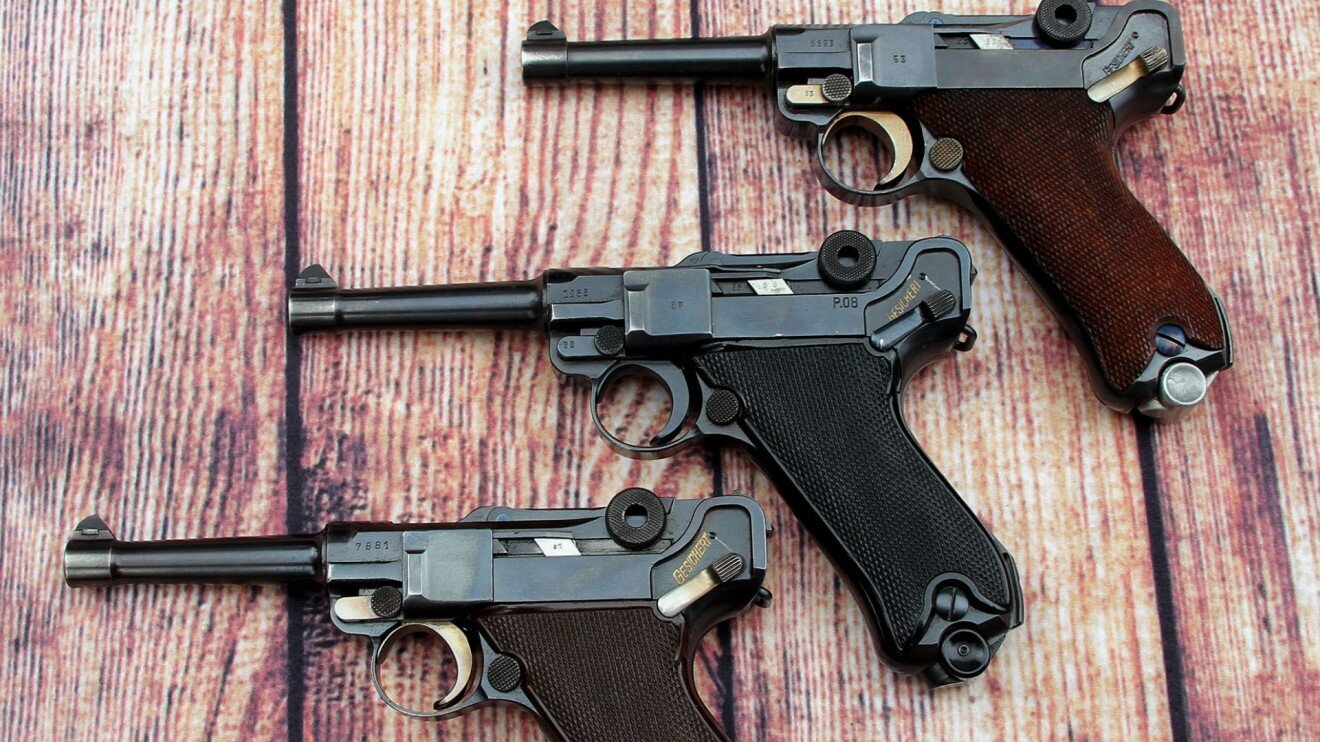
The Parabellum pistol, widely known as the Luger (Luger P08), is one of the most recognizable firearms in world history. The name "Parabellum" comes from the Latin phrase "Si vis pacem, para bellum" ("If you want peace, prepare for war").
History of its creation
The pistol was developed by Georg Luger, based on a design by the Austrian gunsmith Hugo Borchardt. The first model, called the Pistole Parabellum, was patented in 1898. In 1908, the pistol was adopted by the German army as the Pistole 08 (P08).
Georg Luger: a biography of its creator
Georg Johann Luger (1849–1923) was born on March 6, 1849, in Steinach am Brenner, in the Austrian Empire. He was educated at the Vienna Commercial Academy. He did his military service in the 78th Infantry Regiment of the Austro-Hungarian army, where he developed a keen interest in firearms.
After his service, Luger worked as an accountant, but soon went to work for the arms manufacturer Ludwig Loewe in Berlin. In 1891, Luger became acquainted with the Borchardt pistol and saw potential for improving it. By 1898 he had modified the design, creating a more compact and ergonomic weapon.
Luger was not only an inventor but a talented marketer. He actively demonstrated his pistol to military departments in various countries and achieved considerable commercial success. Despite the success of his invention, Georg Luger died on December 22, 1923, in relative obscurity in Berlin.
Technical features
The Parabellum pistol has a number of unique characteristics that set it apart from comparable weapons:
- Locking mechanism: A unique toggle-lock system that ensures high shooting accuracy.
- Caliber: Originally 7.65mm, later 9mm (known as 9x19mm Parabellum).
- Magazine: Holds 8 rounds, located in the grip.
- Effective firing range: Up to 50 meters.
- Overall length: 222mm.
- Weight, unloaded: About 870g.
Why the Parabellum is considered an outstanding weapon
The Luger pistol was revolutionary for its time, for several reasons:
- Ergonomics: A comfortable grip angled at 55 degrees provides a natural hold and intuitive aiming.
- Accuracy: Thanks to a rigidly fixed barrel and the toggle-lock system, the pistol delivers exceptional accuracy.
- Reliability: With proper handling and maintenance, the mechanism operates without fail.
- Influence on the firearms industry: The 9x19mm Parabellum cartridge, developed for this pistol, became one of the most widely used pistol cartridges in the world.
- Cultural status: Thanks to its distinctive silhouette, the Luger became a pop-culture icon, a symbol of German weaponry in both world wars.
Historical counterparts and rivals
Several notable counterparts existed during the period when the Parabellum was developed and widely used:
- The Mauser C96: Another iconic German pistol, produced from 1896. Distinguished by its box magazine in front of the trigger guard and its distinctive grip.
- The Colt M1911: An American self-loading pistol adopted in 1911. It became one of the most successful pistols in history.
- The Browning M1900: A design by John Browning that had an enormous influence on the development of self-loading pistols.
- The Borchardt pistol: The Parabellum's predecessor, with a bulkier design featuring a return spring in a hinged grip.
Legacy
Although production of the Luger pistol ended after the Second World War, its influence on the firearms industry endures to this day. Modern collectors highly prize original Parabellums, and some companies produce replicas.
The 9x19mm Parabellum cartridge that Georg Luger created remains the standard NATO caliber and is used in dozens of modern firearms around the world — the best proof of its creator's genius.