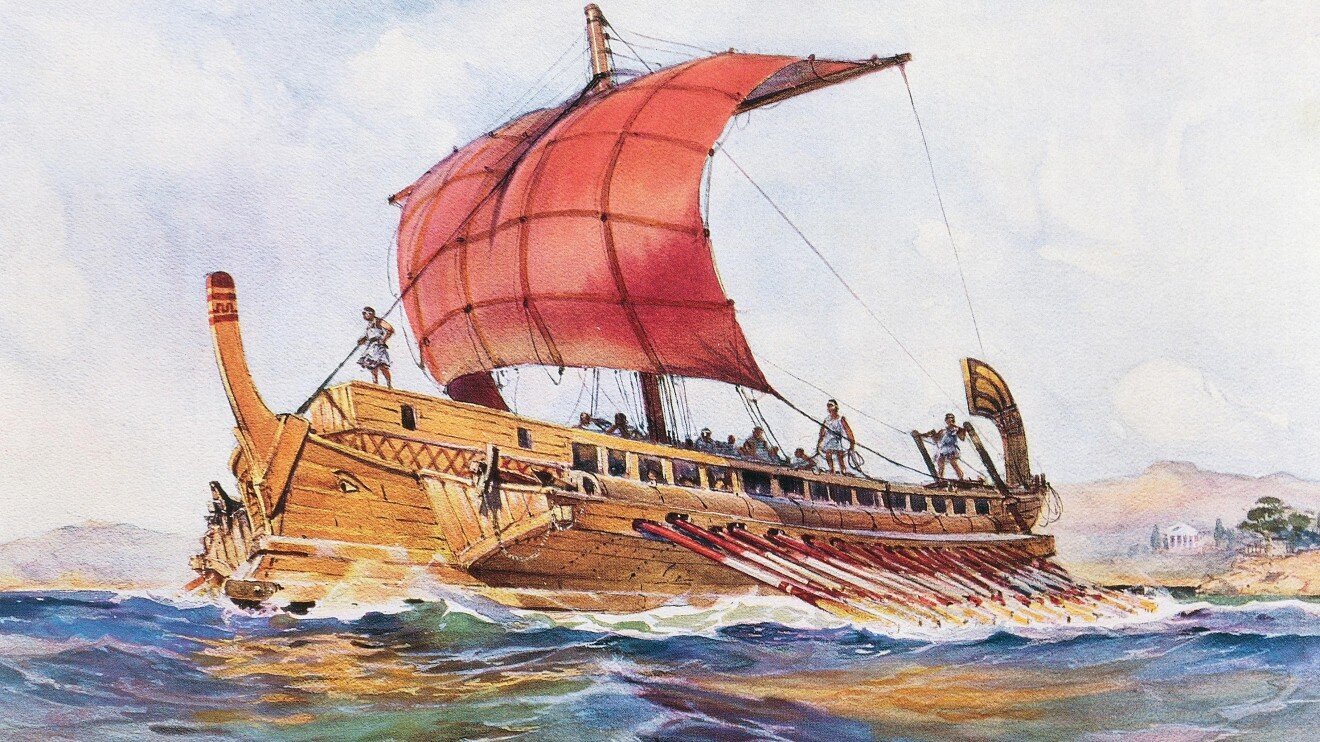
The Ship of Theseus paradox, also known as Theseus's ship, is one of the oldest and most intriguing philosophical puzzles concerning the nature of identity and the persistence of objects through time. Its essence can be put as a simple question: if every component part of an original object has been replaced, is it still the same object?
According to the ancient Greek myth, as retold by Plutarch, the legendary hero Theseus returned from the island of Crete to Athens by ship after defeating the Minotaur. The Athenians held the memory of that voyage sacred and preserved the hero's ship, regularly sending it on a sacred mission to the island of Delos. But time is relentless: before every voyage, the vessel needed repairs. Old, rotting planks were replaced with new ones. The process went on for decades, until the moment came when not a single original plank remained.
It was at that point that a dispute broke out among ancient philosophers: could the fully renewed ship still be considered the very vessel Theseus had sailed? Or was it now an entirely new ship, simply built in the image and likeness of the old one?
Complicating the Paradox
Thomas Hobbes proposed a more complex version of the paradox that makes the problem even thornier. Imagine that none of the replaced planks were thrown away, but were carefully stored instead. Once enough of the old planks had accumulated, someone decided to build a second ship out of them, reproducing the original construction exactly. Now we have two ships before us:
- The first ship, which was continuously used and gradually renewed, but retained its function and historical continuity
- The second ship, assembled from the original planks, materially identical to the original vessel
Which of them is the true Ship of Theseus? The one that preserved continuity of existence, or the one made up of authentic materials?
Philosophical Solutions to the Paradox
Denying Identity Over Time
The ancient Greek philosopher Heraclitus of Ephesus proposed a radical solution to the paradox. His famous saying holds: "You cannot step into the same river twice." In Heraclitus's view, the world exists in a state of constant change, and the identity of objects over time is an illusion.
On this view, the ship in the harbor today and the ship in the same harbor yesterday are two different objects, even if not a single plank was replaced. Every moment in time constitutes a unique event. The water in a river flows, the molecules are constantly renewed — and so the river is constantly changing and is never the same river twice.
Plutarch quoted Heraclitus as saying that, owing to the swiftness and speed of change, a river "scatters" and "gathers" again, simultaneously coming into being and vanishing, "approaching and receding." This view radically rejects the everyday understanding of identity that most people rely on in ordinary life.
The Four-Dimensional Approach: Perdurantism
Modern philosophers such as Theodore Sider and David Lewis have proposed treating objects as four-dimensional entities, extended not only in space but also in time. This theory is known as perdurantism, or the "worm theory."
Picture an object not as a three-dimensional thing existing at a single moment in time, but as a four-dimensional "worm," stretched out along the time axis. Under Heraclitus's conception, a river becomes a four-dimensional object in which every temporal "slice" contains different water, but all those slices together make up one and the same river.
On this approach, the Ship of Theseus remains numerically identical to itself as a four-dimensional object, even though its three-dimensional temporal slices differ from one another. You could say you can't step into the same temporal slice of a river twice, but you can step into the same four-dimensional river twice.
Worm Theorists and Stage Theorists
Within perdurantism there are two subgroups:
- Worm theorists hold that a persisting object consists of distinct temporal parts, extended through the block universe the same way physical objects are extended through space. Chairs, mountains, and people are four-dimensional worms stretching through spacetime.
- Stage theorists (exdurantists) treat an object as a specific temporal part, or stage, at each given moment. A subject exists only for an instant, but is connected by special relations to other temporal parts in the past and future.
The Aristotelian Solution: The Four Causes
Aristotle's school of philosophy offered a subtler solution, grounded in his doctrine of the four causes. According to Aristotle, every object is characterized by several types of cause:
- The material cause — what a thing is made of (planks, nails)
- The formal cause — what kind of thing it is, its essence and structure (a ship of a certain shape)
- The efficient cause — who made the thing and how (the shipwrights, using certain tools and methods)
- The final cause — what the thing is for, its function and purpose (carrying people and cargo)
Aristotle argued that the formal cause matters most — the essence of a thing, its "whatness." The Ship of Theseus remains the same ship because its formal cause hasn't changed: its construction, shape, and purpose remain what they were. The material cause (the specific planks) has changed, but that isn't what matters most.
What's more, the ship kept serving the same ends: mythically, carrying Theseus; politically, convincing the Athenians that Theseus had really been a historical figure. The efficient cause, too, could be said to persist, if the same craftsmen used the same tools and methods when replacing the planks.
Numerical and Qualitative Identity
Some philosophers propose distinguishing two kinds of sameness:
- Numerical identity — being one and the same object in the strict sense
- Qualitative identity — objects being indistinguishable in their properties
After the first plank is replaced, the ship remains numerically the same (it's still that ship), but has changed slightly in its qualities. With every replacement, the qualitative difference grows, but numerical identity may still be preserved thanks to the continuity of its existence.
The trouble with this solution is that, once too many properties are brought into play, any possibility of identity collapses. For instance, a ship that changed its position in space without swapping a single plank could, by a spatial criterion, be considered a "different" ship.
Gradual Loss of Identity
On this view, identity isn't absolute — it gradually erodes as parts are replaced. The name "Ship of Theseus" is a true description only so long as the ship, and all its parts, remain directly connected to Theseus and took part in his legendary voyage.
A museum curator, before any restoration, can truthfully say: "This bed in the captain's cabin is the very bed Theseus slept in." But once the bed is replaced, that statement becomes false. A more accurate description would be: "A replica of Theseus's bed." The new bed is just as foreign to Theseus as an entirely new ship would be.
As parts are replaced, the new ship corresponds less and less to the original, and the gap widens with every repair. In Hobbes's version, the reassembled boat, built from the original parts, has a stronger claim to being the true Ship of Theseus, since its parts are the actual pieces of matter that took part in the hero's voyages.
One Ship in Two Places
This extravagant solution holds that both the repaired ship and the reconstructed one can lay claim to identity with the original, since both trace their history back to it. Both, therefore, are identical to the original.
Since identity is a transitive relation (if A = B and B = C, then A = C), the two ships are also identical to each other, and constitute a single ship existing in two places at once.
This solution looks absurd by the lights of common sense, but some philosophers defend the possibility of such a situation in special cases.
Conceptualism: The Ship Doesn't Exist
The radical position of conceptualism holds that no ship, as such, exists at all. A "ship" is merely a label, a concept created by the human mind to designate a particular organization of matter and energy in space and time.
The old "ship" is a concept. The new "ship" (with its parts replaced) is a different, analogous concept. If the two concepts were perfectly identical, the human mind couldn't compare them at all — there would be nothing to compare. It follows that the old and new ship cannot be identical, for the simple reason that people are capable of telling these concepts apart.
Cultural Analogues of the Paradox
Jeannot's Knife
French culture has its own version of the Ship of Theseus paradox — the expression "Jeannot's knife" (Le couteau de Jeannot). It's a knife that first had its blade replaced, then its handle, then its blade again, yet is still considered "the very same knife."
The expression comes from an 1779 play, Les battus paient l'amende, written by Louis-François Dorvigny. In the play, the servant Jeannot explains to Suzon: "But it's nothing, I'll give you another, a real knife from Langres, the best there is; you'll never see the end of it. It's already worn out two handles and three blades, and it's always the same one!"
In Spain, the same paradox is simply called "the family knife," and in Hungary, "Lajos Kossuth's pocketknife." The popularity of this image across different cultures shows how universal the philosophical problem of identity really is.
The Teleportation Paradox and Personal Identity
Derek Parfit's Thought Experiment
The British philosopher Derek Parfit, in his book Reasons and Persons (1984), carried the Ship of Theseus paradox over into the domain of personal identity, proposing a thought experiment involving teleportation.
Picture a teleporter — a device that scans your body atom by atom, then puts you to sleep and destroys you on Earth. Information about the position of every atom is transmitted to Mars at the speed of light. There, another machine reconstructs you out of local materials (carbon, hydrogen, and so on), in exactly the same arrangement of atoms.
The key questions:
- Is the teleporter a means of travel, or a means of killing someone and then producing a copy?
- Is the person on Mars the same person who stepped into the teleporter on Earth?
- Does the person destroyed on Earth continue to exist?
The person reconstructed on Mars will remember stepping into the teleporter, will feel the nick from that morning's shave on their upper lip, and will possess every memory the original had. But is this really a continuation of existence, or the creation of a perfect copy with the illusion of continuous consciousness?
Complicating It Further: Multiple Copies
Parfit takes the experiment further. Imagine the teleporter is modified so that it doesn't destroy the original, but instead produces an infinite number of copies of it. Each copy would claim to remember stepping into the teleporter on Earth. Each would be convinced it was the original, having successfully teleported.
If all the copies are identical and share the same memories, can each of them be considered "the same person"? Or does the existence of multiple copies prove that none of them is the original person?
Parfit's Conclusions
Working through thought experiments like these, Parfit concludes that any criterion for personal identity will turn out to be insufficient. There are no "further facts" about identity beyond physical and psychological connections.
What genuinely matters, in Parfit's view, is psychological connectedness — memory, character traits, beliefs, desires. If that psychological connectedness is preserved, then there is continuity of the person, even if strict identity may be called into question.
Parfit even suggests we might adopt the view that the copy on Mars isn't "someone else," but a different stream of consciousness belonging to the same "self." He writes: "I need not accept that my Replica on Mars is someone else... I can believe that I am now having another stream of consciousness, of which, within this stream, I am unaware."
Alternative Philosophical Positions
Daniel Dennett's Position: No Single "Self"
The philosopher and cognitive scientist Daniel Dennett offers a radical solution to the problem of personal identity. He argues that consciousness contains no single controlling authority, no unified subject, no "self" at all. The entire operation of consciousness is a system of spontaneously self-organizing processes.
According to Dennett, the idea that a "self" exists is one of the central philosophical myths embedded in Western philosophy ever since René Descartes and his famous "Cogito ergo sum" ("I think, therefore I am").
If there is no single "self," then the question of whether the original and the copy in the teleportation paradox have "the same self" simply doesn't make sense. There's no such entity to compare in the first place. There are only patterns of neural activity and information processes.
Daniel Kolak's Position: Open Individualism
The philosopher Daniel Kolak takes the opposite extreme, known as "open individualism." He argues that all people are, in fact, one and the same person. The "self" is identical across all people — there is only a single universal consciousness, manifesting through countless individual bodies.
On this view, the "self" of the original and of the duplicate is, of course, the same, because the "self" is the same in every being. Differences between individuals are merely surface manifestations of a single subject of experience.
This position has parallels in certain Eastern philosophical traditions, particularly Advaita Vedanta, which asserts the unity of Atman (the individual self) and Brahman (universal consciousness).
Practical Applications of the Paradox
Cryonics and Resurrection
The duplicate paradox has an important practical application for cryonics — the technology of freezing bodies or brains in hope of future revival. If cryopreservation of the brain could serve as a basis for precisely reconstructing a new brain from the preserved information, the question arises: would the reconstructed brain possess the same personality?
What's more, if a single brain can be created from the preserved information, there's no technical reason to stop at one reconstruction. Ten, a hundred, a thousand identical copies could be made. Would every reconstructed brain possess one and the same identity? Or would each copy be a separate person?
Digital Immortality
Similar questions arise around the idea of "uploading consciousness" into a computer. If it becomes technically possible to scan a brain and recreate its structure in digital form, would the digital copy be a continuation of the original person's existence, or a separate entity?
If the original person remains alive after the digital copy is made, it's clear these are two distinct persons. But if the person dies right after the copying, does that change the copy's status? Does it become a "true continuation"?
Philosophy of Law and Moral Obligations
Parfit extends the logic of his thought experiments to establish a new framework for morality and social regulation. He holds it immoral to cause harm to others. If we accept that psychological connectedness matters more than strict identity, we might conclude that society ought to protect an individual's "future selves."
Smoking tobacco, for instance, could be classified as a violation of your "future self's" right to a healthy life. Today's "you" harms tomorrow's "you." Even if strict identity between you today and you twenty years from now is questionable, the psychological connectedness is strong enough to speak of moral responsibility.
Parfit himself, however, doesn't endorse the aggressive paternalism and control over personal freedoms that this logic might seem to license.
Connections to the Philosophy of Space and Time
Presentism, Eternalism, and the Growing Block
The Ship of Theseus paradox is closely tied to fundamental questions in the philosophy of time. There are three main positions:
- Presentism holds that only the present truly exists. The past no longer exists, the future does not yet exist. On this picture, Theseus doesn't exist, because he died long ago.
- Eternalism holds that the dimension of time is analogous to the dimensions of space. All objects — past, present, and future — genuinely exist. Theseus exists at a particular temporal location, the same way distant galaxies exist at particular spatial locations.
- Growing block theory holds that the present and the past genuinely exist, but the future does not yet exist. The four-dimensional spacetime block of the universe grows as the future turns into the present.
The choice among these theories affects how the Ship of Theseus paradox gets resolved. For a presentist, the Ship of Theseus exists only in the present moment, and the question of identity concerns the relation between the current ship and memories of the ship in the past. For an eternalist, every temporal version of the ship exists, in reality, as parts of a four-dimensional worm.
Substantival and Relational Conceptions
Philosophical conceptions of space and time split into substantival and relational views:
- The substantival conception (Democritus, Epicurus, Newton) treats space and time as special entities existing in their own right, independent of material objects.
- The relational conception (Aristotle, Leibniz) treats space and time as special relations between material objects, outside of which they do not exist.
For a substantivalist, the Ship of Theseus exists "in" time as in some container. For a relationist, the question of the ship's identity is a question about the relations between different states of material objects.
Modern Interpretations
Quantum Mechanics and Nonlocality
Some philosophers have tried to connect the identity paradox to phenomena in quantum mechanics. The principle of nonlocality and quantum entanglement point to a level of reality deeper than ordinary three-dimensional space, where the very concept of distance ceases to apply.
The physicist and philosopher Michael Heller argues: "If you accept that the fundamental level of physics is nonlocal, everything becomes natural, since any two particles far apart from each other are, at that fundamental nonlocal level, in the same place. For them, time and space don't matter."
Can this principle be applied to the identity of objects? If, at the deepest level of reality, space and time aren't fundamental, then perhaps questions about the identity of objects over time also call for a revision of our intuitive assumptions.
An Information-Theoretic View of Identity
In the digital age, some philosophers propose an information-based approach to identity. On this view, an object's identity is determined not by its material substrate, but by the informational pattern it embodies.
The Ship of Theseus remains the same ship as long as a certain informational structure is preserved — its design, shape, functional organization. The specific planks are just carriers of information, which can be replaced without losing the information itself.
Likewise, a person's identity is an informational pattern realized in the neural connections of the brain. That pattern could, in theory, be transferred to a different substrate (biological or electronic) without any loss of identity.
This theory, however, runs into the problem of copying: if information can be copied, several identical patterns can be created. Are they all "the same" object, or different objects with identical content?
The Ship of Theseus in the Context of Consciousness and Self-Identification
Continuity of Consciousness
One of the key aspects of personal identity is the continuity of conscious experience. When we wake up in the morning, we feel like the same person who went to sleep the night before, despite the gap in conscious experience during sleep.
This intuition underlies many approaches to the problem of identity. If there is a continuous chain of mental states, linked by memory and causal connection, we tend to speak of identity as preserved.
But Parfit's teleportation paradox calls into question whether this criterion is sufficient. The teleported person has memories of continuous experience, but the original physical continuity was, in fact, broken. Is the feeling of continuity enough to constitute real continuity?
Déjà Vu and Glitches in Identity
In the context of the novel, the character Zhorik explains déjà vu as a "glitch," when the body connects to the wrong record of consciousness in the "table." This is a fantastical explanation, but it raises an interesting philosophical question: what if our sense of identity isn't a fundamental feature of reality, but rather a functional relation between the body and the stream of experience?
Some philosophical theories suggest something similar. Functionalism in the philosophy of mind, for instance, holds that mental states are defined not by their intrinsic nature, but by their functional role within a cognitive system.
Multiple Personalities and Splitting Identity
Real psychological phenomena, such as dissociative identity disorder (multiple personality), create practical versions of the identity paradox. If a single body can be "home" to several personalities, each with its own memories and character traits, what is the relation between the body and personal identity?
Split-brain cases also create philosophical puzzles. After the corpus callosum connecting the brain's hemispheres is severed, each hemisphere can display independent behavior. Does that operation create two persons in one body?
Critiques and Limits of the Various Solutions
Problems with Denying Identity
The Heraclitean solution — denying identity over time — seems philosophically radical but practically unworkable. If objects really don't preserve identity even from moment to moment, any meaningful judgment about the world becomes impossible.
We couldn't say "this chair is broken," because "this chair," at the moment of speaking, is no longer the object we started talking about. Promises would become meaningless: the person who made a promise yesterday isn't the person who's supposed to keep it today.
Still, defenders of this view might reply that we can speak of "practical identity" for everyday purposes, while acknowledging that strict metaphysical identity doesn't exist.
Problems with the Four-Dimensional Approach
Perdurantism and four-dimensional ontology solve some problems while creating new ones. Worm theory holds that we are four-dimensional objects, but our experience seems decidedly three-dimensional. We don't experience every moment of our lives at once; we experience only the present.
Stage theory tries to account for this, but runs into difficulties of its own. If I am only a momentary stage, connected by special relations to other stages, why should I care about the well-being of those other stages? Why should the suffering of "tomorrow's me" matter to "today's me"?
The Problem of Arbitrary Definitions
Many solutions to the Ship of Theseus paradox ultimately boil down to a choice of how to define "the same." This can look like dodging the problem. Is the question of a ship's or a person's identity really just a matter of linguistic convention?
Some philosophers accept this conclusion: the Ship of Theseus paradox shows that the concept of identity doesn't correspond to some objective feature of reality, but is a conceptual tool we apply more or less arbitrarily.
Other philosophers resist this conclusion, arguing that there must be an objective truth about whether a given object is the same as some past object.
The Philosophical Significance of the Paradox
Exposing Our Intuitions
The Ship of Theseus paradox is valuable because it lays bare the hidden assumptions in our ordinary thinking. We don't usually stop to consider what it means "to be the same object over time," but the paradox forces us to make our intuitions explicit.
It turns out our intuitions are contradictory. We want to say that a ship continuously used and repaired is "the same" ship. But we also want to say that a ship built from the original planks has a special connection to Theseus. Both of these wishes cannot be satisfied at once.
The Limits of Language and Thought
The paradox may point to fundamental limits in our language and conceptual schemes. Perhaps reality simply isn't organized in such a way that the question "Is this the same object?" always has a determinate answer.
Ludwig Wittgenstein argued that many philosophical problems arise from the misuse of language, from attempts to apply concepts outside their natural use. Perhaps the Ship of Theseus paradox is one example of exactly that kind of misuse.
Its Significance for Understanding the Self
When the paradox is applied to personal identity, the stakes rise. The question of whether I am the same person I was ten years ago, or whether I will be the same person ten years from now, carries deep consequences for ethics, law, and personal relationships.
If personal identity isn't strict, this bears on our concepts of moral responsibility (should I answer for actions committed by "me" in the past?), personal commitments (do promises made by a past "self" still bind?), and concern for the future (why should I care about the well-being of a future "me"?).
Conclusion: Embracing Uncertainty
The Ship of Theseus paradox has existed for more than two thousand years, and in that time countless solutions have been proposed, yet none has won universal acceptance. Perhaps that itself points to the fact that the problem has no single correct answer.
Different solutions may be more or less useful in different contexts. For a museum curator, material continuity matters — a ship made of the original planks carries special value. For the citizens of Athens, who used the ship for sacred ceremonies, functional and historical continuity is what matters.
The philosophical significance of the paradox lies not in finding a final answer, but in deepening our understanding of identity, time, and change. The paradox teaches us to treat our intuitions critically, to recognize the complexity hiding behind apparent simplicity, and to accept uncertainty where certainty isn't possible.
In the end, the Ship of Theseus reminds us that reality is richer than our conceptual schemes. The world isn't obligated to conform to our expectations of clarity and certainty. Sometimes the wisest answer to a philosophical question is to recognize that the question itself has been framed in a way that doesn't match the structure of reality.
And still we go on thinking about the Ship of Theseus, because through that thinking we come to understand ourselves better — beings who are continuously changing, while still holding onto a sense of our own identity, stretched from the past into the future.