The expression "Gorky Park," in the context of the 1990s, is an interesting case of a cultural shift in how the name of a famous Moscow park was used, influenced by a popular rock band.
The Maxim Gorky Central Park of Culture and Leisure
The Maxim Gorky Central Park of Culture and Leisure (abbreviated TsPKiO, or Gorky Park) is a Moscow park of culture and recreation, one of the capital's largest and most popular green spaces. The park opened on August 12, 1928, and in 1932 it was given the name of writer Maxim Gorky, to mark the 40th anniversary of his public and literary career.
The park sits on a picturesque bank of the Moskva River, close to the city center. Its formal garden section appeared in 1923, after the All-Russian Agricultural Exhibition was held on the site of the former Orlovsky Lug dump. The layout from the entrance to Neskuchny Garden was designed by the avant-garde architect Konstantin Melnikov.
At various times, outstanding architects worked on the park's design: El Lissitzky and Alexander Vlasov among them. The main entrance arch was built in 1955, to a design by architect Georgy Shchuko. Part of the TsPKiO occupies the historic Neskuchny Garden, laid out in the first third of the 19th century.
The park in the Soviet era
The park was originally created as the first Soviet "park of culture and leisure," intended to serve as a venue for broad political-education and cultural work among the working population. It was meant to be a place for "the mass propagation of Soviet culture and proletarian art."
In the 1930s, the park had an entertainment parachute tower — according to the American magazine "Popular Science," as of March 1935 this was the first structure of its kind in the world. The park had theaters, cinemas, and hosted large public events and exhibitions.
During the Great Patriotic War, the park continued receiving visitors, though its summer programming was devoted to wartime events. In the postwar period, the TsPKiO was restored after bombing damage. In 1947, the park was awarded the Order of Lenin for the quality of its "cultural service to the working population."
The band Gorky Park
Gorky Park (its international name) is a Soviet and Russian hard rock band, formed in 1987 by musician, composer, and producer Stas Namin at his SNC production center in Moscow. It is the only Soviet or Russian band ever to have charted on MTV and Billboard, achieving worldwide fame.
The original lineup included: guitarist Alexei Belov, vocalist Nikolai Noskov (both formerly of the band "Moskva"), bassist Alexander "Big Sasha" Minkov, guitarist Yan Yanenkov, and drummer Alexander Lvov (formerly of the band "Ariya").
The band's main springboard to popularity in the USSR, the US, and elsewhere was its appearance at the Moscow Music Peace Festival, organized by Stas Namin and Doc McGhee. The festival took place August 12–13, 1989, at Luzhniki Stadium, under the slogan "Rock Against Drugs," and was broadcast on MTV in 59 countries.
The band's worldwide success
Gorky Park performed at the festival alongside stars such as Bon Jovi, Ozzy Osbourne, Mötley Crüe, Scorpions, Cinderella, and Skid Row. After the festival, in August 1989, the American company PolyGram released the band's first and only studio album, titled "Gorky Park," recorded entirely in English by the original lineup.
The album made the Billboard 200 chart in 1989, bringing the band worldwide fame. As the Iron Curtain fell and Western interest in the Soviet Union grew, Gorky Park quickly became widely known. The band seemed a kind of symbol of American-Russian friendship.
The band's first music video, "Bang," got MTV rotation. Their next two singles — "Try to Find Me" and the collaboration with Bon Jovi, "Peace in Our Time" — received airplay on major radio stations.
Gorky Park's concerts often featured the band dressed in traditional Russian style, waving Soviet and American flags. In 1991, the band won a Scandinavian Grammis award for Best New International Artist.
The band's influence on how the park was perceived
The rise and international success of the band Gorky Park in the late 1980s and early 1990s had an unexpected effect on how certain segments of the population perceived the park itself. Young people drawn to Western rock music, and following the band's work, began using the English name "Gorky Park" or its Russian equivalent, "gorky park" ("bitter park"), in everyday speech.
This was especially typical of "hip" young people who listened to contemporary music and followed Western cultural trends. To them, the name "gorky park" sounded more modern and stylish than the official "Maxim Gorky Central Park of Culture and Leisure."
The wordplay rested on the fact that the writer Gorky's surname sounds like the English word "gorky" (evoking "bitter," the literal meaning of "gorky" in Russian), which gave the park's name a special flavor in an era of openness to Western culture. This linguistic pun reflected the spirit of the time — the period of perestroika and glasnost, when Soviet society was actively absorbing Western cultural influences.
The park in the 1990s
By the mid-1990s, Gorky Park was going through a difficult period of transformation. Most of the park was taken up by the "Chudo-Grad" ("Miracle City") entertainment complex, with rides, market stalls, and cafes. Admission to the park once again required a fee. Next to "Chudo-Grad" stood a competing complex, "Luna Park," also charging admission.
Between the two complexes there were 73 rides in total, ranging from children's attractions to extreme thrill rides. Many of the park's architectural and sculptural monuments were, by this point, badly in need of restoration. It was a time when the Soviet system of organizing leisure was giving way to new, often commercial, forms of entertainment.
From 1993 to 2014, Gorky Park held a 50-ton model of the "Buran" space shuttle, used for a time as an attraction. It served as a symbolic bridge between the heroic Soviet past and the uncertain post-Soviet present.
Cultural context
The use of the name "gorky park" in the 1990s reflected broader cultural currents of the time. This was a period when the Russian language was actively absorbing Anglicisms, and young people sought to underscore their connection to global culture by using "Western" names and terms.
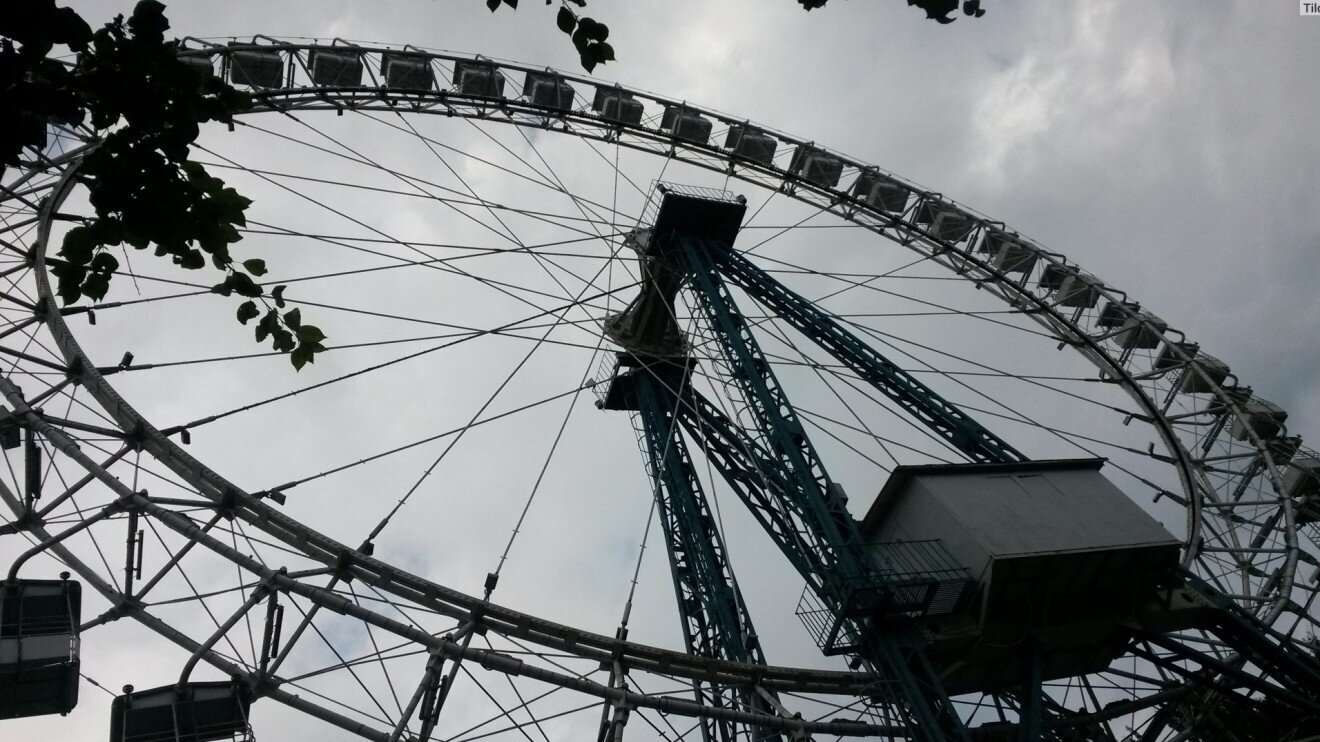
The phrase "riding the Ferris wheel in gorky park," used in the novel, thus points not just to a specific place (the Ferris wheel really did operate in the park from 1958 to 2008), but also displays the speaker's linguistic preferences, and their belonging to a particular cultural milieu.
Interestingly, the band Gorky Park, which had sparked this reinterpretation of the park's name, was already in decline by the mid-1990s. As music critics have noted, once the perestroika era ended, the band's fame in America faded fairly quickly, though they continued performing in Russia.
"Gorky park" in the 1990s, then, was not simply a geographic name, but a cultural phenomenon, reflecting the complex processes of cultural transformation in post-Soviet society, where the Soviet legacy intertwined with Western influences, creating a unique linguistic and cultural landscape for the era.