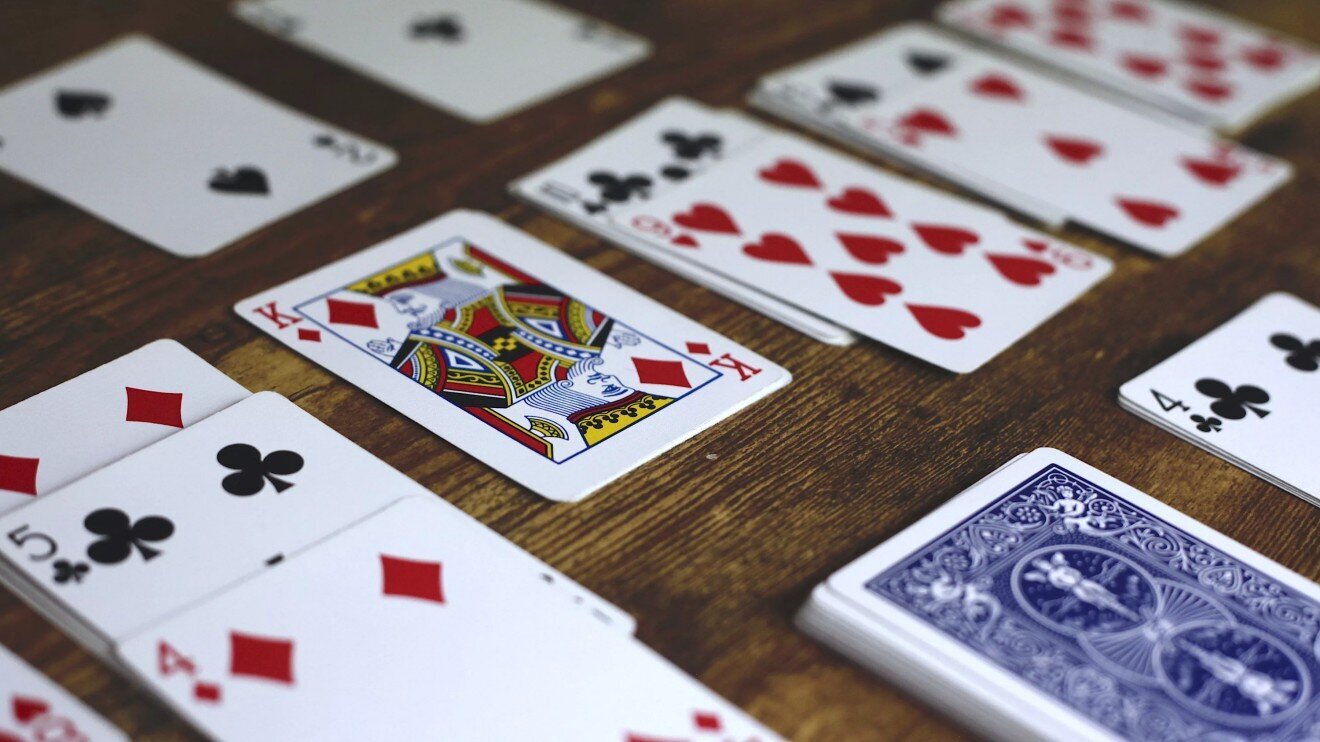
Solitaire (from the French patience) is a card-based puzzle game played by a single person. The game consists of arranging cards according to specific rules, aiming to sort them or reach a particular combination.
The history of solitaire
Solitaire's history stretches back to the 18th century. The first solitaire games are believed to have appeared in France, at the court of Louis XIV. Originally, they were used for fortune-telling and predicting the future, and only later became a pastime and a way to while away the hours.
In Russia, solitaire games became widespread in the 19th century, especially among the nobility. They're mentioned in many classic works of Russian literature, including those by Pushkin, Tolstoy, and Dostoevsky.
The goal of the game
The goal of most solitaire games is to arrange an entire deck according to specific rules, usually sorting cards by suit and/or rank. In some variants, cards must be gathered into special combinations, or particular cards must be freed up.
A key concept in solitaire is "coming out." A game "comes out" if the player manages to reach the goal, and "doesn't come out" if the rules prevent it from being completed successfully.
Main types of solitaire
- Klondike — one of the most popular solitaire games, familiar to many from the standard Windows game suite. The goal is to build four suit piles, ascending from ace to king.
- Spider — a complex solitaire game requiring sequences of cards of one suit, from king down to ace.
- FreeCell — a solitaire game that's solvable almost every time. It uses four free cells for temporarily holding cards.
- Solitaire — the general English-language term for many such games (in Russian, "pasyans").
- Pyramid — a solitaire game where cards are arranged in a pyramid shape, and the goal is to clear all cards by finding pairs that sum to 13.
- Napoleon at St. Helena — a difficult solitaire game with a low chance of coming out, said by legend to have been invented by Napoleon himself.
The symbolism of solitaire
In literature and culture, solitaire often serves as a metaphor for fate, a life's path, or fortune-telling. Laying out a game of solitaire can symbolize:
- An attempt to bring order to the chaos of life
- A yearning for control over one's own fate
- A search for answers to difficult questions
- Patience and method
Interesting facts
- There are more than 200 different solitaire variants, ranging from very simple to extremely difficult.
- Some solitaire games are mathematically unsolvable for certain starting arrangements of cards.
- Klondike became one of Microsoft's first computer games and played an important role in teaching users how to use a mouse.
- In tsarist Russia, special books existed describing various solitaire games and their fortune-telling interpretations.
- For many people, laying out a game of solitaire serves as a form of meditation and helps them focus.
The psychological dimension
Psychologists note that playing solitaire can have a calming effect on the nervous system, help structure one's thinking, and train attention. It's an activity that demands focus without causing much stress, making it a good way to relax.
In your novel, the line "Cold fingers with a flawless manicure laid out the solitaire of my new life" is a vivid metaphor: someone's hand (perhaps fate, or an influential person) methodically arranges the protagonist's future, like cards in a game of solitaire — governed by rules, but with an element of chance too.