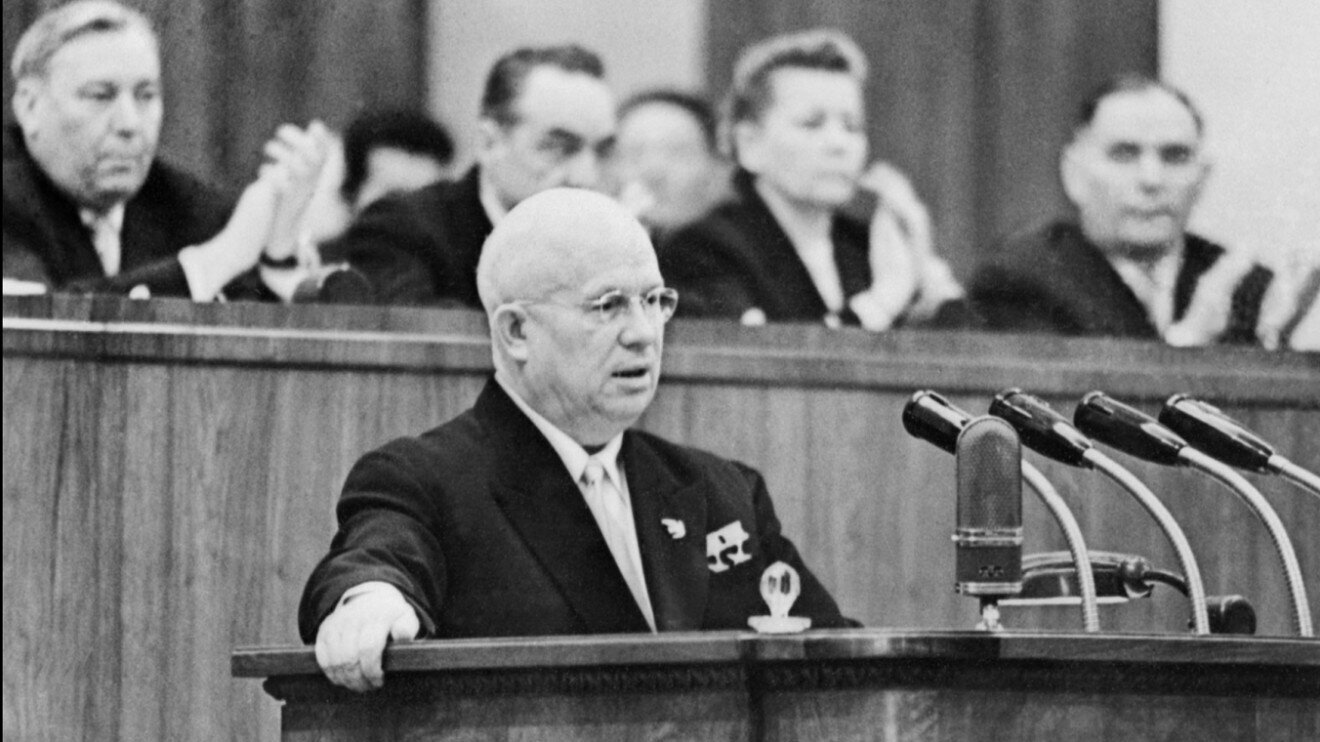
On February 25, 1956, at a closed session of the 20th Congress of the CPSU, Nikita Sergeyevich Khrushchev read out a report titled "On the Cult of Personality and Its Consequences." This document, which came to be known among the public as the "Secret Speech," became a watershed moment in Soviet history — the beginning of the official denunciation of Stalinism, a symbol of the end of the era of terror, and the first step on the road to the "Thaw." From that moment on, Soviet power admitted, for the first time, that crimes had occurred in its own history, laying responsibility for them on Joseph Vissarionovich Stalin.
Khrushchev's report was based on the work of a special Central Committee commission that included Pospelov, Komarov, Aristov, and Shvernik. The commission investigated the causes of the mass repressions of the 1930s–1950s, above all against the Party elite. According to its findings, more than a million and a half people were arrested in 1937–1938 alone, of whom around 680,000 were shot. The repressions touched not only the top Party circles — hundreds of thousands of ordinary citizens fell victim as well.
The report spoke of violations of the law, extrajudicial killings, fabricated "conspiracies," and the use of torture during investigations. Particular emphasis fell on Stalin's personal responsibility for organizing the terror and suppressing dissent. Khrushchev cited numerous examples from the archives, including NKVD directives, resolutions, and testimony about the brutality inflicted in its dungeons.
The report was a shock to the Party elite. The session at which it was read took place in complete silence and tension. As witnesses later recalled, even the military men, who might have been expected to object, said nothing. It was a genuine shock: for the first time from the podium of a top-level Party congress, harsh criticism was leveled at Stalin himself — a figure who had been elevated for decades to something close to a demigod.
Despite the closed nature of the session, the report quickly became known outside the USSR. Within a few weeks, copies began circulating among Communists abroad, and later in the Western press. Inside the country it was distributed to Party organizations, but was not published openly until the late 1980s.
It was from this moment that a new era in Soviet history began — Khrushchev's "Thaw," to be followed by decades of stagnation, and then by Mikhail Gorbachev's Perestroika. In that sense, the 1956 report was not only a political turning point, but also the symbolic start of a slow, but irreversible, unraveling of the Soviet system — a process which, in the view of the novel's character, "still can't manage to end, going all the way back to '56."