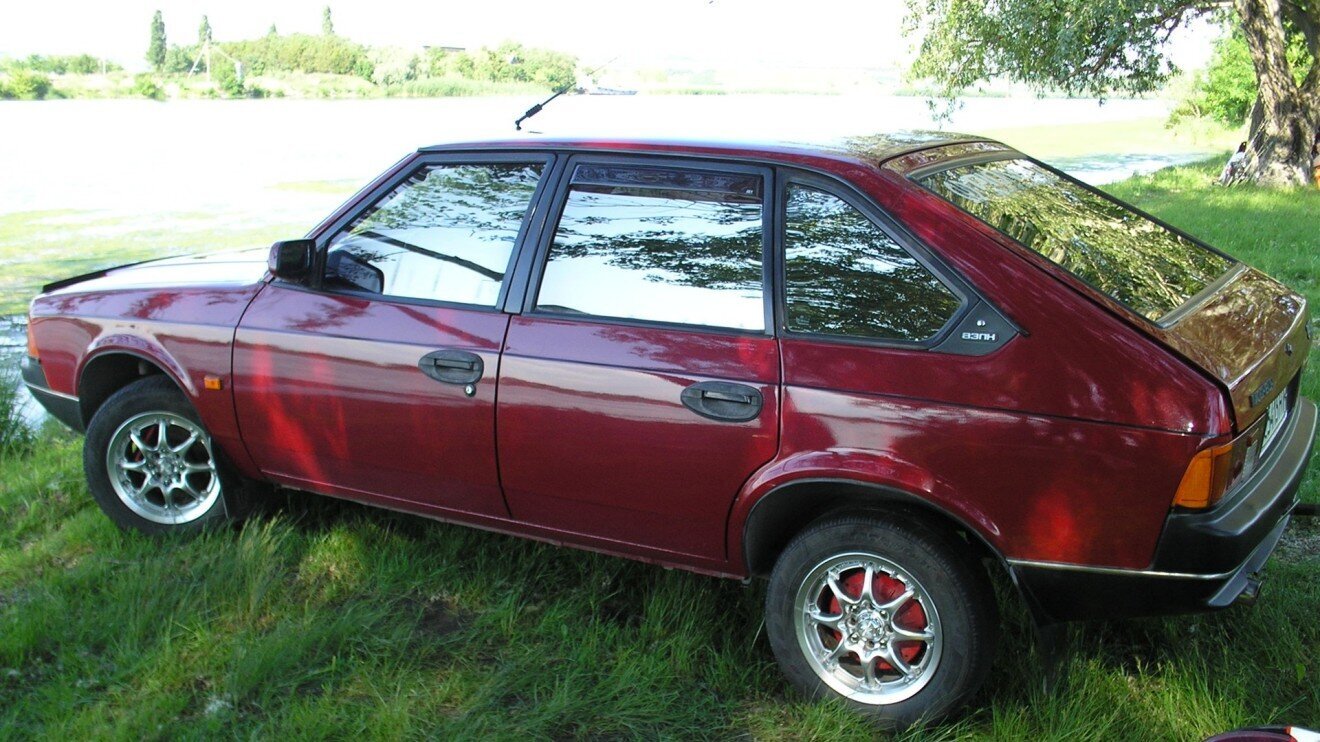
The "Moskvich-2141," known on export markets as the ALEKO (from "Avtozavod Leninskogo Komsomola," the Lenin Komsomol Automobile Plant), was the last significant achievement of Soviet car design and a symbol of the transition between the USSR and the new Russia.
Birth of a Legend
The arrival of a front-wheel-drive Moskvich in 1986 was a genuine sensation. For the first time since the early 1970s, AZLK's output could offer real competition to the Zhigulis coming out of Tolyatti. The new model differed radically from every previous Soviet car — a modern hatchback with front-wheel drive, MacPherson-strut suspension, and stylish design that looked like a visitor from the future next to the boxy "classic" models around it.
The "forty-first" cost around 9,600 rubles — almost half again as much as the popular VAZ-2106, immediately positioning it as a prestige car. By 1991 the price had climbed to 20,000 rubles, exceeding the price of the "Nine" (VAZ-2109) by two and a half thousand.
A Fun Fact
Contrary to popular belief, the Moskvich-2141 was not the most expensive Soviet car — the Volga GAZ-24-10 cost around 16,000 rubles.
French Roots and Soviet Realities
The story of how the model was created is wrapped in myth. It's true that the body of the French hatchback Simca 1308 — "European Car of the Year 1976" — was used as a prototype. But the claim that it was simply copied wholesale is an exaggeration. Only the upper body section and the window-seal profiles were taken from the Simca, while the entire structural frame, suspension, and drivetrain were designed from scratch.
The key difference lay in the layout: where the French car had a transversely mounted engine, Soviet engineers chose a longitudinal arrangement. The decision was forced on them — the engine bay had to accommodate the none-too-compact UZAM and VAZ-2106 engines.
"They brought us a body from the 'Simca,' which was supposed to serve as the basis for a mockup... We shaped the future 'forty-first' right on top of it. It was very hard going — for a month and a half, maybe two, I couldn't get my team to even approach that mockup! Everyone was so insulted..."
A Brief Moment of Glory
From 1987 to 1989, the Moskvich-2141 really was more prestigious than the Zhiguli, and even than the front-wheel-drive Sputnik. The car beat its rivals on interior space, came with a punchy 80-horsepower VAZ-2106 engine, and looked European and modern. Plenty of owners of Tolyatti-built cars eyed the owners of "forty-firsts" with envy.
The model's prestige, however, proved short-lived. With the arrival of the VAZ-2109 and, especially, the "ninety-three" and "ninety-nine" series, the Moskvich began losing ground. Build-quality problems, a tendency to rust (especially in the 1990s), and a lack of any real model-line development gradually eroded its reputation.
Eggplant and Other Details
The deep purple "eggplant" color mentioned in the text was one of the popular finishes for the Moskvich-2141. In an era dominated by white, gray, and blue cars, that color made a car stand out on the road and underscored its owner's status.
A Tragic Kind of Fame
The Moskvich-2141 gained a somber notoriety after the death of Viktor Tsoi in August 1990. An investigation found, however, that the crash was caused by the driver falling asleep at the wheel, not by any fault in the car's design.
Unfulfilled Hopes
The Moskvich-2141 was originally meant to get its own family of engines, including a 1.8-liter turbodiesel. AZLK even built an engine plant, 90–95% complete, but the economic crisis of the early 1990s and enormous loan obligations ($800 million) buried those plans. The equipment was stripped down and lost.
As a result, the "forty-first" was stuck with "borrowed hearts" to the end — UZAM and VAZ-2106 engines, and later French Renault F3R272 units. A small batch of cars was fitted with Ford XLD418 diesel engines.
A Symbol of the Era
By 1993, the Moskvich-2141 was no longer new, but it remained a symbol of success and prosperity. For many Soviet people it still represented a "dream car" — unattainable, modern, and prestigious. Seeing one show up in a village never failed to draw attention and stir up envy among the neighbors.
Production continued until 2002 (in a modernized version called the Svyatogor), but the model's peak popularity fell right at the turn of the 1980s–90s, when the "Aleko" really could be considered the dream car of the Soviet motorist.