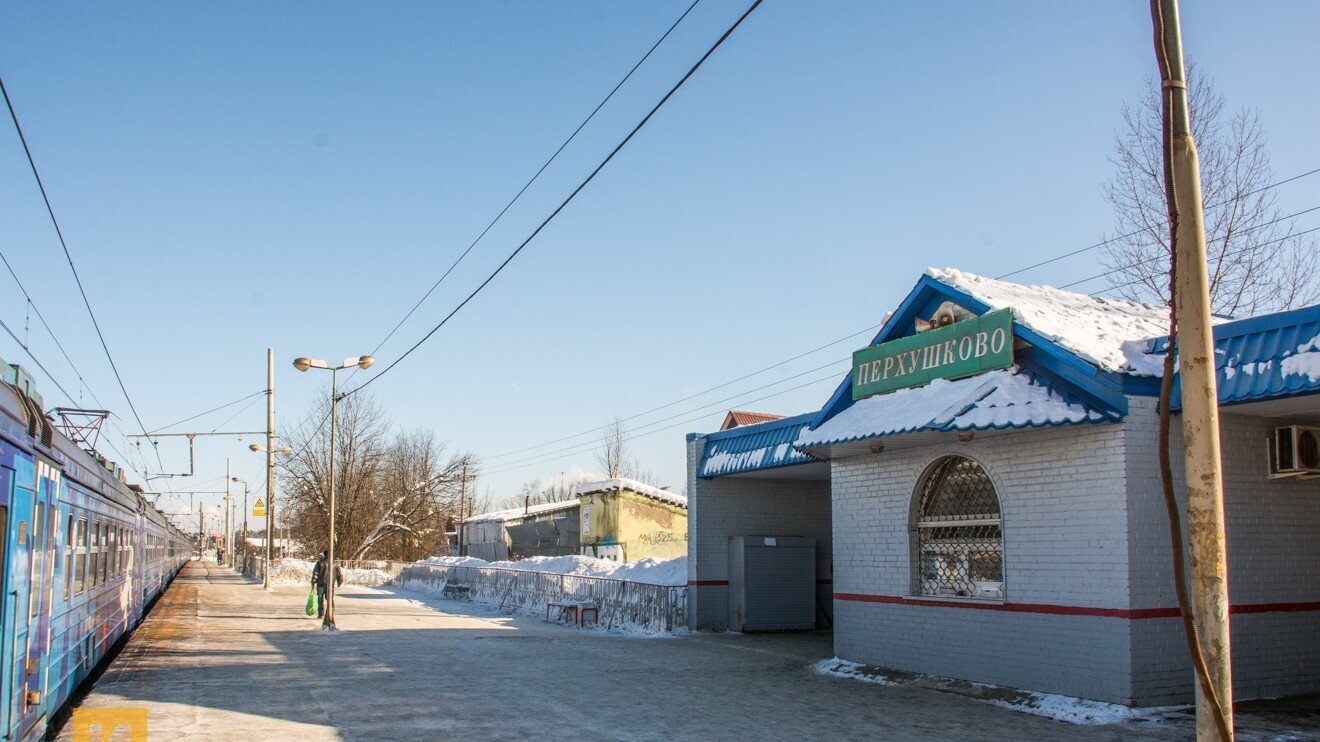
A village in the Odintsovo district of Moscow Oblast, located on the historic Mozhaisk Highway.
Geographic location
Perkhushkovo lies 32 km west of central Moscow, and 9 km west of Odintsovo. The village stretches along the Mozhaisk Highway, one of the main transport arteries connecting the capital with Russia's western regions.
The Medvenka River flows through the village. To the southeast lies the village of Trubacheyevka; on its other sides, the village is surrounded by meadows and dacha communities.
The origin of the name
The village's name comes from the surname of the voivode Grigory Perkhushkov, who was granted land here in the mid-15th century. The surname derives from "Perkhushka," a diminutive form of the name Perkhur — a colloquial variant of the male name Porfiry.
Historical significance
Perkhushkovo is not merely a village outside Moscow, but a genuine crossroads of Russian history. Located on the old Smolensk Road, from the 17th century onward it served as the first post station out of Moscow, through which passed all the major events of Russian history.
Early history (15th-17th centuries)
The first documented mention of Perkhushkovo dates to the late 16th century, when the village belonged to Semyon Fyodorovich Nagoy — uncle of Ivan the Terrible's last wife, Maria Fyodorovna Nagaya. After Ivan the Terrible's death and Fyodor Ioannovich's accession, the fortunes of the Nagoy family changed dramatically: the all-powerful Boris Godunov had them exiled to Uglich, where the tragedy of Tsarevich Dmitri would later unfold.
In 1610, Semyon Nagoy transferred a quarter of the village to the Luzhetsky Monastery in Mozhaisk. According to a 1627 census record, Perkhushkovo belonged to the steward Vasily Ivanovich Nagoy, with the monastery owning a portion. The village had 16 peasant and landless-peasant households, with 27 residents.
In the 17th century, the village was sometimes called Pokrovskoye, after a church built here in honor of the Feast of the Protection of the Mother of God. After Vasily Nagoy's death, the estate passed to his daughter Anna, who married Prince Pyotr Cherkassky.
The Cherkassky era (late 17th to first half of the 18th century)
In 1699, Princess Anna Vasilyevna Cherkasskaya bequeathed the village to her grandson — Prince Alexander Bekovich-Cherkassky, who went down in Russian history for the tragic Khiva expedition of 1717.
The Khiva expedition
On the orders of Peter the Great, Bekovich-Cherkassky led an expedition of 6,000 men to negotiate with the Khan of Khiva, search for gold, and scout a trade route to India. The expedition ended in disaster — the Khivans disarmed the Russian force, killing some and taking the rest prisoner.
Among the Cossacks, a saying long persisted: "died like Bekovich."
The estate's golden age: the Yakovlev era (mid-18th to mid-19th century)
In 1756, the village was acquired by Major General Mikhail Alexandrovich Yakovlev, under whom Perkhushkovo experienced its greatest flourishing. It was during this period that the estate's architectural character took shape.
The architectural ensemble
- 🏛️ The manor house — two stories (the first of stone, the second of wood), with a six-column portico
- ⛪ The Church of the Protection of the Mother of God — built of stone, in the Baroque style (1763)
- 🌳 A formal park with a pond
- 🏘️ Outbuildings
The estate's economy
By the end of the 18th century, State Councillor Nikolai Mikhailovich Yakovlev held 46 households and 510 serfs. Some peasants worked corvee labor, others paid quitrent, taking up carting work.
1812: the Patriotic War
Perkhushkovo, located on the road to Mozhaisk, found itself at the epicenter of the fighting. According to local legend, Napoleon spent a night in the Yakovlevs' manor house — the day after the Battle of Borodino, the French emperor stopped here to rest for the night.
"All night, a candle burned in the second-floor window. Perhaps it was here that Napoleon first felt a grim foreboding — for a dead silence greeted him in Perkhushkovo."
During the French presence, a partisan detachment under General I.S. Dorokhov was active in the surrounding area.
Literary connections
Alexander Herzen
From 1816, the village belonged to the sons of Herzen's grandfather, Alexei Alexandrovich Yakovlev. The writer visited Perkhushkovo on several occasions:
- August 1830 — learned here of the July Revolution in France
- 1834 — planned to marry his abducted bride here
- 1838 — stopped by with his young wife on the way to his father's estate
- Summer 1844 — his last visit
"The neglected manor house stood on the great road, surrounded by flat, cheerless fields; but after the closeness of the city, I found this dusty road quite pleasing."
Nikolai Gogol
May 18, 1840 — here, Gogol said farewell to his friends before leaving the country. As custom dictated at the time, those seeing him off would ride out to the first post station.
"Gogol bid us a tender farewell... He got into the carriage with our kind Panov, and we stood on the road until the carriage passed out of sight. Pogodin was genuinely upset, and Shchepkin dissolved into tears..."
Gogol promised to return in a year with the first volume of "Dead Souls" finished — and he kept his word.
Other literary connections
- Alexander Pushkin — passed through Perkhushkovo on his way to visit his grandmother at nearby Zakharovo
- Leo Tolstoy — visited here, gathering material for "War and Peace"
Decline and revival (mid-19th to early 20th century)
After the death of Alexei Alexandrovich Yakovlev, the last member of the family line, the estate passed to his former serf Zhilkin, who had become a merchant in Zvenigorod. By the late 19th century, the estate was in decline.
Administrative significance
As of 1890, the village, with 392 residents, served as the center of its volost (rural district). Here were located:
- The volost administration
- A village school
- A center of tailoring, with local craftsmen working for Moscow merchants
The 20th century: from revolution to the present
1926
Census recorded: 166 households, 894 residents
Infrastructure: a primary school, a reading room, a hospital, a credit cooperative, a village council
November 1941
Perkhushkovo housed the headquarters of the Western Front, under the command of G.K. Zhukov
The postwar decades
A collective farm was organized, and the village later became a dacha community
Perkhushkovo in 1993
By the early 1990s, Perkhushkovo was a typical village outside Moscow, going through a period of transformation. Its proximity to Moscow and its historic location on a major transport artery made it attractive to well-off Muscovites.
Population
Per the 1989 census: 272 households, 712 permanent residents
Infrastructure
- A district hospital with a septic ward
- A school (periodically threatened with closure)
- The active Church of the Protection of the Mother of God
Transport
- The Mozhaisk Highway (a federal route)
- The "Zdravnitsa" rail platform
- Bus service to Odintsovo and Zvenigorod
The construction boom of the early 1990s
During the period of economic liberalization, Perkhushkovo, like many villages outside Moscow, became an attractive site for New Russian entrepreneurs to build country houses. Its historic setting, good transport access, and relative proximity to Moscow made the village ideal for status-conferring country homes.
Advantages of the location
- 32 km from central Moscow
- A direct highway connection
- Rail access
- The site's historical significance
- Developed infrastructure
Types of construction
- Elite cottages
- Homes with full amenities
- Estates built in a historical style
- Dacha complexes
Architectural heritage
The manor house
A two-story building in the Classicist style (1760s), with a brick first floor and a wooden second floor (first half of the 19th century). Its facade is decorated with a six-column portico and a balcony. By the 1990s, it was in poor condition.
The Church of the Protection of the Mother of God
A stone church in the Baroque style, built in 1763 at the expense of M.A. Yakovlev. It was rebuilt twice in the 19th century. It remains active, and serves as a gathering point for worshippers from the surrounding settlements.
A historical destiny
Perkhushkovo is a unique example of how a modest village outside Moscow became a witness to, and participant in, key events of Russian history. Through this place passed the Time of Troubles, the Petrine reforms, the Patriotic War of 1812, and the revolutions of the 20th century.
"Here, in this modest village, runs a serious historical magnetic anomaly. As Nicholas Roerich put it, 'Something happened everywhere.'"
In 1993, Perkhushkovo continued to live within this history, while at the same time becoming a symbol of a new era — a time when successful entrepreneurs built their country residences here, continuing a centuries-old tradition in which this place was home to people who shaped the course of Russian history.