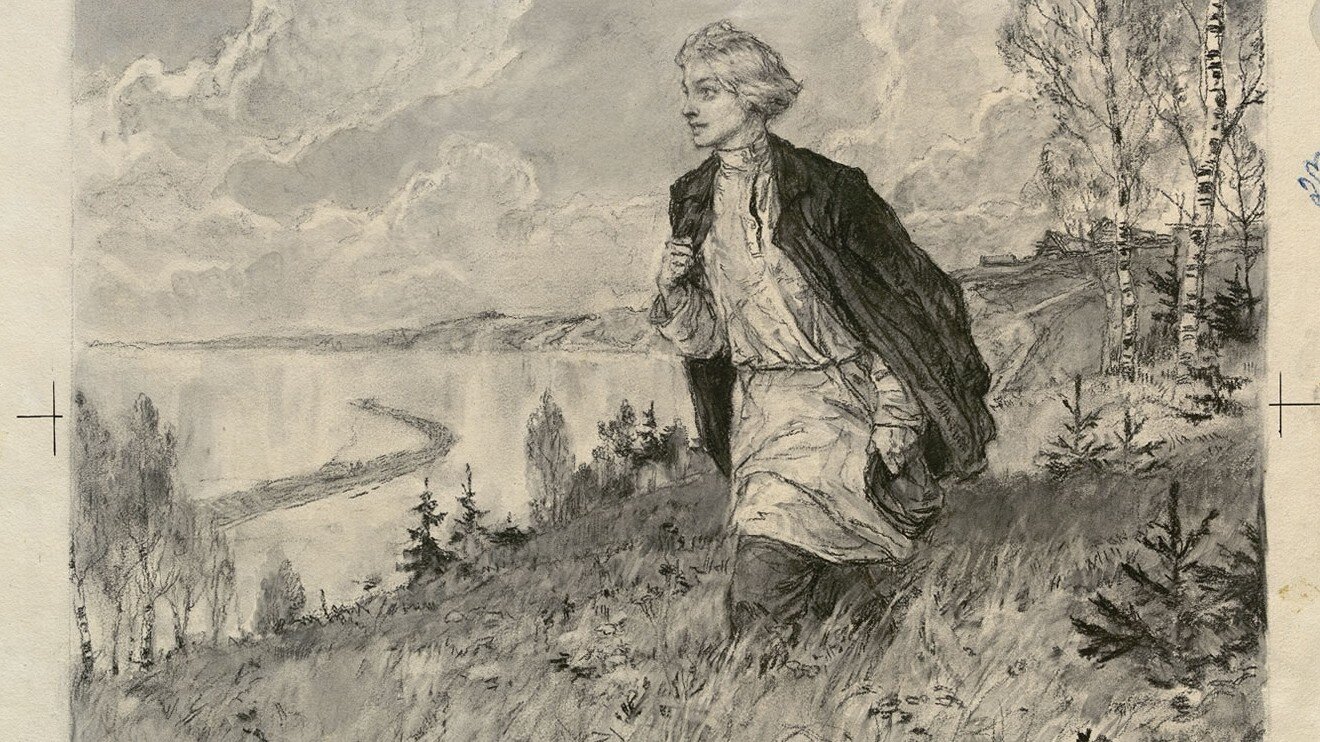
The lines the protagonist quotes come from the philosophical song of Grigory Dobrosklonov — a key character in Nikolai Nekrasov's unfinished poem "Who Is Happy in Russia?" (1863-1877).
Context within the poem
The song appears in the closing part of the poem, "A Feast for the Whole World," where the young seminarian Grigory Dobrosklonov reflects on two paths in life open to a person. It's a philosophical meditation on choosing between a selfish existence and service to higher ideals.
Amid this earthly realm
For a heart that's free
There are two roads.
Weigh your proud strength,
Weigh your firm will:
Which one to walk?
The first road — "the wide, well-trodden road" — is the road of passion, selfishness, and the struggle for material gain. It's this road the lines quoted in the novel describe:
One is wide —
A well-trodden road,
Slave to passions,
Along it, a huge crowd,
Hungry for temptation,
Marches on.
There, an eternal,
Inhuman
War of hatred boils
Over fleeting riches...
There, captive souls
Are full of sin.
The character of Grisha Dobrosklonov
Grigory Dobrosklonov is one of the most significant characters in Nekrasov's poem, embodying the ideal of a defender of the people and a fighter for justice. A young man from an extremely poor family (his father, an irresponsible deacon's assistant; his mother dead young of poverty), he studies at a seminary and lives half-starved, yet is full of love for the common people and faith in a better future for Russia.
The character's prototypes
Scholars see in Dobrosklonov traces of the literary critic Nikolai Dobrolyubov (their surnames sound alike), as well as autobiographical echoes of Nekrasov himself — both knew hardship in their youth and devoted their lives to serving the common people.
Symbolic significance
Within the poem, Dobrosklonov's song marks a key ideological moment. Seven peasant wanderers search all across Russia for a truly happy person, but never find one. Yet in the poem's finale, Grisha appears — a penniless seminarian who, despite poverty and hardship, finds true happiness in serving the people and believing in a brighter future.
Nekrasov never finished the poem — his death in 1877 cut the work short. But the figure of Dobrosklonov and his song became a symbol of the Russian intelligentsia choosing "the other — the narrow, honest road," a path of service to the "overlooked" and the "oppressed."
Relevance in the context of the 1990s
The protagonist's quoting of these lines in 1993 is no accident. The era of perestroika and the "wild '90s" became a time when many chose exactly "the wide, well-trodden road" — the path of quick enrichment, often at any cost. "An eternal, inhuman war of hatred over fleeting riches" describes the atmosphere of early Russian capitalism with striking precision.
Recalling Nekrasov's lines at a moment when the protagonist is watching a corporate drinking bash underscores the contrast between the lofty ideals of Russian literature and the prosaic reality of a time of transition.
Historical background
"Who Is Happy in Russia?" was written during a period of great social change — after the abolition of serfdom in 1861. Nekrasov sought to make sense of the fate of the Russian people during the shift from feudalism to capitalism, which lends his reflections a striking resonance with the 1990s as well.