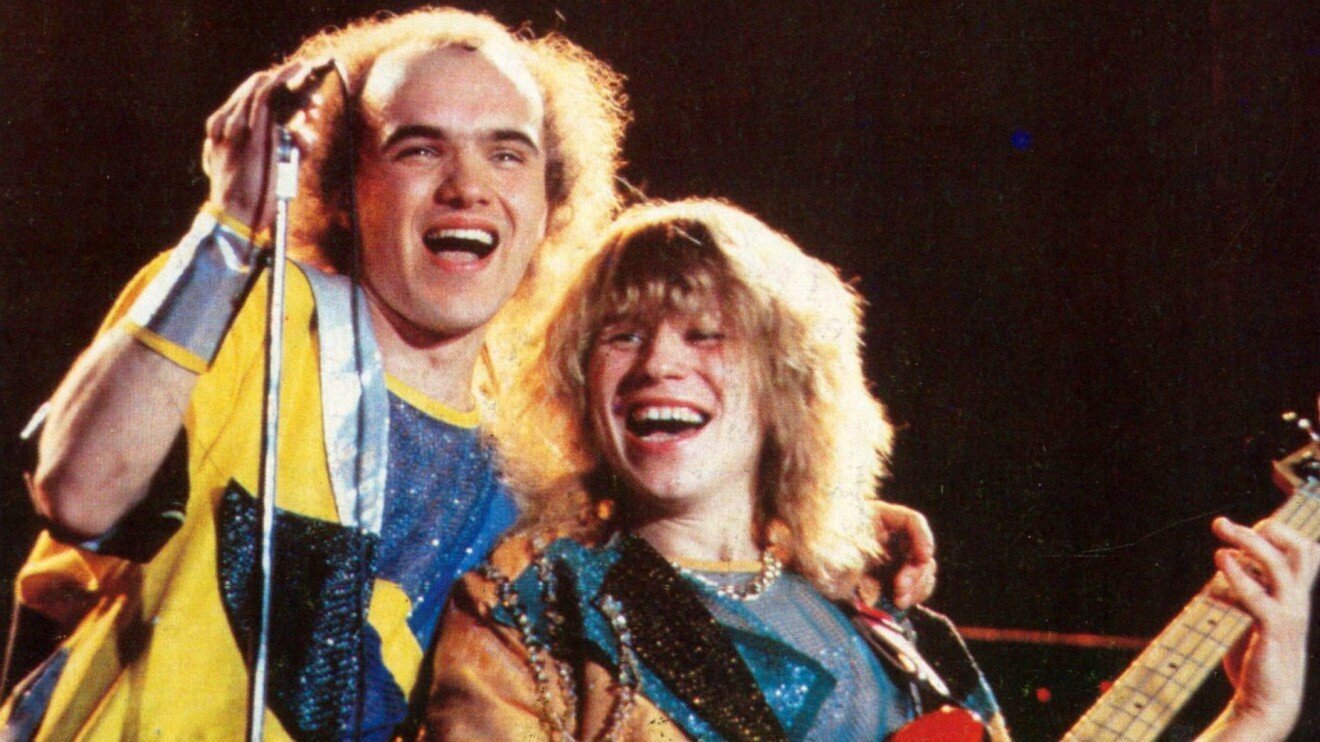
The novel mentions a cafe-diner called "Black Coffee and Langet," opened in the "Metallsnab" building on Warsaw Highway. The establishment's name is no accident — it echoes both the name of the legendary rock band "Cherny Kofe" ("Black Coffee"), the surname of its frontman, and the dish called "langet."
The band's history
"Cherny Kofe" is one of the most significant bands of the Soviet and Russian rock scene, founded in 1979 by Dmitry Varshavsky. The band's story began with the song "Strana" ("Country"), set to lyrics by Andrei Voznesensky, which Varshavsky wrote while studying at the Gnessin State Musical College.
The band's first professional recording — the track "Polyot Ptitsy" ("Flight of a Bird") — was made in 1981 at the Melodiya studio. By 1982, bassist Fyodor Vasilyev and drummer Andrei Shatunovsky had joined Varshavsky, forming the core of the band's early lineup.
Peak popularity (1986-1992)
The band achieved its greatest success in the second half of the 1980s. In 1987, it released the cult album "Perestupi Porog" ("Step Over the Threshold"), which sold nearly two million copies and became a landmark for metal fans of the time. The band toured extensively across the USSR and played prestigious festivals, including "Rock Panorama '87" at Luzhniki Stadium.
In 1988, "Cherny Kofe" took part in the San Isidro international festival in Madrid, a sign of the band's recognition abroad. That same year, they filmed their first music video, for the song "Vladimirskaya Rus,'" at the tsarist residence in Kolomenskoye.
By the late 1980s, "Cherny Kofe" was one of the most popular rock bands in the USSR, especially among fans of heavy music.
The connection to the metal-industry theme
The choice of the name "Black Coffee" for a cafe inside the "Metallsnab" building in the novel symbolically links two concepts: the metallurgical industry and rock culture. In real history, "Cherny Kofe" genuinely had close ties to "metalheads" — the subculture that took its name from its love of heavy metal music.
The band played the "Monsters of Rock USSR" festival in 1989 in Cherepovets — a major center of the metals industry. Such coincidences underscore the inseparable link between Russian rock culture and industrial cities, where metalheads made up a significant share of rock bands' audiences.
The situation by 1993
By the time the novel is set (1993), the band was going through a difficult period. In 1992, Dmitry Varshavsky moved to the United States, where he lived and worked until 1999. During this time, "Cherny Kofe" essentially stopped performing live in Russia, though the band's frontman continued recording and performing in America.
The mention of a "Black Coffee" cafe in the novel, then, reflects not just the band's popularity among metalheads in the early 1990s, but also hints at the band's own temporary "absence" from the Russian scene — much as the cafe itself appeared in an empty storefront.
Langet is a classic meat dish of Russian cuisine, consisting of thin, elongated slices of beef tenderloin, 8–10 mm thick, pounded and pan-fried, either breaded or simply in butter. The name comes from the French "languette," meaning "little tongue," reflecting the dish's characteristic elongated shape.
To make langet, beef tenderloin is cut into portioned slices, lightly pounded with a wooden mallet, rubbed with salt and black pepper, and then pan-fried in hot butter for 2 minutes on each side, until golden brown. It is served with pan juices, butter, and a side of fried vegetables or potatoes. In Soviet-era public catering, langet was considered a restaurant dish.
The name of the cafe, "Black Coffee and Langet," contains a pun, since "langet" sounds like the medical term for a type of plaster splint used to immobilize a limb after a fracture. This wordplay between an elegant meat dish and an orthopedic device is especially fitting for an establishment catering to "hardened metalheads" — members of a subculture known for its disregard of convention and its dark sense of humor.