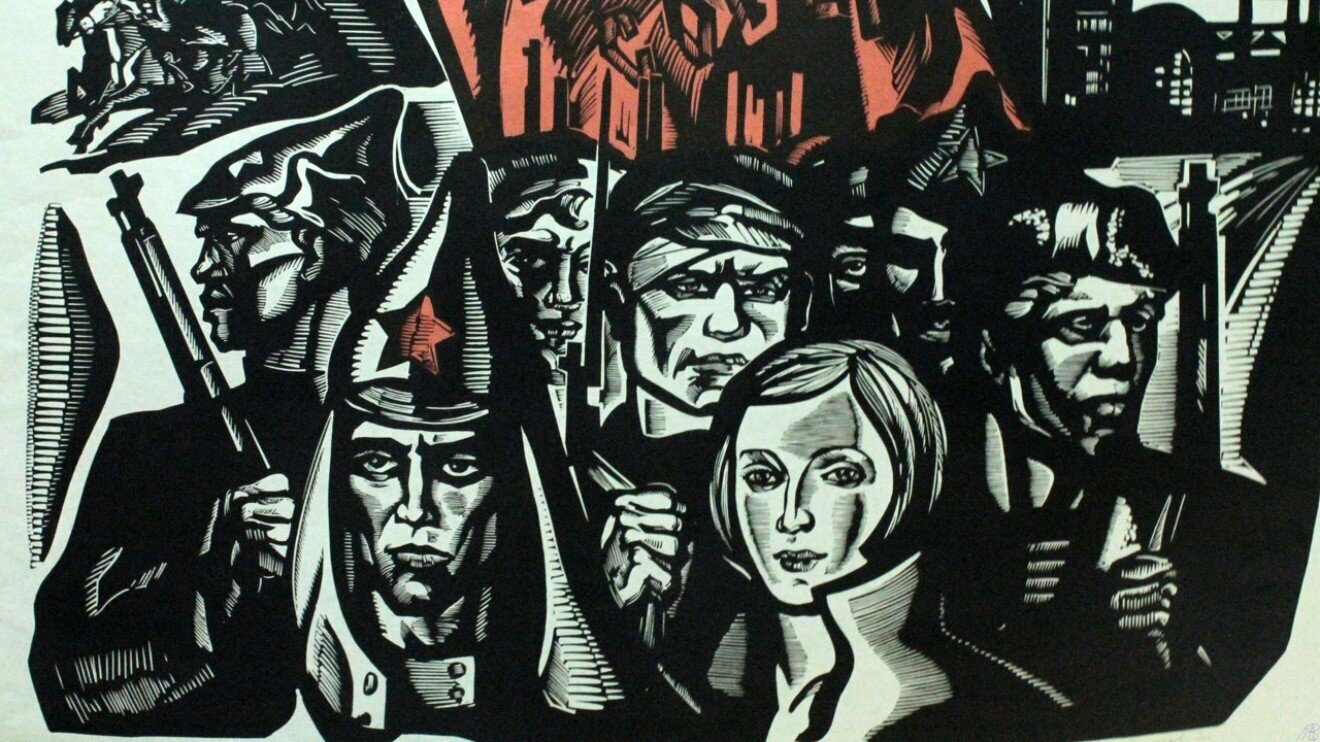
«The Farewell Komsomol Song,» also known by its opening line, «The order has come: he goes west…», is one of the most poignant songs of the Soviet era, written in 1937. The lines quoted in the novel belong to this very piece, which became an unofficial anthem of wartime partings.
How It Came About
The poem «Parting» came from the pen of Mikhail Vasilyevich Isakovsky and was first published on February 4, 1936, in the Smolensk newspaper «Bolshevik Youth.» The text was later reprinted by the magazine «Young Collective Farmer.» A year later, the same magazine published the verses set to music, under the title «The Farewell Komsomol Song» — the music was written by composer Dmitri Pokrass.
Notably, Isakovsky was inspired by a scene from the film «Girlfriends» (1935), which shows a Komsomol rally after which young people head straight to the front of the Civil War. The poet was deeply struck by the short, halting farewell dialogue between the characters, particularly the line: «Write to me!.. — Where? — I don’t know…», which transformed in the song into the aching: «Write… anywhere at all!»
Isakovsky also poured his own memories of the Civil War into the poem, having witnessed it in the Smolensk region in 1919, when he saw off his comrades, young Komsomol members from Yelnya, to the front.
Cultural Significance
The song gained particular popularity in the late 1930s, a period of the first military trials after the Civil War: the conflicts at Lake Khasan and the Khalkhin Gol River, the war with Finland, the liberation campaigns into Western Ukraine and Belarus. The lines «he goes west, and she the other way» captured the realities of that time exactly.
But the song won its true nationwide recognition during the Great Patriotic War, when its words of parting, hope of return, and the wish «if death, then instant, if a wound, then small» became a kind of incantation for millions of people, a promise of reunion after victory.
The Lyrics
The song has six verses telling a simple story, typical of its time: young people saying goodbye before the young man ships out to the front. The girl wishes him a «swift victory» and a safe return home, and he asks her to write him a «little letter.» She answers with a question: «But where should I write? How will I know your path?» And then comes the final, most piercing line: «It doesn’t matter,» he said quietly. «Write… anywhere at all!»
Performers and Interpretations
Over the years, the song entered the repertoire of many well-known performers. It was sung by Lyudmila Zykina, Leonid Utyosov, Iosif Kobzon, the ensemble «Pesnyary,» and many others. «The Farewell Komsomol Song» became one of the iconic songs about war and separation, even though it originally spoke of events from the Civil War.
Legacy
«The Farewell Komsomol Song» is a vivid example of how a song can outgrow the era of its creation and become a symbol of an entire age. The phrase «The order has come: he goes west…» turned into a cultural code, an instantly recognizable line evoking wartime, separation, and hope of return. In the context of a novel set in Russia in 1993, this quote draws a deep historical parallel between different eras of Russian history, underscoring the continuity of human experience and fate.