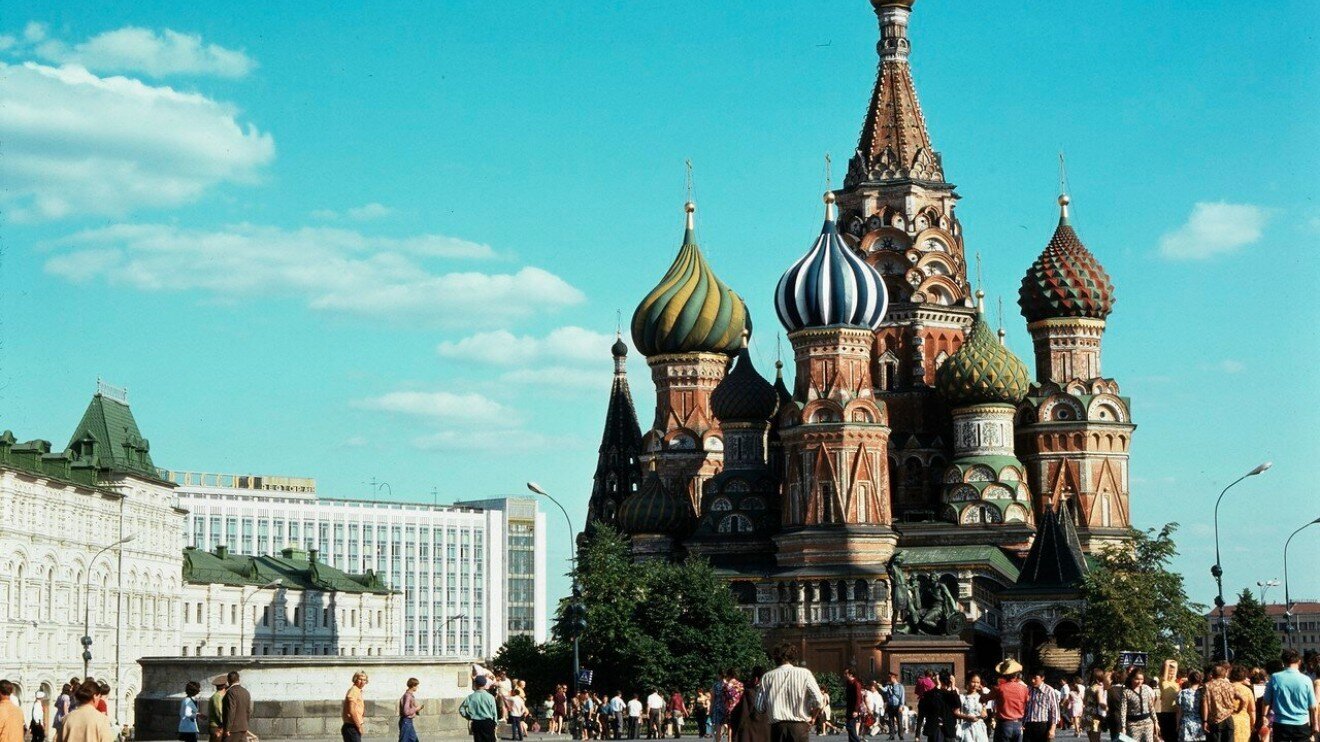
The Cathedral of the Intercession, better known as St. Basil's Cathedral, is an Orthodox church located on Red Square in Moscow. It's one of Russia's most recognizable symbols, a masterpiece of 16th-century Russian architecture.
The cathedral was built between 1555 and 1561 on the orders of Tsar Ivan IV (the Terrible) to commemorate the capture of Kazan and victory over the Khanate of Kazan. The architects are traditionally identified as Barma and Postnik (some sources hold they were one person — Postnik Yakovlev, nicknamed Barma).
Architectural features
The cathedral's uniqueness lies in its composition — the building consists of nine churches (chapels) united into a single ensemble. The central church is dedicated to the Intercession of the Theotokos, surrounded by eight pillar-shaped churches. Each is topped with a dome of distinctive shape and coloring, giving the cathedral its unmistakable, fairy-tale appearance.
Originally, the domes weren't as bright and colorful as they are today. Their current multicolored painting only appeared in the 17th century. Before that, the domes were either gilded or covered in white tin.
Basil the Blessed
The cathedral got its more popular second name from Basil the Blessed (Basil the Naked) — a Moscow holy fool, a popularly venerated saint who died in 1557. Basil was buried by the walls of the cathedral while it was still under construction, and in 1588 a tenth church was built over his grave. Over time, people came to call the entire complex "St. Basil's Cathedral."
Historical facts
There's a legend that Ivan the Terrible ordered the architects blinded so they could never build anything more beautiful. However, there's no historical confirmation of this legend.
In 1812, during the French occupation of Moscow, Napoleon reportedly ordered the cathedral blown up as his troops withdrew from the city, but the plan was never carried out, thanks to a sudden rainstorm that extinguished the fuses.
During the Soviet era, the church was under threat of demolition, since it stood in the way of parades on Red Square. According to one version of events, the architect Pyotr Baranovsky, who'd been ordered to prepare the cathedral for demolition, sent a telegram to Stalin threatening to kill himself if the church were destroyed. The cathedral was preserved and turned into a museum.
Since 1990, St. Basil's Cathedral has been part of the UNESCO World Heritage list, as part of the architectural ensemble of the Moscow Kremlin and Red Square. Today the church functions as a museum and is one of Moscow's major tourist attractions.
Religious services are held regularly on major Orthodox holidays, and the cathedral also houses a museum exhibit on the history and architecture of this unique landmark.