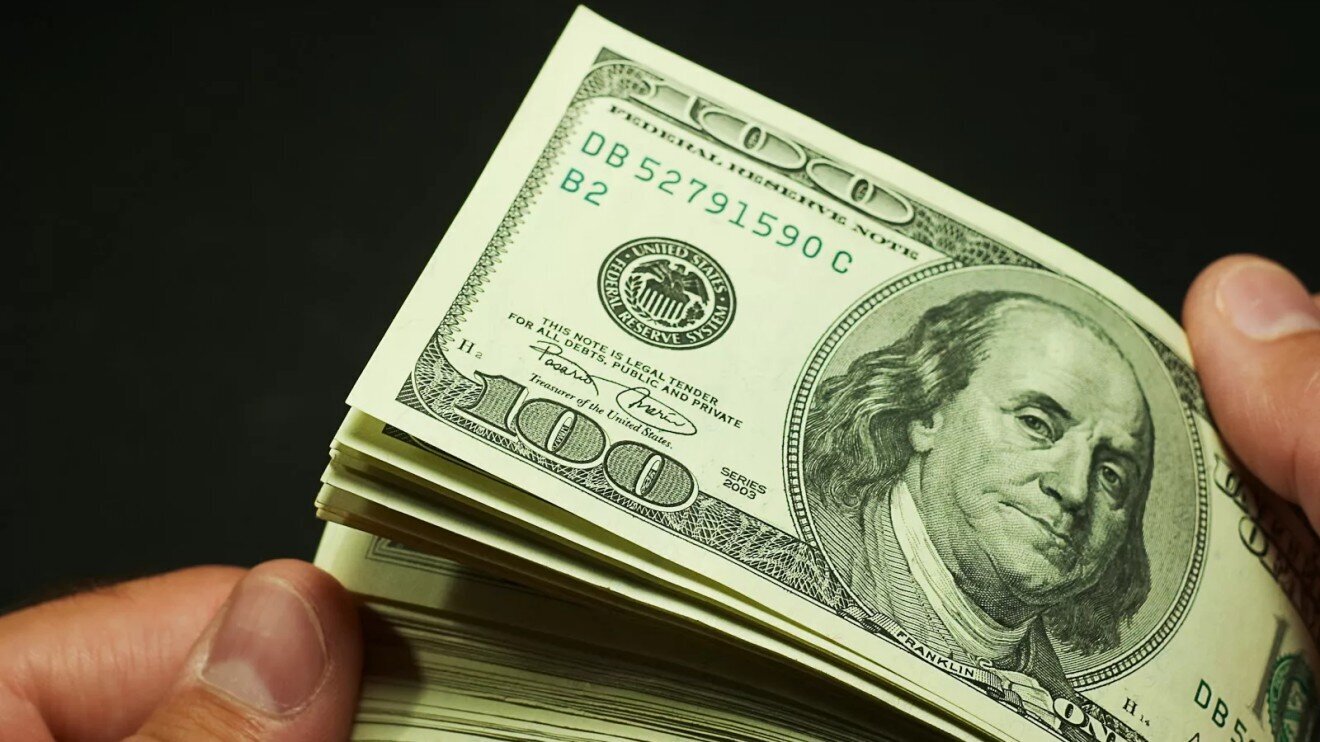
In early-1990s slang, «a grand and a half in greenbacks» meant fifteen hundred US dollars. «Greenbacks» was slang for American dollars, named for the distinctive green color of the bills. In 1993, this sum represented a significant amount of capital, equivalent to several years' salary for the average Russian.
The Dollar Exchange Rate and Its Trajectory
The US dollar's exchange rate against the ruble rose dramatically over 1993, reflecting a deep economic crisis. In January the rate stood at 417 rubles to the dollar; by December it had climbed to 1,247 rubles — a threefold increase over the year. The average annual rate hovered around 1,000 rubles to the dollar.
Runaway inflation reached 840 percent for the year, meaning the national currency lost roughly nine-tenths of its value. Prices changed literally by the day, and shops couldn't keep up with re-pricing their goods. People rushed to convert rubles into dollars or spend them on durable goods as quickly as possible.
The Purchasing Power of $1,500
To understand the value of fifteen hundred dollars in 1993, it helps to compare it against average incomes. The average salary nationwide was 58,700 rubles a month, or about 700,000 rubles a year. At the average annual exchange rate of 1,000 rubles to the dollar, that came to just $700 a year.
So $1,500 equaled more than two years' salary for the average worker. For a doctor with nine years' experience working a job and a half and earning 78,900 rubles a month (roughly 950,000 rubles a year), that sum equaled a year and a half of income.
Food Prices in 1993
Bread and Staples
Food prices in 1993 were strikingly out of proportion to people's incomes. Basic staples cost:
- Bread (a loaf) — 300 rubles
- A white baguette — 200 rubles
- Milk (1 liter) — 315-350 rubles
- Potatoes (1 kg) — 240 rubles
- Eggs (10) — 830 rubles
On the average salary of 58,700 rubles, a person could buy about 195 loaves of bread or 186 liters of milk a month. That meant bread and milk alone for a family of four ate up a significant share of household income.
Meat and Meat Products
Meat became a genuine luxury for most families:
- Pork — 2,600 rubles per kilogram
- Beef (fillet) — 2,200 rubles per kilogram
- Boiled «Lyubitelskaya» sausage — 1,100 rubles per kilogram
- Frankfurters — 3,500 rubles per kilogram
An average monthly salary bought only 22 kilograms of pork or 53 kilograms of boiled sausage. For a family, that meant a real constraint on meat consumption.
Dairy and Cheese
Dairy products were likewise expensive:
- Cottage cheese, 9% fat (500 grams) — 420 rubles
- Russian or Poshekhonsky cheese — 2,000-2,200 rubles per kilogram
- Cheese (average price) — around 3,000 rubles per kilogram
A kilogram of good cheese cost roughly the same as 10 liters of milk, or 1.5 kilograms of beef. $1,500 (1,500,000 rubles at the average annual rate) could buy 500 kilograms of cheese.
Grains and Sugar
Even simple grains weren't cheap:
- Rice — 280 rubles per kilogram
- Buckwheat — 600 rubles per kilogram
- Rolled oats, «Gerkules» brand (500 grams) — 150 rubles
- Sugar — 750 rubles per kilogram
- Salt — 81 rubles per kilogram
Fruits and Vegetables
Fruit became a luxury item:
- Oranges — 2,700 rubles per kilogram
- Bananas — 1,450 rubles per kilogram
- Lemons — 2,700 rubles apiece
- Apples — 1,000 rubles per kilogram
A kilogram of oranges cost as much as nine loaves of bread. $1,500 could buy 555 kilograms of oranges, or 1,500 kilograms of apples.
Alcohol and Tobacco
Prices for alcohol and tobacco:
- «Moskovskaya Osobaya» vodka (0.5 liters) — 2,200 rubles
- Domestic cigarettes — 300 rubles a pack
- Imported cigarettes («Monte Carlo,» «LM») — 550-3,000 rubles a pack
- «Chesterfield» cigarettes — 3,500 rubles
- «Marlboro» cigarettes — 4,500-4,700 rubles
Non-Food Goods
Clothing and Footwear
Clothing prices were disproportionately high relative to income:
- Women's coat — 150,000 rubles
- Children's tracksuit (plain) — 12,000 rubles
A woman's coat cost 2.5 average monthly salaries. $1,500 could buy 10 women's coats, or 125 children's tracksuits. This explains why many families kept wearing old Soviet-era clothes or altered them to make them last.
Household Appliances
Household appliances remained a dream for most families:
- Color television — 400,000 rubles
- Gold Star television — 1,200,000 rubles
- Domestic sofa bed — 210,000 rubles
- Samsung recording video player — 950,000 rubles ($950)
A television cost almost seven average monthly salaries. $1,500 could buy one good imported television, or three domestic color televisions, or a video player and a half.
Cars
The car market in 1993 ran mostly in dollar terms:
- Domestic car (average) — 9,000,000 rubles
- VAZ-21053 — $4,200 (4,200,000 rubles)
- GAZ-31029 — $6,500 (6,500,000 rubles)
- Audi 100, no papers — $1,500
A domestic car cost 153 average monthly salaries, or nearly 13 years' income. Fifteen hundred dollars was roughly a third of the cost of a new Lada, or a quarter of a new «Volga.» That's precisely why the market for undocumented used imports thrived — a relatively modest sum could buy a decent car.
Utilities and Medicine
Utilities
Utility payments in 1993 remained relatively affordable by today's standards. The average per-person charge was around 2,000 rubles plus roughly the same again for electricity. For a family of four, that meant about 8,000 rubles a month, or roughly 13-14 percent of the average salary.
Medicine
Some medications remained affordable:
- Nitroglycerin — 17 rubles
- Aspirin — 112 rubles
These were among the few items that stayed within reach for the general population.
Transport and Services
Public Transportation
Fares for public transport:
- City bus — 10 rubles a ride
- Moscow metro (summer) — 10 rubles per token
- Moscow metro (from autumn) — 30 rubles per token
A hundred rubles bought 10 bus rides, or 10 metro tokens in summer and just 3 in autumn. Public transport remained one of the few genuinely affordable services.
The Social Fabric
The Poverty Line
The official subsistence minimum in 1993 was 20,600 rubles a month. 46.1 million people — 31 percent of the population — lived below the poverty line. This statistic doesn't fully capture the reality, though, since prices ran 5 to 10 times higher than today's, while the subsistence minimum was only about twice today's level.
Pensions
The average pension in 1993 was 19,900 rubles a month. With that sum a pensioner could buy:
- 66 loaves of bread, or
- 63 liters of milk, or
- 7.6 kilograms of pork, or
- 83 kilograms of potatoes
Pensioners found themselves in a particularly dire position, since their income fell below the subsistence minimum. Many survived only thanks to relatives' help or produce from their own garden plots.
Wage Delays
A serious factor deepening the population's hardship was widespread delay in wage payments. Salaries were held up anywhere from one to six months. Amid galloping inflation, every month of delay meant a real loss of purchasing power measured in tens of percent.
What $1,500 Could Buy
Ways to Spend «a Grand and a Half in Greenbacks»
In the context of the novel, Zhorik's character buys an undocumented Audi 100 for exactly this sum — a typical use of that kind of capital. Alternatively, $1,500 (1,500,000 rubles at the average annual rate) in 1993 could:
- Buy an undocumented used foreign car (as in the novel)
- Cover a third of the cost of a new domestic car
- Buy 3,750 kilograms of pork
- Buy 500 kilograms of cheese
- Buy 5,000 loaves of bread
- Buy 10 women's coats
- Buy 3 domestically made color televisions
- Buy 7 sofa beds
- Support a family of four comfortably for 6-8 months
Reselling the Car
In the novel, Zhorik plans to resell the Audi for a «fiver» — five thousand dollars. A markup of $3,500 (a 2.3-fold gain) was entirely realistic for the undocumented used-car market of the time. Buyers were, in effect, paying for the possibility of legalizing the car through informal channels, or for simply using it «as is,» assuming all the risk themselves.
Five thousand dollars in 1993 was already serious capital, comparable to the cost of a new domestic car, or more than seven years' salary for the average worker. With that sum, one could start a small business, buy several used foreign cars to resell, or provide for a family for two years.
The Broader Economic Context
The 1993 Currency Reform
In the summer of 1993, the government under Prime Minister Viktor Chernomyrdin carried out a currency reform. Adult Russian citizens were allowed to exchange up to 100,000 rubles for the new currency, with a special stamp placed in their passport to record it. At the average annual exchange rate of 1,000 rubles to the dollar, that came to roughly $100. The restricted exchange period ran through December 31, 1993.
The exchange limit didn't apply to 10,000-ruble notes from the 1992 series. The reform was meant to withdraw old Soviet currency, as well as rubles still circulating in other former Soviet republics, from circulation.
Dollarization of the Economy
From January 1992 through the early 2000s, big-ticket purchases — cars, real estate, expensive appliances — were priced not in rubles but in hard currency, meaning US dollars and German marks. The ruble lost its function as a store of value and was used only for day-to-day expenses.
People rushed to convert rubles into dollars at the first opportunity. Currency exchange booths operated on every corner, and rates could shift several times a day. The dollar became, in effect, a parallel currency — savings were kept in it, prices for expensive goods were set in it, and salaries were paid «in envelopes» denominated in it.
The Shadow Economy
Trading undocumented cars, as in the episode with Zhorik, was part of a vast shadow market. By some estimates, 40 to 50 percent of the economy operated in the shadows. «Buy low, sell high» schemes flourished across every sector, from shuttle trading to real estate and car deals.
Undocumented cars were brought into Russia from Germany and other European countries, arriving through various channels: fraudulent insurance claims (as in the novel), theft, and gray customs schemes. Price depended on the method of acquisition and whether documents existed. A car with «clean» papers cost two to three times as much as the same model without them.
Conclusion
«A grand and a half in greenbacks» in 1993 represented a substantial sum, equivalent to more than two years' salary for the average Russian. Amid runaway inflation and economic chaos, the dollar became a genuine hard currency, a symbol of stability in an unstable world.
Prices for food, clothing, and durable goods were wildly out of proportion with people's incomes. A family with two working doctors could barely make ends meet. A third of the population lived below the poverty line, and pensioners survived on the edge of hunger.
In these conditions, the chance to earn fifteen hundred dollars on a single deal looked like a path to financial independence. Get-rich-quick schemes, undocumented trading, shadow operations — all of it marked an era when the old rules had stopped working and new ones hadn't yet taken hold.