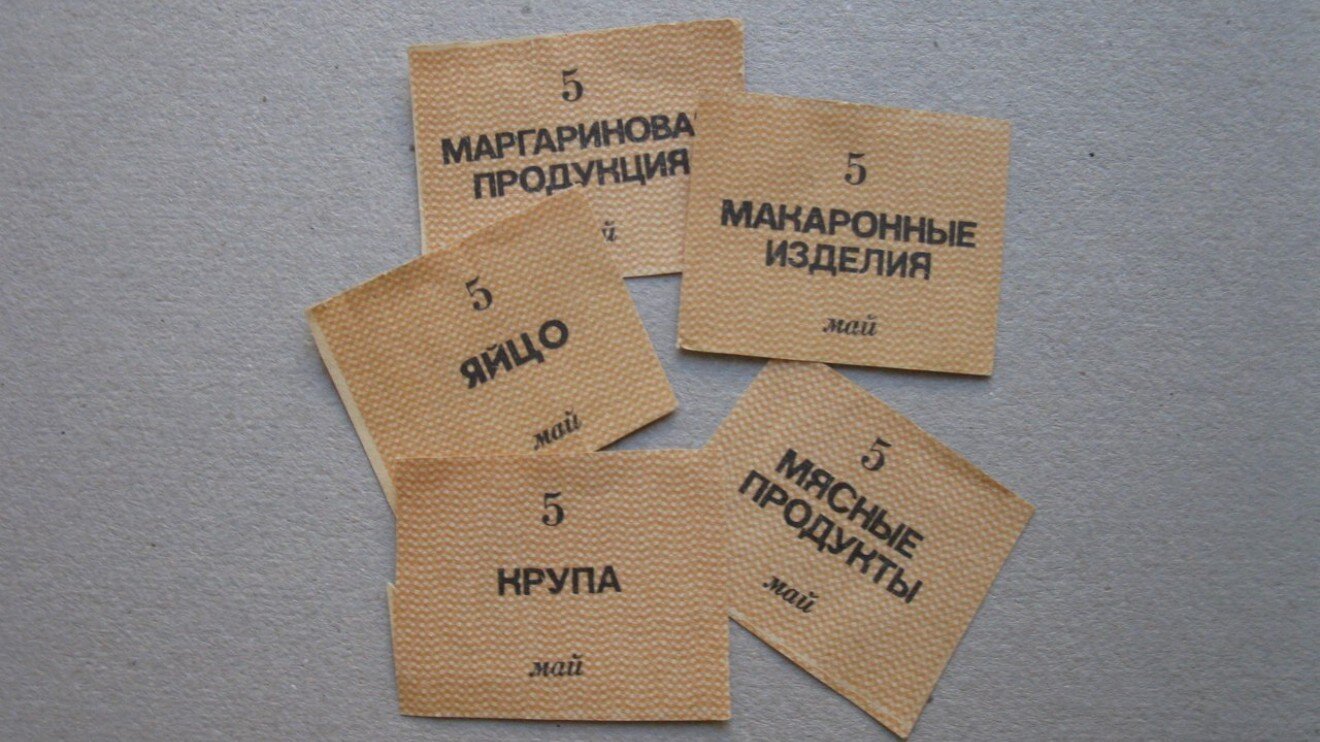
In the 1980s, the Soviet Union saw the return of a card-based system of distributing goods — a phenomenon many considered a relic of wartime. Coupons for meat, butter, sugar, and other goods became an inseparable part of the everyday life of Soviet citizens.
Historical background: the ration-card system before the 1980s
A card-based system of distributing goods was nothing new for the USSR. The first food ration cards appeared as far back as the Russian Empire, during the First World War. In 1916, coupons were introduced for scarce sugar, and by 1917 the system covered other goods as well.
In Soviet history, the ration-card system was introduced several times:
- 1917-1921 — the period of "War Communism," when the young Soviet state could not supply the population with the goods it needed
- 1929-1935 — the Stalinist period of industrialization and collectivization
- 1941-1947 — the wartime and postwar period
- 1980-1991 — a period of mounting crisis in the planned economy
Between these periods, ration cards were abolished, symbolizing the overcoming of economic hardship. Every return to rationed distribution, however, was a sign of serious problems in the economy.
The conditions that brought coupons back in the 1980s
By the late 1970s, the Soviet economy had begun to run into serious trouble. Several factors contributed to the growing shortages:
Economic causes
Falling oil-export revenue. The USSR traded heavily in oil, letting it buy food and consumer goods abroad. But the fall in world oil prices in the late 1970s and early 1980s significantly reduced its foreign-currency earnings.
The inefficiency of the planned economy. The centralized system of resource distribution couldn't respond adequately to shifts in supply and demand. Producers had no incentive to improve product quality or expand their range of goods.
Growth of the money supply. The state printed money to fund social programs and military spending, leading to hidden inflation — there was money, but nothing to buy with it.
Social factors
Changing consumer expectations. Soviet citizens, especially in major cities, began demanding higher quality and a wider selection of goods. The planned economy could not keep pace with these changes.
The shadow economy. A portion of goods flowed into "gray" distribution schemes — through connections, favors, and the black market. This worsened shortages in state retail.
The timeline of coupons' introduction in the 1980s
The coupon system was introduced gradually, first in individual regions, then spreading across the country:
The late 1970s to early 1980s
The first coupons appeared in major industrial centers. Sverdlovsk, Perm, Chelyabinsk, and Vologda introduced limits on buying meat and meat products. In Chelyabinsk Oblast, for example, the 1981 butter ration was:
- 200 grams a month for residents of Chelyabinsk, Magnitogorsk, and 5 other major cities
- 150 grams for smaller cities
- 100 grams for most other settlements
The mid-1980s
From 1985–1986, the coupon system began spreading more widely. Alongside the traditional coupons for meat and butter, restrictions were added for:
- Sugar and confectionery
- Buckwheat groats
- Vegetable oil
- Tobacco products
The late 1980s
This period saw the coupon system at its most widespread. In December 1989, Sverdlovsk introduced coupons for alcoholic beverages — one bottle of vodka (or another alcoholic drink) per family member per month.
On December 29, 1989, a "wine riot" broke out in Sverdlovsk — a crowd of thousands, gathered in line at the Central Grocery Store for alcohol ahead of the New Year holiday, blocked tram traffic on Lenin Avenue. Senior regional and city officials had to be called in to calm the crowd.
How the coupon system worked
Getting coupons
Coupons were issued at one's place of residence, through the housing management office (ZhEK) or student dormitories. The number of coupons depended on how many people were registered at the address. They were issued monthly, usually at the start of the month.
Additional goods, obtained by enterprises through barter deals with other organizations, could be distributed at the workplace, through trade union committees.
Using coupons
To buy a scarce item, one had to not only pay money, but present the matching coupon. Without a coupon, buying the item at a state store was impossible, even for a customer with cash in hand.
The oversight system was fairly strict. Buying meat under a "coupon-order," for instance, required two stamps: from the ZhEK that issued the coupon, and from the store making the sale.
Consumption norms
Typical monthly rations in the mid-1980s were:
| Item | Ration per person per month |
|---|---|
| Meat and meat products | 2 kg |
| Butter | 200 g |
| Vegetable oil | 500 g (per quarter) |
| Sugar | 1 kg |
| Buckwheat | 1 kg |
| Alcoholic beverages | 1-2 bottles |
The system's quirks and shortcomings
Coupons that couldn't be redeemed
One of the biggest problems was that even with coupons in hand, the goods themselves were often simply unavailable in stores. One memoirist writing about life in Yakutsk from 1986 to 1989 noted that over three years, he was never once able to redeem his meat and butter coupons — those items sold out in the first days of the month.
In Chelyabinsk Oblast, the meat-product situation worsened in 1985, and coupons were redeemable mainly for boiled sausage, pork, and "scrawny mutton."
Lines and social tension
Getting goods with coupons often required standing in line for hours. People would claim a spot the evening before, standing watch all night. In winter, harsh weather made this especially difficult.
A characteristic feature of alcohol lines was that people held onto each other by the waist, forming a "human chain," so no one could cut in.
The rise of a shadow market
The coupon system spawned an entire economy of resale and exchange. A market emerged for the coupons themselves — less scarce ones (for groats, say) were traded for more valuable ones (for cigarettes, alcohol, meat).
Vodka became a kind of currency. Even non-drinkers would redeem their alcohol coupons, either to resell them or to use as a thank-you for favors.
Regional variation
Differences in supply rations
Large and "closed" cities were supplied better than the provinces. This led to attempts to limit out-of-towners buying up goods. Local authorities partly introduced coupons to prevent visitors from stripping shelves of scarce goods.
A settlement's status directly affected its supply rations. Residents of regional centers received more than residents of district towns, who in turn received more than rural residents.
The northern regions
In remote northern regions, such as Yakutia, the coupon system was introduced earlier — already in 1986. This reflected the particular supply challenges of these territories, and their more acute shortages.
Rations in northern cities could be nominally higher, but actual availability of goods was worse, due to logistical problems.
Social consequences
Psychological impact
The return of the ration-card system, after decades without it, was a serious psychological blow for Soviet citizens. Many saw it as a sign of the socialist system's decay.
From the diary of Galina Pavlova, an accountant at the Institute of Mining (January 7, 1991): "Yesterday we were issued food ration cards. It makes me want to cry, the rations keep shrinking..."
The formation of consumer survival strategies
Citizens developed various strategies for coping with shortages:
- Stockpiling — buying goods in bulk whenever they appeared
- Barter — exchanging goods among friends and neighbors
- Using connections — getting goods through acquaintances in retail
- Switching to substitutes — taking up garden plots
Its effect on family diets
Limited access to meat and dairy seriously affected diets, especially for children and teenagers. Many families were forced to base their meals around potatoes, bread, and produce from their own garden plots.
This exact period shaped a generation that grew up under conditions of nutritional deprivation, which showed in young people's physical development.
The global context: ration systems in other countries
Wartime
During the Second World War, ration systems were in effect in many countries:
- The UK — butter, sugar, and bacon were rationed starting in 1940; by 1942, almost everything except bread and vegetables was rationed
- The US — from 1942, sugar, meat, tires, gasoline, bicycles, and shoes were rationed
- Germany — the imperial ration-card system included 62 types of cards
An important distinction: in Western countries, ration cards were abolished as goods markets recovered after the war. In the USSR, they returned during peacetime, owing to systemic problems in the economy.
Social support in market economies
In countries with market economies, food-assistance systems are used as a tool for supporting the least protected members of society. In the US, for example, the food-stamp program (SNAP) provided assistance to 46.7 million people in 2012.
The fundamental difference from the Soviet system: in market economies, coupons are meant to support the poor, not to ration goods universally amid a shortage.
Attempts at reform
Proposals for price reform
In 1986, the first secretary of the Volgograd Regional Party Committee proposed, at the 27th CPSU Congress, addressing the gap between supply and demand by reforming retail prices and abolishing coupons.
The country's political leadership, however, long hesitated to take the unpopular step of raising prices, preferring administrative methods of managing shortages instead.
Perestroika and the deepening crisis
Paradoxically, perestroika policy, aimed at reviving the economy, initially made shortages worse. The partial elimination of mandatory state deliveries and the end of the foreign trade monopoly led goods to flow out of state retail channels.
Exporting enterprises and cooperative businesses ended up with money not backed by an equivalent supply of goods, increasing inflationary pressure.
The end of an era: 1991-1992
By the late 1980s, the coupon system had reached its widest extent. Between 1989 and 1991, coupons were introduced for nearly every basic food and everyday necessity, including bread, milk, eggs, groats, tea, soap, and laundry detergent.
The system lasted until early 1992, when Russia began radical economic reforms. Price liberalization, the deregulation of trade, and the legalization of private enterprise quickly eliminated the shortages — though at the cost of a sharp drop in the population's purchasing power.
Conclusion
The 1980s ration-coupon system became one of the most vivid symbols of the crisis in the Soviet planned economy. It demonstrated the centralized system's inability to supply the population with even basic foodstuffs in peacetime.
For an entire generation of Soviet citizens, coupons became a symbol of the humiliation and failure of a system that had promised abundance under communism. The experience of living with coupons shaped a distinctive psychology of scarcity, whose influence was felt long after the ration-card system was abolished.
At the same time, the coupon system helped avoid outright famine, and ensured at least minimal guaranteed supplies for every segment of the population. It was one of the last expressions of the paternalistic character of the Soviet state, which tried to shield citizens from the effects of economic crisis through administrative means.
This historical note was prepared based on archival documents, memoirs, and studies of the Soviet period.