Background information on the technology of producing cola-type carbonated drinks, and on the particular features of whiskey blends in the early 1990s.
The technology of producing cola from syrup
The economic advantages of syrup-based production
Producing cola-type carbonated drinks from concentrated syrup was significantly more economical than importing the finished product. Key savings came from: a 10–15-fold reduction in transport costs, lower customs duties, and the ability to bottle locally.
The technology for producing cola from syrup is based on diluting a concentrated syrup with carbonated water, at a ratio of 1:5 or 1:6. The syrup contains all the flavor and aroma components, sugar, acids, and preservatives. At the production site, all that's needed is:
- Water treatment: purification, demineralization, chlorination of the water
- Carbonation: infusing the water with carbon dioxide under 3–4 atmospheres of pressure
- Mixing: precise dosing of syrup and carbonated water
- Bottling: filling bottles or cans, with immediate sealing
Advantages of syrup-based production
Economic
- Transport costs cut by 85–90%
- Reduced warehouse space needed
- Flexible production volume
- Lower customs duties
Technical
- Long shelf life for the syrup (up to 2 years)
- Consistent quality
- Can be adapted to local tastes
- Fast production start-up
The Coca-Cola recipe
The recipe for Coca-Cola has been a trade secret since 1886. Several versions of the recipe have, however, been found in archives. The most credible is one taken from the diary of the drink's creator, John Pemberton:
Coca-Cola syrup recipe (for 2.5 gallons)
Main ingredients
- • Sugar — 30 lbs (14 kg)
- • Water — 2.5 gallons (9.464 L)
- • Citric acid — 3 oz (85 g)
- • Caffeine citrate — 1 oz (28 g)
- • Vanilla extract — 1 oz (30 mL)
- • Lime juice — 1 quart (946 mL)
- • Coca leaf extract — 4 oz (118.3 mL)
- • Caramel color — for coloring
The secret ingredient, "7X" (2.5 oz per 5 gallons)
- • Alcohol — 1 quart (236.6 mL)
- • Orange oil — 80 drops
- • Lemon oil — 120 drops
- • Cinnamon oil — 40 drops
- • Coriander oil — 20 drops
- • Nutmeg oil — 40 drops
- • Neroli oil — 40 drops
Modern recipe changes
In today's cola formulas, coca leaf extract has been replaced with caffeine citrate, obtained as a byproduct of decaffeinating coffee. Its flavor and aroma now come from a combination of vanilla, cinnamon, and various essential oils.
"Johnnyson" whiskey: the origin of the name
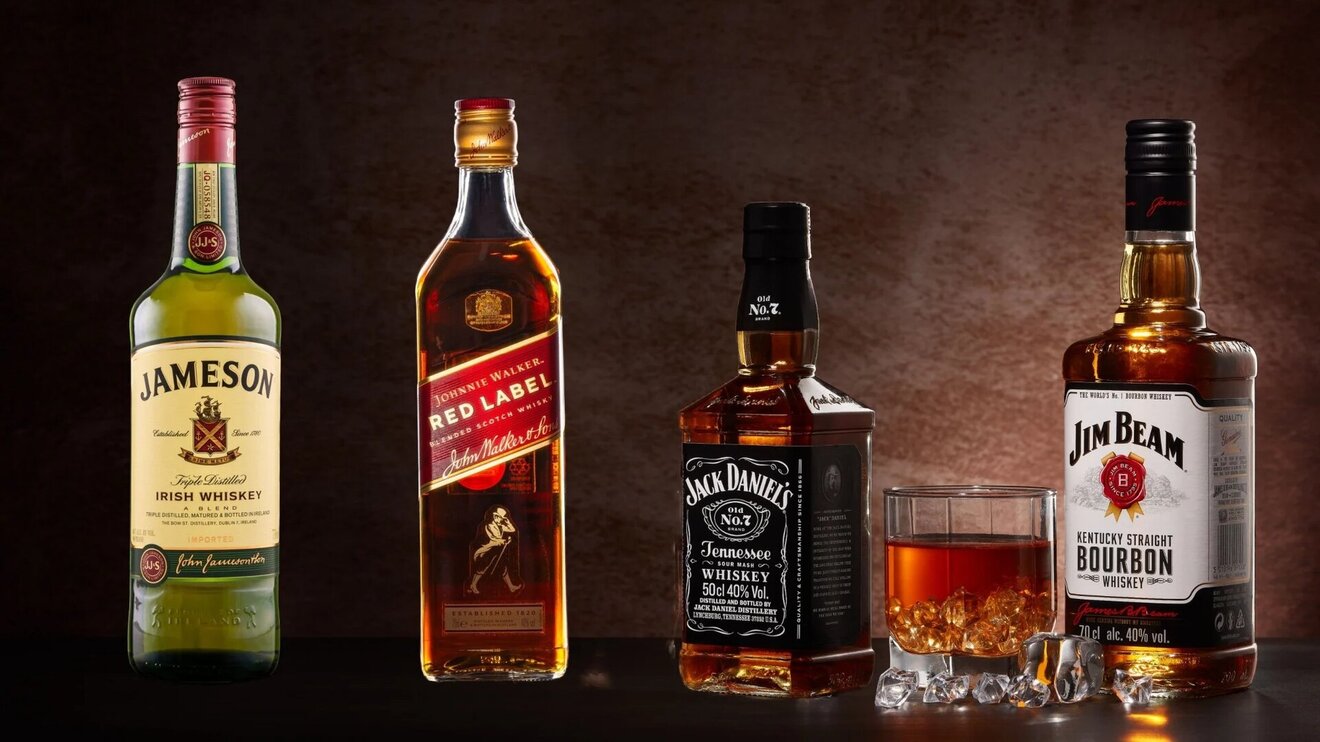
The name "Johnnyson" is a mashup of two famous whiskey brands: Ireland's "Jameson" and Scotland's "Johnnie Walker." Such naming was typical of products imitating well-known brands.
Jameson
Irish whiskey
- Founded: 1780, Dublin
- Founder: John Jameson
- Type: Traditional Irish whiskey
- Features: Triple-distilled, smooth flavor
- Production: New Midleton Distillery, County Cork
- Status: The world's most popular Irish whiskey
By 2019, sales exceeded 8 million cases a year. Owned by the French group Pernod Ricard since 1988.
Johnnie Walker
Scotch whisky
- Founded: 1820, Kilmarnock
- Founder: John Walker
- Type: Blended Scotch whisky
- Features: Complex blends, color-coded labels
- Production: More than 150 million liters a year
- Status: The world's most widely sold Scotch whisky
Sold in 120 countries around the world. Owned by the drinks giant Diageo.
Key differences between Jameson and Johnnie Walker
| Attribute | Jameson | Johnnie Walker |
|---|---|---|
| Origin | Ireland | Scotland |
| Distillation | Triple-distilled | Double-distilled |
| Character | Smooth, light | Complex, layered |
| Base | Single pot still, with grain whiskey added | A blend of 40+ varieties |
| Aging | From 4 years | From 3 years (Red Label) to 12+ years (Black Label) |
The technology behind whiskey knockoffs
Producing whiskey knockoffs in Eastern Europe rested on a few basic principles:
Rectified grain alcohol (from wheat, rye, or corn) was diluted to the desired strength (40–43%). To imitate the effect of aging, the following were added:
- Oak essence or oak bark extract
- Caramel color
- Vanillin, for smoothness
- Glycerin, for body
To imitate the taste of genuine whiskey, producers used:
- Smoky notes: a peat infusion, or liquid smoke
- Honey notes: honey, or a honey essence
- Fruit notes: apple or pear essences
- Spices: cinnamon, nutmeg, coriander
- Preparing the alcohol: diluting to 45–50% for better dissolution of the essences
- Flavoring: adding every component in a strictly defined order
- Resting: letting it sit 2–4 weeks to stabilize the flavor
- Filtering: removing insoluble particles
- Final dilution: bringing it down to retail strength
- Bottling: into bottles with appropriate labeling
Quality characteristics
The quality of these knockoffs fell well short of genuine whiskey, but was enough to meet demand for a relatively cheap "Western" spirit. Key differences:
- Lacking the complexity of flavor found in real whiskey
- A chemical aftertaste from synthetic flavorings
- Aroma that faded quickly
- A harshness not found in aged spirits
The economics of production
Cola production from syrup
- Cost of syrup: $0.05–0.08 per liter of finished drink
- Transport costs: cut 10–15-fold
- Customs duties: on concentrate rather than the finished product
- Profit margin: 300–500%
Whiskey-knockoff production
- Production cost: $0.50–0.80 per 0.5L bottle
- Retail price: $3–5 per bottle
- Production time: 2–4 weeks
- Profit margin: 400–600%
Historical note
The technologies described here were widespread across Eastern Europe in the early 1990s, as a market for Western goods took shape while the genuine products remained out of reach for most consumers, given the high prices. Local producers filled this niche, creating affordable knockoffs of popular brands.