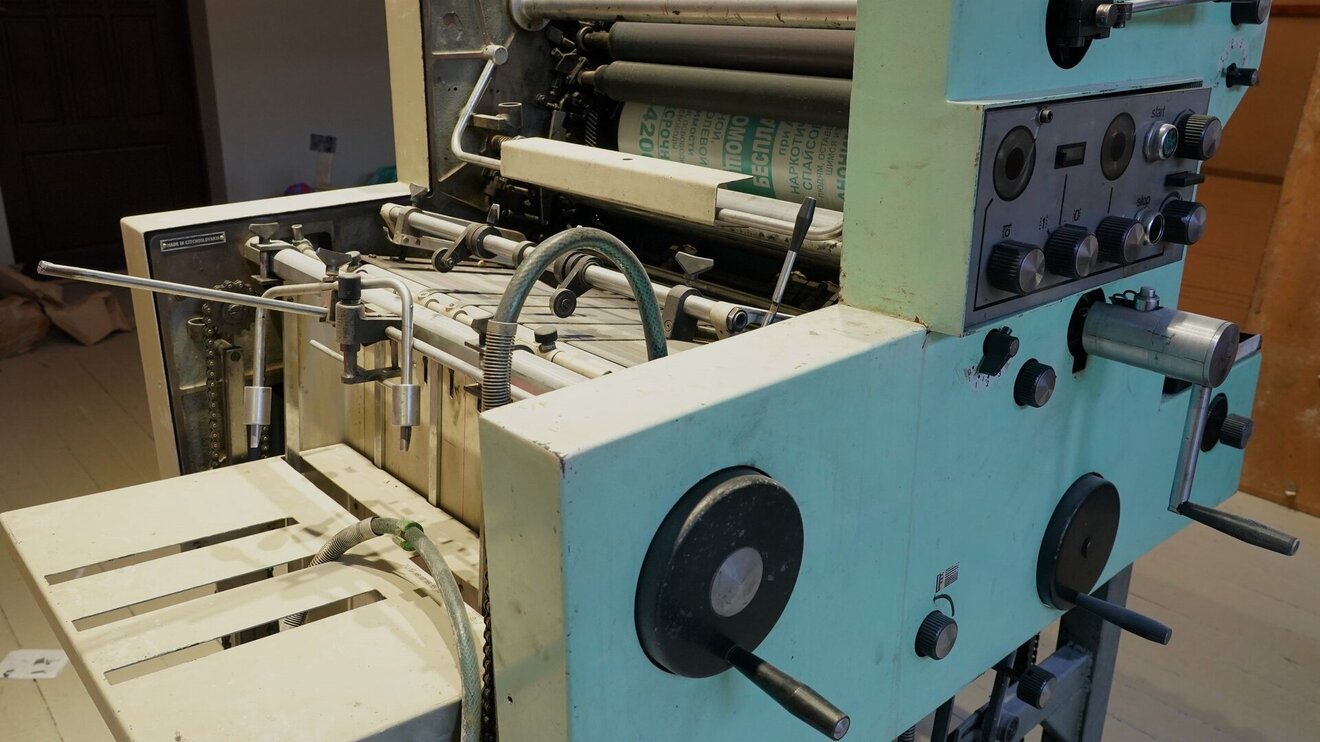
The Adast Romayor is a legendary series of sheet-fed offset printing presses made in Czechoslovakia, which remained practically unchanged for more than 30 years and became a symbol of accessible printing across Eastern Europe.
Origins and Production History
Production of the Adast Romayor began in the 1960s at the Czech company Adast. The company designed the model as a simple, reliable press for small and mid-sized print shops. The first Romayor II was produced from 1960 to 1965, in a run of only 2,965 units, which makes it a museum-grade rarity today.
The best-known models were the Romayor 313 and 314, which used perforated printing plates. These were the machines that became truly mass-produced, spreading widely across Eastern Europe. Production continued, with minor changes, until 1997, when the Adast company went bankrupt.
Technical Design and Features
The Romayor was a single-color, sheet-fed offset press with manual sheet feeding. A key feature that set it apart from competitors like AB Dick or Ryobi was its push-type side lay register system. This design ensured good sheet control and reasonably precise positioning, both critical for quality printing.
Competitors typically fitted entry-level presses with a pull-type side lay, which worked well with heavy paper stock but caused problems with thin sheets — they could spring back from the register. Only the German Heidelberg presses in the KORS, KORD, and GTO lines had a patented push-type register that handled thin paper effectively.
The Dampening System
One of the trickiest systems to calibrate on the Romayor was its dampening system. It used rollers wrapped in felt, which needed careful adjustment. A neighboring chrome-plated pressure roller squeezed excess moisture out of this wet «sock.» Modern printers can barely imagine how difficult it was to get the dampening feed dialed in on machines like this.
The machine used perforated printing plates, which placed serious limits on registration accuracy. The photographer preparing the plate had no room for error during exposure, since once printing began, the plate’s position could only be adjusted along the length or width of the sheet. Diagonal register correction was impossible.
Technical Specifications of the Adast Romayor 314
- Maximum sheet size: 360×500 mm
- Minimum sheet size: 155×210 mm
- Maximum print area: 331×488 mm
- Minimum paper size: 135×180 mm
- Plate dimensions: 368×490×0.15 mm
- Offset blanket size: 410×496×1.9 mm
- Paper stack height: 400 mm (feeder and delivery)
- Maximum speed: 7,500 sheets per hour
- Dimensions: 1120×1400×1490 mm
- Power consumption: 1.1 kW
- Weight: 720 kg
Modifications and Development
Romayor 313 — the base model with a single print unit, which formed the foundation for the whole lineup.
Romayor 314 — an improved model with automatic paper feeding and a better sheet-registration system. This modification became the most widespread and mass-produced version.
Romayor 315 — a modernized machine with more up-to-date features, developed to stay competitive on the Central European market. It featured a digital display, better ergonomics at the operator’s station, and met GS safety standards. Buyers could choose either the classic Molleton-style dampening system or the Varn Kompac system for the new machine. The noisy Czech compressor was swapped for a European Becker unit.
Romayor 314-5 — an experimental five-color modification that never reached series production. It was a hybrid built from five single-color Romayor units, designed to lay down five colors in a single pass.
Offset Printing: How It Works
The Romayor operated on the offset-printing principle — an indirect method in which ink is transferred from the printing plate onto an intermediate rubber surface (the offset blanket) before being applied to the paper. This method produced good print quality and could handle a variety of paper types.
The printing process went through several stages: first, the plate was dampened with water in the non-printing areas, then inked, with ink adhering only to the printing elements. The image was then transferred to the offset blanket, and from there to the paper, under pressure from the impression cylinder.
Working With Inks and Materials
As a single-color machine, the Romayor was designed to print one color per pass. Multi-color printing required several runs, with drying time in between. The machine handled a range of inks well, from simple text inks to the heavier inks used for solid areas and illustrations.
Working with different materials demanded real skill from the printer. Thin paper could deform as it passed through the machine, while heavy card stock required careful pressure adjustment. The Romayor could handle paper weights from 60 to 250 g/m².
Operating Quirks
Running a Romayor demanded real skill from the printer. Getting the ink-water balance right was critical to print quality. Too much water led to ink emulsification and poor results; too little led to toning in the non-printing areas.
Chemical Processes and Materials
Printing plates were made from photopolymer sheets, processed with phosphoric acid. This process required care, since the acid could irritate the printer’s skin. The dampening solution contained special additives to maintain the correct pH and prevent bacterial growth.
Offset inks for the Romayor were made from vegetable oils, combined with pigments and auxiliary substances. Ink quality had a direct effect on the printed result — cheap inks could print unevenly and adhere poorly to the paper.
Maintenance and Repair
One of the Romayor’s biggest advantages was how easy it was to maintain and repair. Most spare parts were affordable and readily available, and some components could easily be reproduced in an ordinary machine shop. This made the machine especially attractive to small print shops working on tight budgets.
Regular maintenance included lubricating the bearings, cleaning the inking system, replacing the offset blankets, and adjusting the dampening system. An experienced printer could handle most maintenance tasks on their own.
Print Quality and Limitations
Despite its simple design, the Romayor could produce quite decent print quality for its class. The machine handled text work, simple illustrations, and even basic halftone images, given proper setup and quality materials.
Its main limitations: no diagonal register correction, limited color-registration accuracy on multi-pass jobs, and fairly low throughput by modern standards. Even so, for the typical needs of a small print shop, these limitations weren’t critical.
Economic Aspects
The Romayor’s low cost made it accessible to aspiring entrepreneurs. A used machine could be bought for a symbolic sum, opening the door to the printing business for people with minimal starting capital. Operating costs were also modest, thanks to the machine’s simple design and the availability of consumables.
The machine paid for itself fairly quickly, even running just 3-4 hours a day. Simple jobs — business cards, flyers, forms — provided steady income at minimal production cost.
Impact on the Printing Industry
The Romayor played an important role in democratizing printing in Eastern Europe. Thanks to how accessible these machines were, printing stopped being the exclusive privilege of large state-run print shops. Countless small businesses gained the ability to offer printing services, fueling competition and improving service quality.
The machine’s ease of use let many people quickly pick up the printing trade. Knowing how to run a Romayor became a kind of entry ticket into the printing industry for a whole generation of tradespeople.
Legacy and the Present Day
Although production of the original Romayor ended in 1997 with Adast’s bankruptcy, in the early 2000s the company Pollly took over manufacturing a modernized version of the Romayor 315. Adast retained the business of selling spare parts for the earlier models, keeping many machines running.
Today the Romayor can be found in printing museums and in the hands of vintage-equipment collectors. Some units are still used for specialized work — printing small runs on designer paper, for instance, or teaching students the fundamentals of offset printing.
Technical Significance
The Romayor became an important link in the evolution of printing equipment, demonstrating that quality offset printing could be both affordable and easy to learn. Many of the machine’s technical solutions laid the groundwork for more modern printing systems.
The Adast Romayor remains a symbol of an entire era in the history of printing — a time when simplicity and reliability were valued over complexity and automation. This machine proved that sometimes the simplest solutions turn out to be the most durable and influential in the long run.