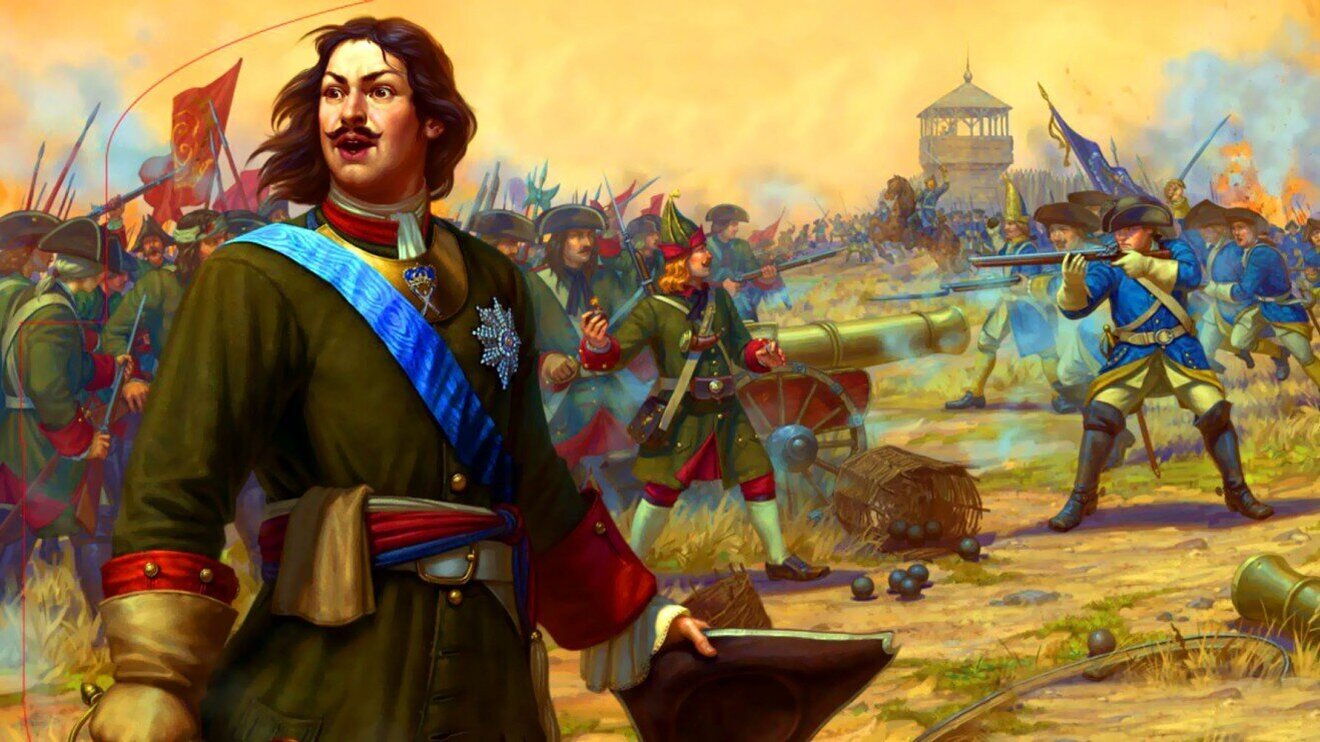
«Wholly like the wrath of God» is a reference to Alexander Pushkin's poem «Poltava» (1828), which includes these lines describing Peter the Great before the Battle of Poltava:
«Forth strides Peter. His eyes
are blazing. His visage is terrible.
His movements swift. He is magnificent,
he is wholly like the wrath of God.»
The poem «Poltava» was written by Pushkin over September and October 1828 and published in 1829. It concerns the events of the Great Northern War, and in particular the Battle of Poltava in 1709 — the decisive engagement between the Russian forces of Peter the Great and the Swedish army of Charles XII, which ended in Russia's complete victory.
The poem was written during a difficult period in Pushkin's life. Having returned from exile, he was under secret police surveillance, and his work faced strict censorship. Under these political constraints, he turned to a historical subject, through which he could express his views on the role of a powerful individual in history and the idea of statehood.
The central storylines of «Poltava» are historical (the events of the Great Northern War and the figure of Peter the Great) and romantic (Maria Kochubey's love for Mazepa and his betrayal). Pushkin created a multilayered work, blending historical narrative with a lyrical, dramatic love story.
The image of Peter the Great in the poem is that of a statesman, a reformer, and a defender of the fatherland. Peter is portrayed not simply as a monarch, but as a historical figure possessing almost supernatural power and will — "wholly like the wrath of God." This metaphor underscores the power, decisiveness, and unyielding will of the reformer-tsar.
In the context of a novel about 1993 Russia, comparing the character Zhorik to Peter from Pushkin's "Poltava" carries a particular weight. The image of a "resolute and focused" hero, transformed in moments of great consequence, echoes the image of a historical figure at a turning point. Just as Peter the Great embodied, for Pushkin, strength and resolve during a critical period for Russia, so too does the novel's character undergo an inner transformation during an era of Russian history no less dramatic.
1993 was, for Russia, a period of profound upheaval and a constitutional crisis that became one of the key moments in the shaping of the modern Russian state. The allusion to Pushkin's poem underscores the historical scale of the events unfolding in the novel and points to a continuity between the various turning points in Russian history.
The use of this literary reference also shows how history and literature echo in the present, how archetypes of behavior and character recur across different historical periods, creating a sense of history's cyclical development.