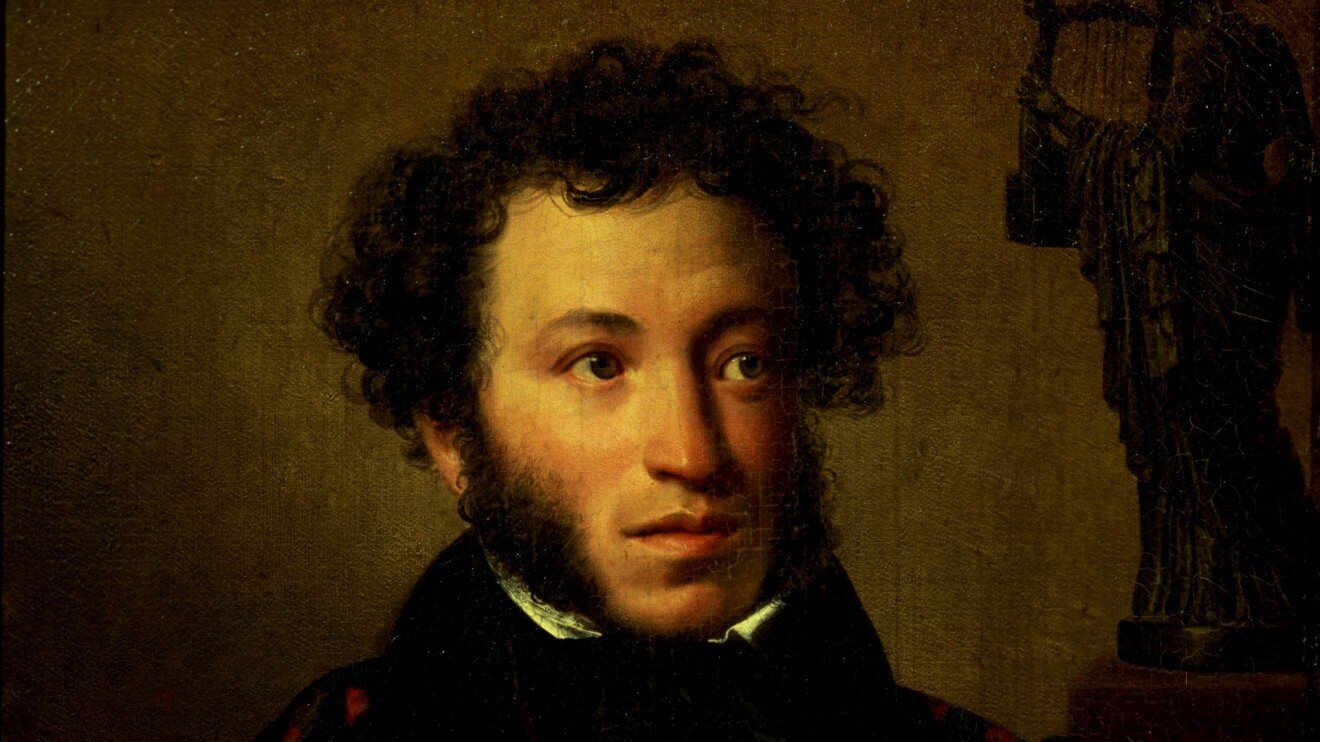
The provocative line "I certainly despise my fatherland from head to toe — but it irks me if a foreigner shares this feeling with me," from a private letter by Alexander Sergeyevich Pushkin, has repeatedly become the subject of dispute and various interpretations. Let us look at the story behind it, and its true meaning.
Historical background
On June 8, 1827 (New Style), Alexander Sergeyevich Pushkin wrote a letter to his friend and literary collaborator Pyotr Andreyevich Vyazemsky. This private letter contained a line that would go on to become one of the most quoted, and simultaneously most widely misunderstood, in Russian literature: "I certainly despise my fatherland from head to toe — but it irks me if a foreigner shares this feeling with me."
The letter was written during Pushkin's so-called "Mikhailovskoye exile," when the poet was confined to his family estate of Mikhailovskoye, under the surveillance of local authorities, for his free-thinking verse and his ties to the future Decembrists.
The full text of the letter
To understand the true meaning of this famous line, it helps to read the letter in full:
To P.A. Vyazemsky
May 27, 1826. From Pskov, to St. PetersburgYou're right, favorite of the muses — I'll make use of my rights as a prodigal son-in-law and future landlord and settle the whole matter by letter. Do I owe you anything or not? Answer me. Did my man, whom I dismissed for his poor manners and poor conduct, take anything from you? It's high time we got rid of Bulgarin too, and "Blagonamerenny," and Polevoy, our dear friend. There's no time for it now, but by God, one of these days I'll take up a journal. I'm sorry you and Katenin can't seem to get along. For a journal, he'd be a real find. I read in the papers that Lancelot is in Petersburg — what the devil does he want there? I also read that 30 men of letters gave him a dinner. Who are these immortals? I count on my fingers and can't come up with the number. When you get to Petersburg, take charge of this Lancelot (of whose verse I don't recall a single line) and don't let him loose in the taverns of our national literature.
We have neither pride nor shame in our dealings with foreigners — in front of the English we make a fool of Vasily Lvovich; before Madame de Staël we make Miloradovich show off in the mazurka. Some Russian gentleman shouts: boy! amuse Hectorka (the Danish hound). We roar with laughter and translate these lordly words for the curious traveler. All of it ends up in his journal and gets printed in Europe — it's vile.
I certainly despise my fatherland from head to toe — but it irks me if a foreigner shares this feeling with me.
You, who are not tied down, how can you stand to stay in Russia? If the Tsar gave me my freedom, I wouldn't stay a month. We live in a wretched age, but when I picture London, the iron railways, steamships, English journals, or Parisian theaters and <brothels> — my dull Mikhailovskoye fills me with longing and fury. In the fourth canto of "Onegin" I depicted my own life; someday you'll read it and ask, with a sweet smile: where is my poet now? there's talent visible in him — and you'll hear in reply, my dear: he fled to Paris and will never come back to accursed Russia — what a clever fellow.
May 27.
Farewell.I imagine you're already in Petersburg, and this letter will go there. It saddens me that I won't get to say goodbye to the Karamzins — God knows if we'll ever meet again. I'm in Pskov now, and a young doctor, drunk, told me that without an operation I won't live past 30. It would be a poor joke to die in Opochka district.
The context of the era
The letter was written in May 1827, during the reign of Nicholas I, who had taken the throne after the Decembrist uprising of December 1825. Pushkin was in a rather difficult position: he had been exiled from the capital for his freedom-loving verse back in 1820, and after the events of December 14, his position became even more precarious.
The poet felt acutely Russia's backwardness compared to European countries. In the letter he mentions Europe's technical achievements — "iron railways, steamships" — which stood in contrast to the patriarchal order of Russian life. Especially painful for Pushkin was Russians' humiliating conduct in front of foreigners.
The true meaning of the line
The word "but" in his famous line is key to understanding Pushkin's position. The poet doesn't simply "despise his fatherland" — he expresses the complex, contradictory feeling of a patriot who sees his country's flaws and suffers because of them. His contempt is directed not at Russia as such, but at specific social and political phenomena:
- Serfdom and social inequality
- Backwardness compared to European civilization
- Humiliating servility before foreigners
- Censorship and political repression
- The ignorance and rigidity of the ruling circles
Pushkin is outraged that Russians themselves display their own backwardness before Europeans, giving them cause for mockery and contempt. The poet is pained by the thought that foreigners might form a negative opinion of Russia after witnessing such scenes.
Literary and historical context
The letter mentions several important figures of the era:
Lancelot refers to Jacques-Arsene Ancelot, a French playwright who came to Russia for Nicholas I's coronation. Pushkin was worried that Russian literary figures would demean themselves before him, revealing their provincialism.
Madame de Staël was the famous French writer who had visited Russia and written about it in her memoirs. Pushkin refers to an episode in which General Miloradovich was made to "show off in the mazurka" for her benefit.
Vasily Lvovich Pushkin was the poet's uncle, also a man of letters, who, in Alexander Sergeyevich's view, allowed the English to make fun of him.
Patriotism through criticism
Paradoxically, it is precisely this line that demonstrates Pushkin's deep patriotism. The poet suffers because his homeland looks unappealing in foreigners' eyes. He longs for Russia to become worthy of respect, rather than an object of Europeans' condescending curiosity.
This sentiment was characteristic of many Russian intellectuals of the time — a love of the fatherland expressed through criticism of it, a drive toward its spiritual and social transformation. Similar attitudes marked both the Slavophiles and the Westernizers, though their prescriptions for "curing" Russia differed.
Its influence on Russian culture
Pushkin's formula — "I despise it, but it irks me if a foreigner shares the feeling" — became a classic expression of a distinctly Russian form of patriotism. It captures the inner contradiction of Russian national self-consciousness:
- A critical attitude toward one's own country
- A painful reaction to outside criticism
- A drive toward self-improvement through self-criticism
- A complex of inferiority in relation to Europe
This theme was developed further in the work of many Russian writers — from Gogol and Herzen to Dostoevsky and Chekhov. It remains relevant today, as questions of national identity and Russia's place in the world continue to preoccupy society.
Modern interpretations
Across different historical periods, this line of Pushkin's has been interpreted in different ways. In the Soviet era, it was often played down or explained away entirely in terms of social causes — a criticism of serfdom and autocracy. In the post-Soviet period, it is often invoked in political disputes, and frequently ripped out of context.
It's important to understand that Pushkin was writing a private letter to a friend, one in which he could allow himself candor and emotion. This is not a programmatic declaration, but the personal confession of a man living through a difficult period of his life.
Conclusion
The line "I certainly despise my fatherland from head to toe — but it irks me if a foreigner shares this feeling with me" remains one of the most precise expressions of the Russian national character. It shows that genuine patriotism can include a critical attitude toward one's homeland's flaws, while still retaining a painful sensitivity to outside criticism.
Pushkin was neither a Russophobe nor a blind patriot. He was a thinking man of his time, one who felt Russia's problems acutely and dreamed of its spiritual transformation. His "contempt" for his fatherland was the contempt of a lover, who sees the flaws of the one he loves and suffers because of them.
This psychological formula remains relevant today, helping us understand the complexity of Russian national self-consciousness and the particular character of Russian patriotism, which is often expressed not through praise, but through passionate criticism, aimed at improvement and spiritual renewal.