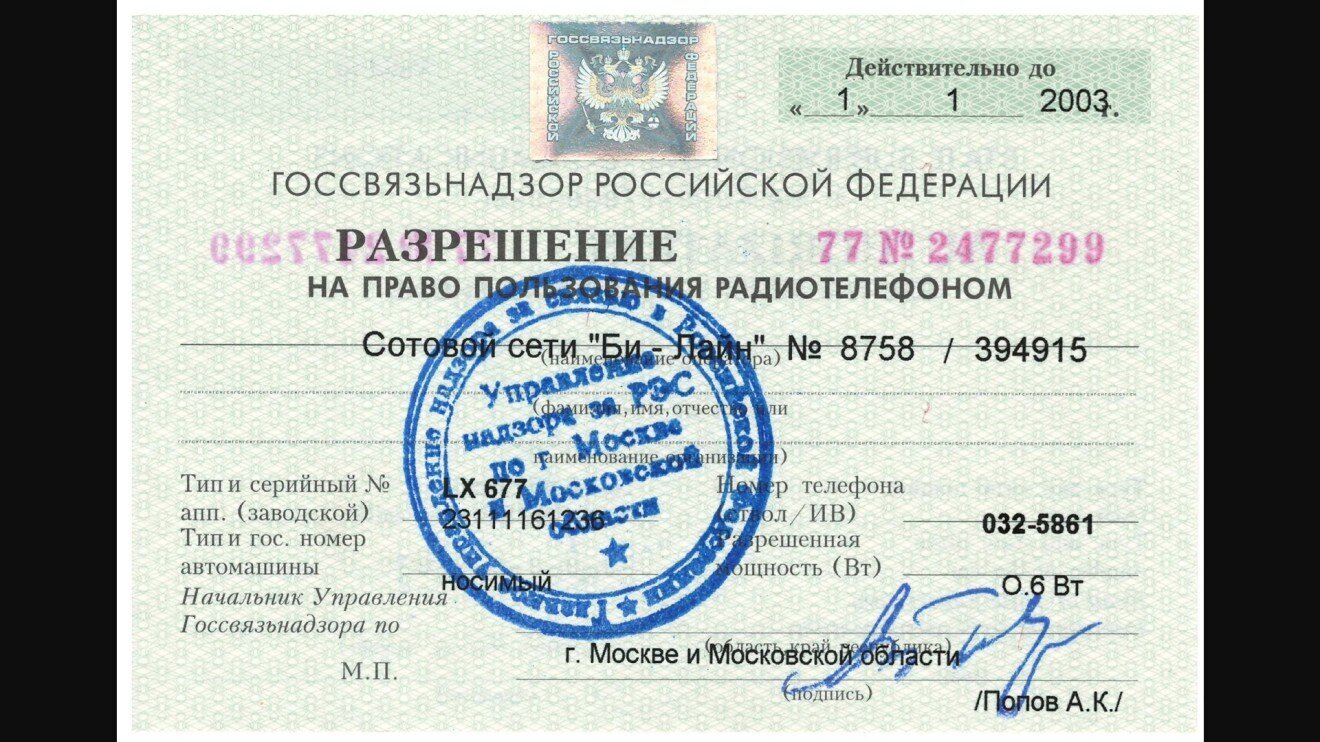
In the early 1990s, owning a mobile phone in Russia required not just significant money, but also navigating bureaucratic procedures that look absurd by today’s standards.
The 1993 Resolution
In 1993 the Government of the Russian Federation adopted a resolution «On Streamlining the Use of Radio-Electronic Devices (High-Frequency Equipment) on the Territory of the Russian Federation,» under which every Russian citizen was required to obtain a special permit from the State Communications Oversight Committee (Gossvyaznadzor) to buy and use a mobile phone.
The state fee for the permit ran about four U.S. dollars — a fairly affordable sum in principle, though the paperwork itself was quite a hassle. Getting the permit required a sales receipt for the phone, without which no document was issued. Even when reselling a used phone, the receipt still had to be produced.
Technical Quirks of the Era
The need for permits was partly explained by the technical standards of the day. The first cellular operators used the Scandinavian NMT-450 standard, the American AMPS, and its digital counterpart D-AMPS. These standards rigidly tied a subscriber’s number to a specific handset, and changing your number meant physically reprogramming the device at the company’s office.
«The standards rigidly tied a subscriber’s number to a handset, so to switch to a different number you had to bring the phone to the company, and they’d reprogram it there.»
A Soviet Legacy
Many experts believed the permit requirement was a holdover from the Soviet era. In the USSR, the authorities tightly controlled the airwaves, jammed «enemy» radio stations, and treated radio transmitters and shortwave receivers as potential espionage equipment.
Only the KGB, the Interior Ministry, the army, and the Ministry of Communications had the right to use the airwaves freely. Even amateur radio operators at DOSAAF-affiliated clubs had to get personal permits for their equipment. Critics argued that the government adopted the 1993 resolution out of sheer inertia, still standing «with one foot in the USSR.»
Fines and Penalties
Though Gossvyaznadzor didn’t actively hunt down violators, the consequences of lacking a permit could be quite serious. During a check, an owner had to not only produce the document but disassemble the phone and remove the battery, so a police officer could match the serial number against the one listed on the permit.
| Year | Minimum Wage (rubles) | Minimum Fine | Maximum Fine |
|---|---|---|---|
| 1997 | 83,490 | 1,252,350 rubles | 5,844,300 rubles |
| 2000 | 132 | 1,980 rubles | 9,240 rubles |
Under Article 137 of the Russian Administrative Code, a violator faced a fine of 15 to 70 times the minimum wage. In practice, citizens preferred to bribe their way out on the spot, which fueled corruption among police officers.
Notorious Cases
The newspaper Kommersant described a case where a Moscow police officer stopped the press secretary of one of the leading cellular companies. The businessman had no personal permit, since the phone was registered to the company. The officer wasn’t satisfied with the corporate permit, and the press secretary ended up paying a 200-ruble bribe.
An even more egregious case involved the owner of a company from Georgia who had no idea about Russia’s requirements for mobile phones. Refusing to hand his phone to a police officer, he resisted and was beaten. At the time, no such permits were required in Georgia, in other CIS countries, or abroad.
The End of the Permits
By 2000, the permit system had thoroughly outlived its usefulness. From 1998 on, Russia was actively adopting the GSM standard, where the phone number was tied to the SIM card rather than the handset, making tracking phones by device pointless.
On February 25, 2000, President Vladimir Putin signed two government resolutions abolishing the mobile-phone permit requirement. The decision wasn’t easy to reach — the FSB opposed scrapping it, and it took a sustained push from Viktor Maneshin, president of the «Association 800.»
Historical Significance
The mobile-phone permit requirement became a symbol of Russia’s transitional era, when new technology collided with outdated bureaucratic procedure. The system not only held back the growth of mobile communications but created fertile ground for corruption.
Scrapping the permits in 2000 opened the door to the explosive growth of cellular service in Russia and became one of the symbols of the country’s technological modernization at the start of the new millennium.