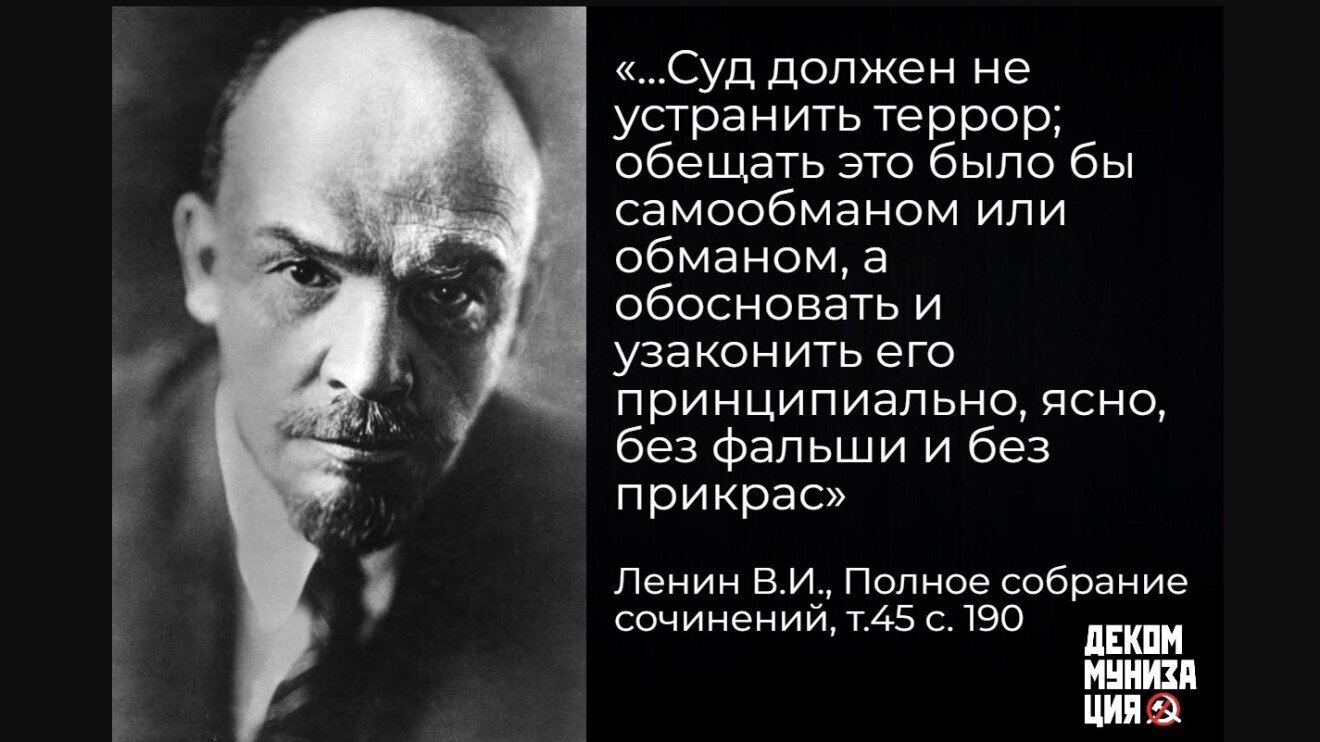
The text’s mention of «revolutionary conscience and terror» refers to one of the darkest periods in Russian history — the era of political repression, when terror became official state policy.
Lenin’s Concept of Terror
Vladimir Lenin didn’t just provide the theoretical justification for terror — he actively built it into the practice of the revolutionary state. In a letter to People’s Commissar of Justice Dmitry Kursky dated May 17, 1922, he wrote:
«The court must not eliminate terror; to promise that would be self-deception or deception, but it must be justified and legitimized in principle, clearly, without falsehood and without embellishment. It should be formulated as broadly as possible, since only revolutionary legal consciousness and revolutionary conscience will set the conditions for its application in practice, on a more or less broad scale.»
This quote shows that terror was treated not as a temporary wartime measure, but as a permanent instrument of revolutionary power, one meant to receive formal legal standing.
«Revolutionary Conscience» as a Principle
In Lenin’s usage, the concept of «revolutionary conscience» meant the right of revolutionary bodies to decide matters of life and death, guided not by written law but by class struggle and revolutionary expediency. This concept became a cornerstone of the repressive system, justifying any cruelty in the name of «higher» revolutionary goals.
The Scale of 1920s Repression
According to researchers, during the church trials of 1921–23 alone, around 10,000 clergy members were repressed, of whom about 2,000 were shot. By the end of 1924, roughly half of the entire Russian episcopate — 66 bishops — had passed through prisons and camps.
Institutionalizing Terror
In 1922, the «Special Council under the GPU Collegium» (OSO) was created, with the power to sentence people to exile or expulsion from the RSFSR for up to 2 years «for anti-Soviet activity.» By 1924 the OSO’s powers had expanded — it could sentence people to up to 3 years in a labor camp without trial.
Political Trials as Theater of Terror
The show trials of the 1920s became an important element of terror as policy:
- The Tagantsev Case (1921) — 833 people were arrested on charges of counterrevolutionary conspiracy, 96 were shot
- The Church Trials (1922–23) — mass arrests of clergy on the pretext of resisting the confiscation of church valuables
- The SR Trial (1922) — a show trial of the leaders of the Socialist Revolutionary Party
- The Shakhty Case (1928) — a trial of technical specialists accused of sabotage
Mass Operations
Especially telling were the OGPU’s «mass operations» in the summer of 1927, after the assassination of Soviet envoy P. L. Voikov in Poland. On Stalin’s direct order, 20 members of the nobility were shot as «hostages,» some 20,000 searches were carried out, and 9,000 people were arrested across the country.
Historical Significance
The terror of the 1920s laid the groundwork for Stalin’s repressive system of the 1930s. The principles of «revolutionary conscience» and a broad reading of «counterrevolutionary activity» let the state crack down on any segment of the population by declaring them «enemies of the people.»
In the context of the novel, set in 1993, mentioning Lenin’s principles of terror takes on a particular irony — in an era of perestroika and democratization, the protagonist regards business jargon with the same reverence once reserved for talk of «revolutionary conscience.» It shows how, in the minds of people in the 1990s, values and priorities were being rethought.