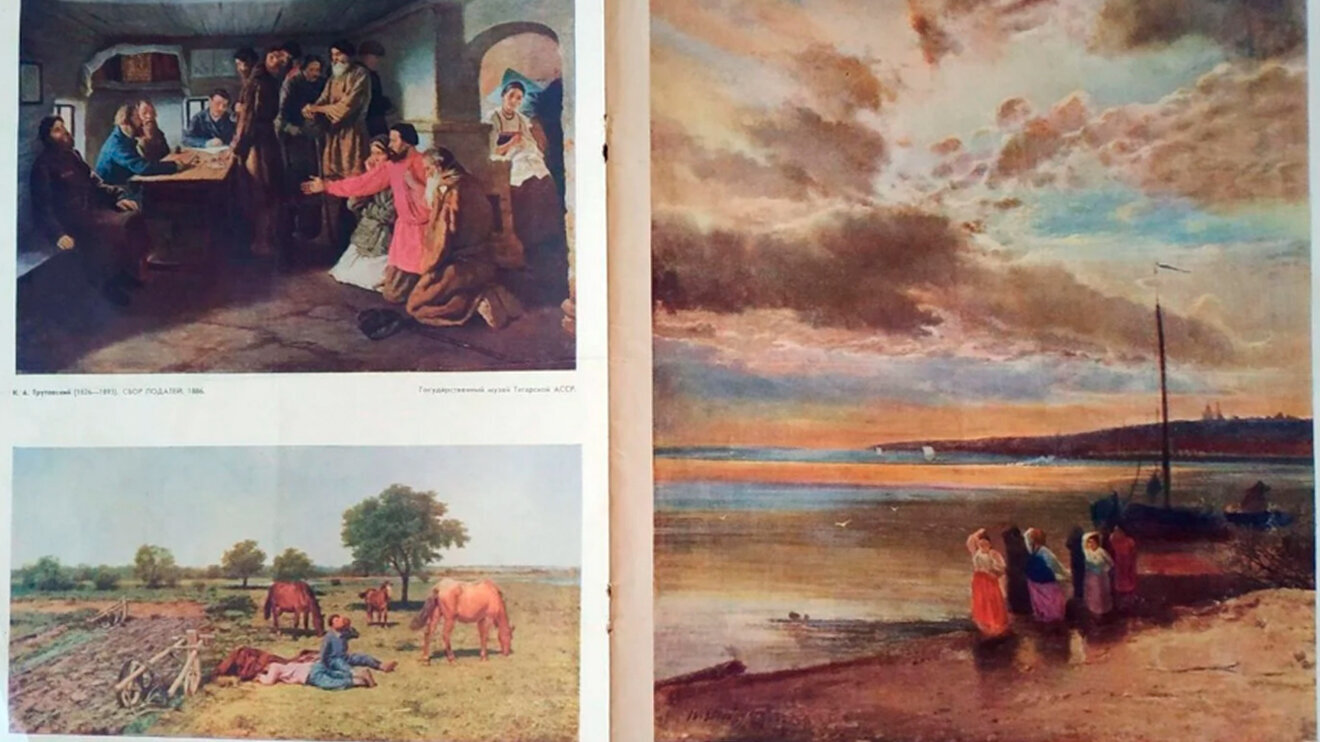
In the Soviet Union, reproductions of works of fine art played a special role in the cultural education of the population. Mass-circulation magazines became the primary channel through which millions of Soviet citizens encountered world painting, sculpture, and graphic art. The phenomenon had deep roots in Soviet cultural policy and left an indelible mark on the aesthetic upbringing of several generations.
Key Publications and Their Role
Ogonyok — a weekly current-affairs and literary-arts magazine published since 1899, one of the most influential publications in the country during the Soviet era. Its circulation reached 2–3 million copies at various points. Ogonyok regularly published full-color reproductions, both on its covers and inside its issues. Especially popular were special reproduction inserts, which readers often cut out and used to decorate their homes.
Smena — a monthly magazine for young people that, from 1924 onward, introduced readers to various artistic movements. It regularly published material on art history, accompanied by quality reproductions, with particular attention to Soviet art and the work of artists from socialist countries.
Yunost — a literary-arts magazine founded in 1955. Alongside literary works, it systematically published painting reproductions, often tying them to the accompanying texts. Yunost played an important role in the aesthetic education of young people, presenting art as an inseparable part of cultural development.
Krokodil — a satirical magazine that, alongside cartoons and humor pieces, also published reproductions of artworks, sometimes for satirical effect or as a contrast to its main content.
The Technical Side of Soviet Reproductions
The quality of reproductions in Soviet magazines varied considerably, depending on a printing house’s technical capacity and a publication’s budget. In the 1960s and ’70s, offset printing predominated, which could reproduce colors and details reasonably accurately. Even so, the limits of the printing technology often distorted color rendering.
Reproduction, as a technical process, demanded highly skilled photographers and printers. Producing a quality reproduction of a painting required even lighting, attention to the color temperature of light sources, and the particular characteristics of the film stock. Under Soviet printing conditions, this was no small task — which explains the variation in reproduction quality across different publications.
Cultural Function and Influence
Reproductions in Soviet magazines served several important functions. First, they democratized art, making it accessible to broad segments of the population regardless of where they lived or their social standing. Residents of remote regions gained a chance to encounter masterpieces held in the world’s greatest museums.
Second, magazine reproductions shaped the aesthetic tastes and artistic preferences of Soviet citizens. Many works of Western art were known in the USSR precisely through magazine publication. Van Gogh’s «The Starry Night,» Leonardo da Vinci’s «Mona Lisa,» the works of the Impressionists — all these masterpieces became part of the ordinary Soviet person’s cultural baggage thanks to reproductions in periodicals.
The Ideological Dimension
The choice of which works to publish wasn’t random. Editorial boards were guided not only by artistic criteria but by ideological considerations. Preference went to works that aligned with the principles of Socialist Realism, or that could be interpreted within a Soviet ideological framework.
Western art was published selectively, often with commentary explaining the social conditions under which the work was created. Special attention went to artists who could be framed as critics of bourgeois society, or as expressing ideas close to socialist ones.
Specialized Publications
Beyond mass-market magazines, there were specialized art publications. Tvorchestvo (from 1957), Dekorativnoye Iskusstvo SSSR (from 1957), and Iskusstvo published higher-quality reproductions, accompanied by professional art-historical essays.
These publications had smaller print runs but played an important role in professional art education and in shaping the tastes of the creative intelligentsia. Their print quality was significantly higher, allowing for more accurate reproduction of the source works’ particular qualities.
Influence on Home Decor
Magazine reproductions significantly shaped how Soviet apartments were decorated. Reproductions clipped from magazines and neatly pasted onto cardboard adorned the walls of millions of Soviet homes — an accessible way to engage with «high» art amid a shortage of art books and limited opportunities to visit museums.
The most popular were landscapes, still lifes, and portraits by the classic masters. Serov’s «Girl With Peaches,» Savrasov’s «The Rooks Have Returned,» and Shishkin’s «Morning in a Pine Forest» became a fixture of the Soviet domestic visual landscape thanks precisely to magazine publication.
Collecting and Archiving
Many Soviet citizens systematically collected magazine reproductions, building home «picture galleries.» The practice was widespread enough that some families assembled entire albums of magazine clippings, organized by artist, period, or theme.
This kind of collecting served an educational function as well as an aesthetic one. Family reproduction collections became the foundation for children’s art education, an introduction to art history, and a way of cultivating cultural interests.
Conclusion
The phenomenon of reproductions in Soviet magazines represents a unique episode in the history of mass culture. It shows how state cultural policy aimed at educating the public could effectively harness periodical print to bring art education to millions.
Despite technical limitations and ideological filtering, magazine reproductions played an important role in shaping the aesthetic sensibility of Soviet society and remained a significant part of the cultural memory of generations raised in the USSR. For many people, these sometimes low-quality print reproductions were their very first encounter with the great works of world art.