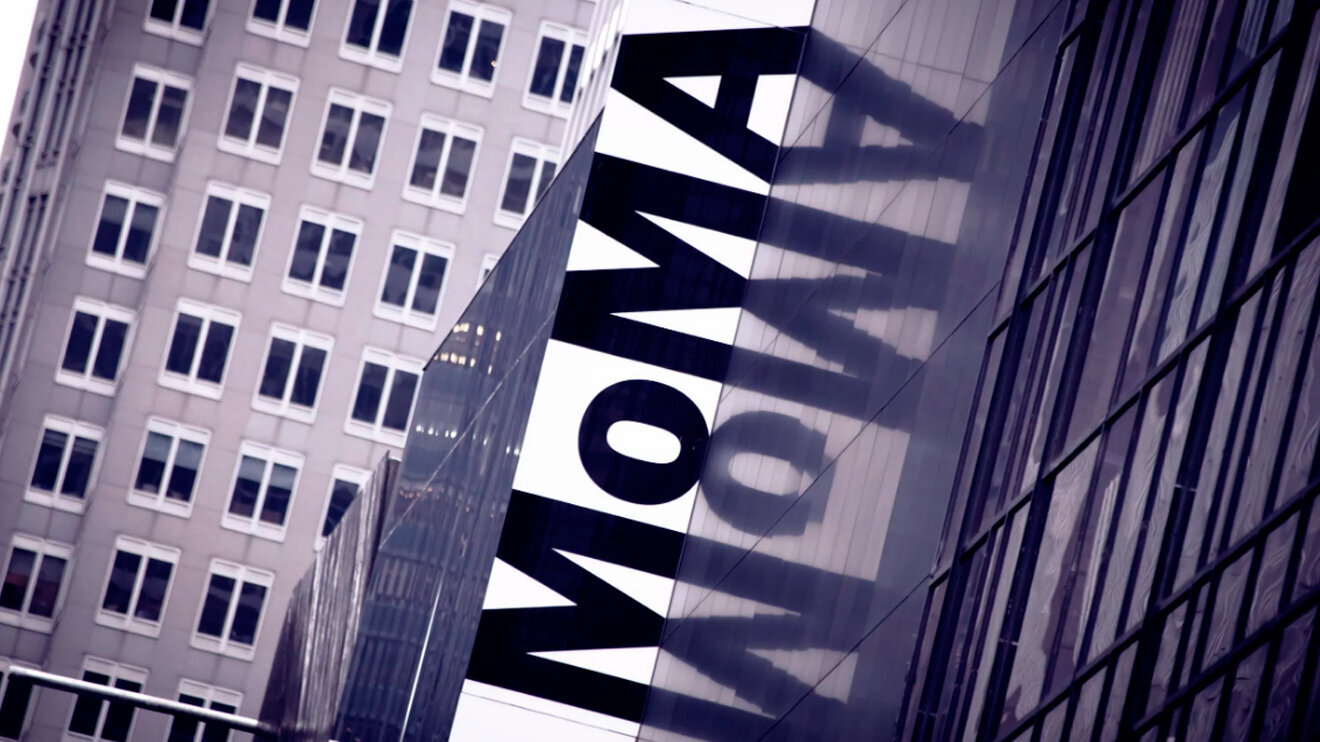
The Museum of Modern Art in Manhattan (MoMA) is one of the world’s most famous and influential museums dedicated to 20th-century art. By the mid-1990s, it had firmly established itself as the essential destination for anyone interested in contemporary art.
Founding
The museum was founded in 1929 at the initiative of Abby Aldrich Rockefeller, wife of the renowned industrialist and philanthropist John D. Rockefeller Jr. Together with her friends Lillie P. Bliss and Mary Quinn Sullivan, she rented modest space on the twelfth floor of the Heckscher Building on Fifth Avenue. The museum opened to the public on November 7, 1929 — just nine days after the famous stock market crash that ushered in the Great Depression.
MoMA’s first director was the young art historian Alfred H. Barr, who turned the museum into a model institution that set the standard for every modern art museum that followed. Barr not only assembled works but also developed new principles for displaying and interpreting them.
Building the Collection
Even the very first exhibition, in November 1929, introduced the public to paintings by Van Gogh, Gauguin, Cézanne, and Seurat — artists who were, at the time, still seen as radical innovators. Especially memorable was the 1935 Vincent van Gogh exhibition, which showed 66 paintings and 50 drawings brought from the Netherlands.
The museum gained international fame through its grand 1939–1940 Pablo Picasso retrospective, staged jointly with the Art Institute of Chicago. Fully planned by Barr, this exhibition declared Picasso the greatest artist of the era and set the model for every museum retrospective that followed.
Highlights of the Collection
By the 1990s, MoMA’s collection numbered more than 150,000 works of art and around four million film reels. Among the gems of the collection are paintings without which 20th-century art is unimaginable:
Vincent van Gogh’s «The Starry Night» (1889) — perhaps the most famous painting in MoMA’s collection. Painted at the Saint-Paul-de-Mausole psychiatric asylum, it depicts a night sky over an imagined town. Swirling clouds and radiant stars create a sense of cosmic energy. The painting became a symbol of art’s expressive power and one of the most recognizable images in world painting.
Pablo Picasso’s «Les Demoiselles d’Avignon» (1907) — the revolutionary work that launched Cubism. Five nude female figures are shown from multiple angles simultaneously, their faces echoing African masks. The painting radically changed ideas about what painting could look like.
Henri Matisse’s «Dance» (1910) — one of the key works of Fauvism. Five red figures dance in a circle on green ground beneath a blue sky. The extremely simplified palette and expressive line convey a sense of primal joy and vitality.
Salvador Dalí’s «The Persistence of Memory» (1931) — the famous «melting clocks,» which became a symbol of Surrealism. Drooping timepieces in a desert landscape embody the relativity of time and the strangeness of human memory.
Other Notable Works
MoMA’s collection also includes Kazimir Malevich’s «White on White» — a manifesto of Suprematism, in which a white square on a white ground declares the triumph of «pure» art over representation. Claude Monet’s «Water Lilies» show the transition from Impressionism to abstraction through images of water lilies in the artist’s garden at Giverny.
American 20th-century art is represented by Andrew Wyeth’s «Christina’s World» — an enigmatic painting of a girl gazing at a house across a field — and Andy Warhol’s famous «Campbell’s Soup Cans,» a symbol of Pop Art and the commercialization of art.
Architecture and Space
By the 1990s, the museum occupied a purpose-built building on 53rd Street between Fifth and Sixth Avenues. In 1984, a 56-story museum tower was added to the main building, more than doubling exhibition space. Bright galleries with white walls and wooden floors created an ideal setting for viewing modern art.
Shaping the Perception of Art
MoMA played a key role in defining the canon of modern art. The museum didn’t simply collect works — it actively shaped which artists and movements were considered significant. Its exhibitions shaped public taste and set the market value of works.
For a Soviet person of the 1990s, accustomed to reproductions in art books and textbooks, encountering originals at MoMA was a genuine shock. Soviet printing quality often failed to capture the true colors and texture of a painting, so works familiar from reproductions revealed themselves entirely anew in the museum.
MoMA in the 1990s
In the mid-1990s, the museum was going through a period of active growth. The Cold War had ended, borders had opened, and the flow of visitors from the former socialist countries grew significantly. For many people from Eastern Europe and Russia, MoMA became the first place they could see originals of works they’d only known from books.
The museum was actively expanding its collection, acquiring new works and preparing a major building expansion, completed in 2004. During this period, MoMA cemented its position as the world’s leading museum of modern art, surpassing even the Centre Pompidou in Paris and Tate Modern in London.
A visit to MoMA in the 1990s was nearly obligatory for anyone with an interest in art. The museum became a place of pilgrimage, where one could not only see masterpieces but feel part of the global artistic process.