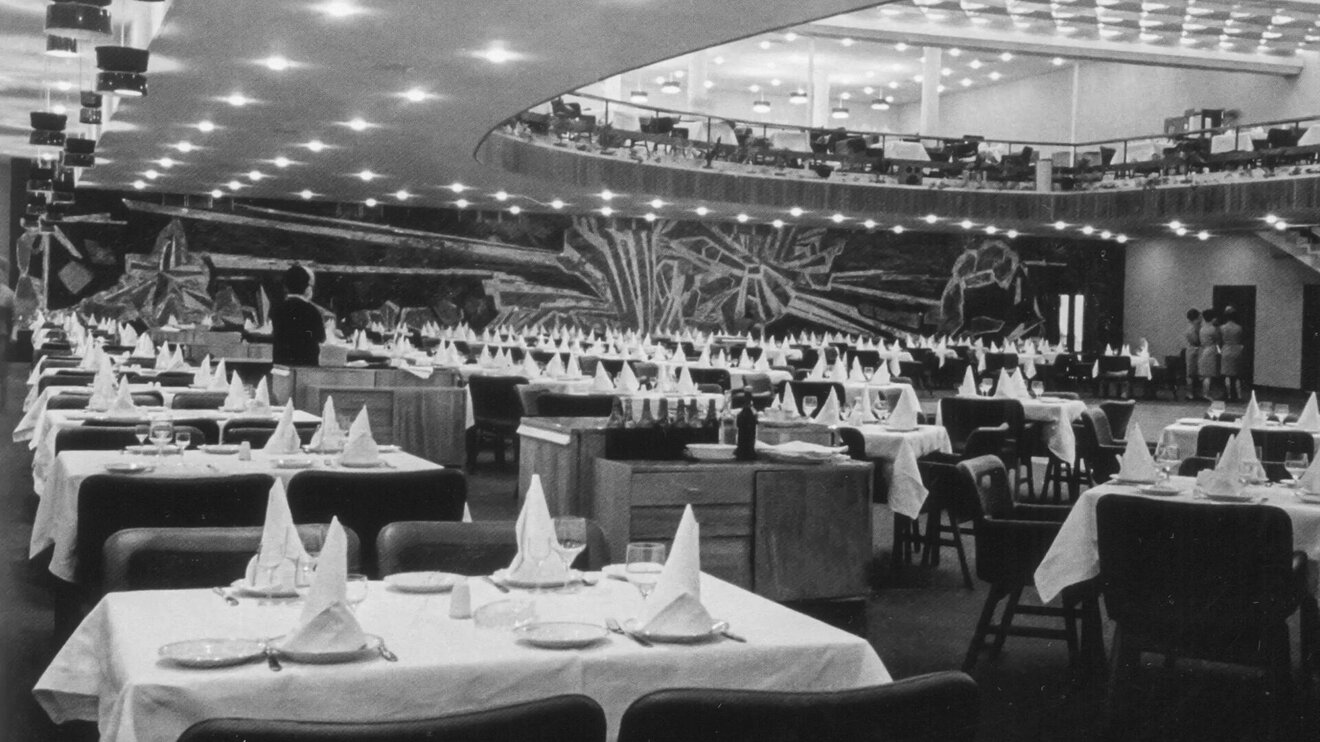
The restaurant "Arbat," mentioned in the novel, was one of the most iconic establishments of Soviet-era Moscow, a symbol of the grand ambitions of the late USSR in the field of public catering and entertainment.
Its history and architectural context
The restaurant "Arbat" opened in 1967, on the newly built Kalininsky Prospekt (now Novy Arbat), at No. 21. Its appearance was directly connected to the large-scale reconstruction of Moscow's historic center undertaken in the 1960s. Under the city's General Development Plan, adopted back in 1935, a radial route was meant to run west from the Kremlin, but the Great Patriotic War postponed those plans.
Construction of the avenue began in 1962 and finished by 1969. The project was designed by a team of architects led by Mikhail Posokhin, which also included Ashot Mndoyants, Igor Pokrovsky, and others. Construction started with digging a kilometer-long, 9-meter-wide tunnel, followed by the roadway itself, and finally the construction of the avenue's residential and administrative buildings — the famous "book-shaped houses."
Scale and records
At its opening, the "Arbat" restaurant was considered the largest restaurant in Europe, and was entered into the Guinness Book of Records. It could serve up to 1,800 guests at once, a truly enormous scale for its time. Its staff numbered around 1,000 people, including cooks, waiters, bartenders, cleaners, porters, engineering and technical staff, and administrators.
These figures reflected not just the Soviet leadership's ambitions in creating prestigious public venues, but the particular character of a planned economy, in which the number of jobs often exceeded what efficient operations actually required.
Architecture and interior design
The restaurant consisted of several halls of varying capacity, each with its own artistic decor. The main hall, entered directly from Kalininsky Prospekt, was a spacious room with a wide mezzanine arranged as stepped terraces. It could seat 1,200 guests at once, at tables spread across several levels, connected by gentle ramps and staircases.
The main hall's ceiling was made of aluminum, with lighting partly concealed behind metal structures, creating a "floating ceiling" effect — a technique characteristic of 1960s Modernist architecture. The hall was further adorned with a mosaic panel of colored smalti, depicting ancient Russian festive rites — a compromise between Modernist aesthetics and traditional motifs.
A second hall, on the basement level, was called "Labirint" ("Labyrinth"). It could be entered from the Garden Ring side, through an underground passage. This room's decor was especially distinctive: its supporting structures were hidden behind decorative curved walls, hung with tapestries. Small niches were set into the walls, filled with ceramic figures and vases, and its light sources, like those in the main hall, were concealed, creating an intimate, chamber-like atmosphere.
Its cultural and entertainment function
"Arbat" was conceived from the start not as a mere restaurant, but as a full-fledged cultural and entertainment center. The dining hall had a stage and a large dance floor. The main hall's stepped structure was designed so that guests on the upper tiers could also enjoy the performances.
A jazz orchestra played at "Arbat" continuously — a fairly bold choice for a Soviet establishment, given official ideology's ambivalent stance on jazz. It hosted the only variety show program in Moscow, one that, according to contemporaries' recollections, was fairly risque in character. This made the restaurant a magnet for the capital's bohemian crowd, a place where more freedom was possible than in most other public venues.
Many later-famous performers began their careers on "Arbat's" stage, including Sergei Zakharov, Irina Allegrova, and Marina Khlebnikova. For some singers, the restaurant's stage became their primary performance venue.
Cuisine and service
The "Arbat" menu was composed in the classic Russian style, matching a "deluxe" category establishment. Despite the restaurant's high status, its prices remained relatively affordable for an average customer — a characteristic feature of the Soviet catering system, in which prestigious venues were subsidized by the state.
An interesting feature of the restaurant's operation was how production was organized. Very little was actually cooked from scratch in the kitchen itself — mostly semi-finished products were used. This was because the underground levels of the stylobate beneath the "book-shaped houses" held a centralized food-production facility, equipped with the most modern equipment of the time. This underground kitchen, located beneath the "Podarki" ("Gifts") and "Sintetika" shops, produced semi-finished goods for every catering establishment on Novy Arbat — a vivid example of the Soviet approach to rationalizing and centralizing production.
In 1982, the "Arbat" restaurant was awarded the prize for "Best Restaurant in Europe for High-Level Banquet Service," attesting to international recognition of its standard of service.
A symbol of the era: the "Aeroflot Globe"
In 1972, ahead of the celebration of the USSR's 50th anniversary, Japanese specialists installed on the restaurant's building the famous "Aeroflot Globe" advertisement — a glowing sphere with illuminated Aeroflot flight routes and a rotating model of a Tu-144 airplane. This structure became one of the most recognizable symbols of Moscow in the 1970s and '80s, frequently appearing in films as a symbol of the USSR's modernity and technical progress.
The "Globe" fit perfectly into Kalininsky Prospekt's role as a showcase for the achievements of Soviet civilization. The supersonic Tu-144, whose routes the globe displayed, embodied the USSR's technological ambitions and its claims to leadership in aviation.
Its clientele and social role
The "Arbat" restaurant became one of Moscow's central attractions, a mandatory stop for every visitor to the capital. Because Kalininsky Prospekt had become the country's administrative center, home to numerous ministries and agencies, the restaurant was constantly visited by groups of business travelers from the regions, official visitors, and tourists from abroad.
The establishment was a fixed stop on Moscow's tourist itineraries, making it more than just a restaurant — an element of Soviet "soft power," a place where foreigners were meant to form an impression of the high standard of living in the USSR and the achievements of the socialist system in serving the population.
Its transformation in the post-Soviet period
After the collapse of the USSR, the economic model that had sustained such enormous establishments stopped working. Under the new economic conditions, a casino was set up in the restaurant's premises — a transformation of cultural spaces into gambling venues typical of the 1990s. The casino operated until 2009, when, along with other similar establishments across Russia, it was closed under federal law.
By 1993, when the events of the novel take place, the "Arbat" restaurant no longer existed in its original form, though memories of it were still fresh, and the building itself, with its distinctive globe, remained a recognizable landmark on Novy Arbat. The mention of a trip to the "Arbat" restaurant in the novel's text, then, might refer either to the already-transformed establishment, or represent an anachronism, underscoring the connection between the events of the story and a fading Soviet era.
In today's understanding, the "Arbat" restaurant remains a symbol of the ambitious projects of the late Soviet period, when the state sought to build model establishments showcasing the advantages of the socialist way of life — establishments that ultimately proved unsustainable under a market economy.